There are two tribes in the entrepreneurial world, and both of them are leaving results on the table.
The first tribe runs on hustle and closing. They talk about crushing it, dominating the market, and doing whatever it takes. Values, for this group, are a liability that slows you down when you need to move fast. The goal is the number, and the number is everything.
The second tribe runs on heart. They talk about alignment, impact, and serving from abundance. They’re genuinely thoughtful, often purpose-driven, and frequently underpaid. For this group, commercial drive is suspect. It signals you’ve sold out, prioritised money over meaning, or lost touch with why you started.
Both tribes are wrong. And if you’ve spent any time in either of them, you already know it on some level.
The third path is less crowded, harder to explain, and far more effective. It’s what Absolutely Awesome calls being spiritually aligned and commercially ruthless. And the reason it works isn’t philosophical. It’s structural.
What “Spiritually Aligned” Actually Means in Business Terms
Let’s get specific about this, because the phrase attracts a lot of baggage.
Spiritually aligned doesn’t mean you meditate before board meetings (though you might). It doesn’t mean you talk about energy, vibration, or divine timing in your quarterly reviews. It doesn’t require any particular belief system.
What it means is that your business operates from a genuine, lived sense of purpose. You know why you do what you do beyond the revenue. You know who you’re genuinely serving and what changes in their life or business as a result of working with you. And your values aren’t statements on a website. They’re the actual operating code for how decisions get made.
The Absolutely Awesome Framework calls this Meaning Gravity. When your mission, values, and actions are genuinely aligned, the business creates an attractive force. People are drawn to it. Clients come through referral. The best candidates apply before you advertise. Partnerships materialise without a pitch. This isn’t magic. It’s the result of being clearly purposeful in a world where most businesses are deliberately vague about what they stand for.
Meaning Gravity Is Not Your Mission Statement
Here’s the thing most purpose-driven entrepreneurs miss. They have a beautifully crafted mission statement and a set of values that look great in the brand guidelines. But those values don’t match how decisions actually get made. The pricing doesn’t reflect the stated commitment to accessibility. The team culture doesn’t match the stated commitment to people. The client experience doesn’t match the stated commitment to excellence.
When that gap exists, it doesn’t go unnoticed. People read behaviour, not statements. And the moment the gap between what you say and what you do becomes visible, the Meaning Gravity collapses. Trust evaporates faster than it was built.
Real alignment is costly and uncomfortable, because it means letting your values constrain your decisions, even when the short-term cost is real. That’s what makes it powerful when you do it.
What “Commercially Ruthless” Actually Means
This is where the purpose crowd tends to flinch. “Ruthless” sounds aggressive. It sounds like the first tribe.
It isn’t.
Commercial ruthlessness isn’t about aggression, extraction, or treating relationships transactionally. It’s about clarity without avoidance. It means being completely clear about what your work is worth, asking for the business without apology, following up without guilt, pricing confidently, and holding your standards without softening them when things get uncomfortable.
Commercial ruthlessness is the commitment to fully receiving the value you create.
The reason this matters is that the purpose crowd often conflates being values-driven with being soft about money. They undercharge because charging properly feels greedy. They avoid the follow-up because pursuing the sale feels pushy. They discount because saying no to a client in need feels wrong. And then they wonder why the business that’s genuinely delivering value isn’t growing the way it should.
Here’s the honest version: undercharging isn’t humble. It’s a form of avoidance. It protects you from the vulnerability of saying “this is what my work is worth” and being tested on that claim. Staying small doesn’t serve your clients. They need the full version of what you offer, and that version requires a business that’s financially sustainable enough to deliver it.
Commercial ruthlessness is not the opposite of purpose. It’s the commercial expression of it.
Why Purpose-Driven Companies Actually Outperform
The business case for this integration isn’t a theory. It’s in the data.
Harvard Business School research by Robert Eccles and colleagues on high-sustainability companies found that purpose-led businesses outperformed low-sustainability ones on both stock price and accounting measures over the long run. Deloitte’s global surveys consistently show that younger talent specifically seeks employers whose values are authentically practised, not performed.
And at the customer level, Cone Communications research found that 87% of consumers will purchase a product because a company advocates for an issue they care about, and 76% will refuse to buy from a company that supports views contrary to their own.
The market isn’t asking you to choose between values and results. The market is increasingly rewarding genuine alignment and punishing the gap between stated and actual values.
The problem isn’t that purpose doesn’t pay. The problem is that fake purpose doesn’t pay, and real purpose without commercial rigour doesn’t scale.
What It Looks Like When Someone Gets Only One Side Right
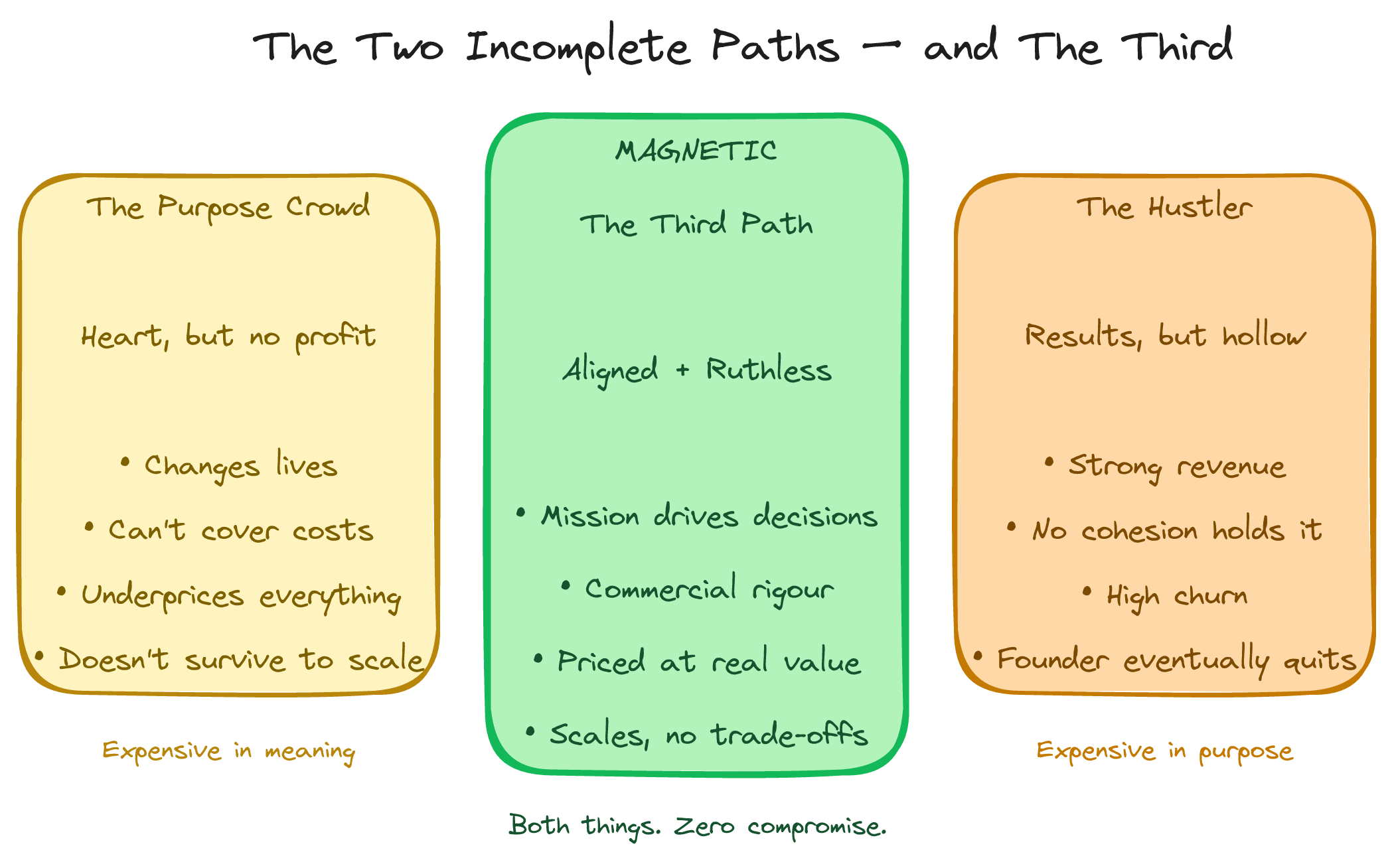
It’s worth being direct about what happens in each incomplete version.
The hustler with no alignment builds a machine. It may generate impressive revenue for a while. But there’s nothing holding it together except momentum, and the founder wakes up one day having built something they don’t want to be inside of. Churn is high because there’s no stickiness beyond the transaction. The team eventually leaves because there’s nothing to commit to beyond the paycheck. The client relationships are shallow because shallow relationships produce them.
The purpose-driven founder with no commercial ruthlessness creates something genuinely meaningful that doesn’t survive. The programme that changes lives but can’t cover its costs. The service that gets extraordinary results but is priced so low it’s not viable to scale. The brand that everyone loves but nobody can figure out how to buy from. The business eventually fails or stays small by necessity, and the people who needed what it offered don’t get it. That’s the exact opposite of the founder’s purpose.
Both are expensive. Just in different currencies.
The Integration: Being Times Thinking Times Doing
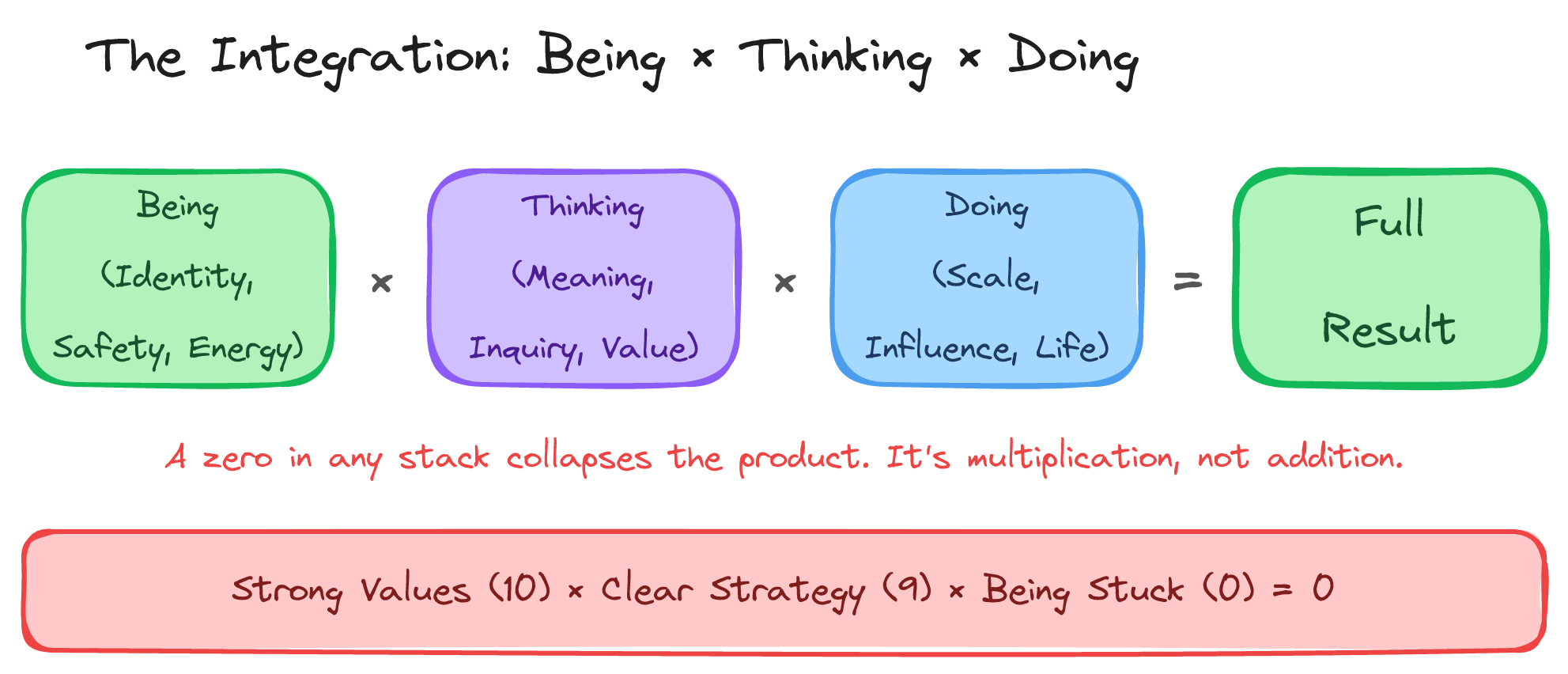
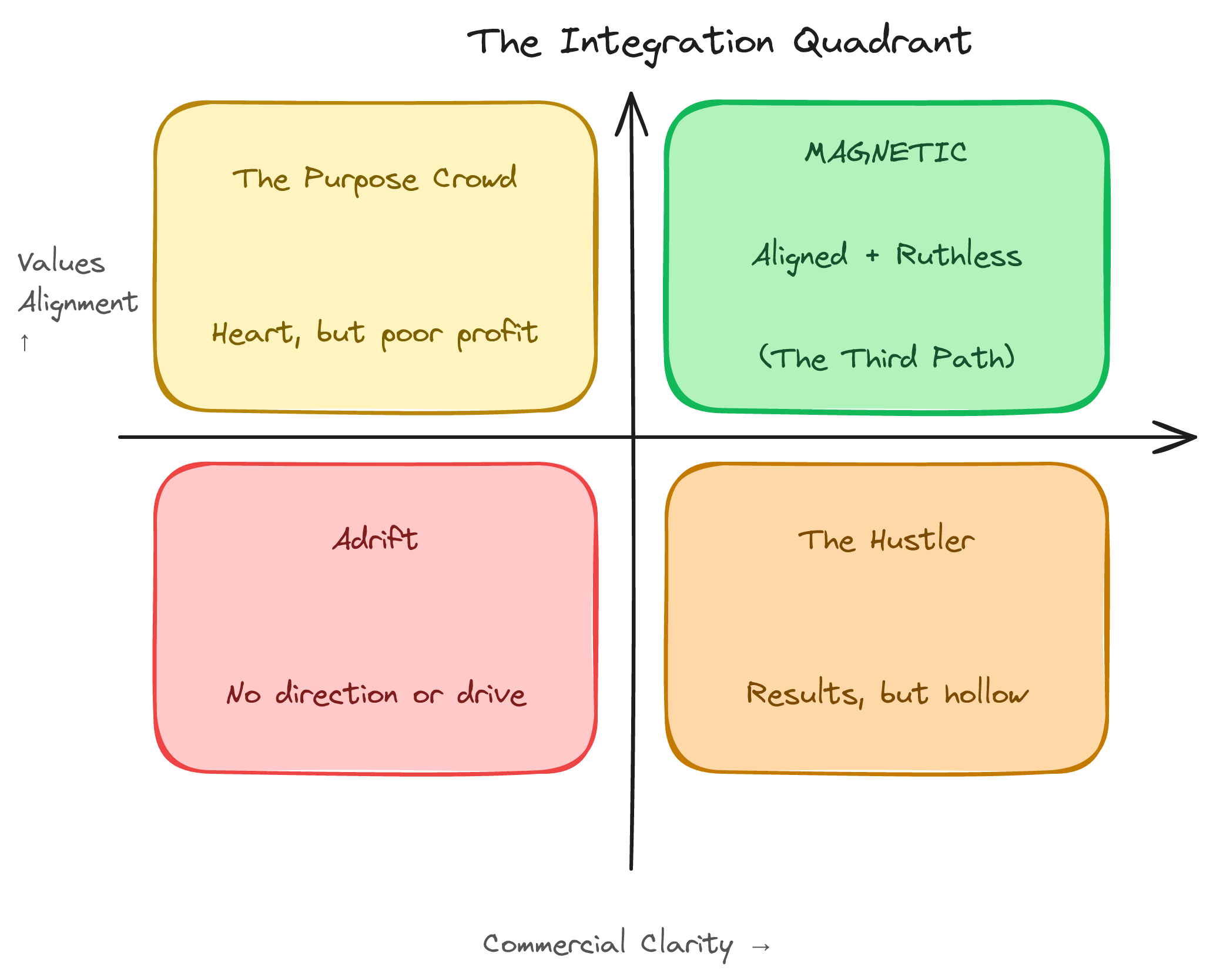
The Absolutely Awesome Framework describes this integration as a multiplication, not an addition. Being (identity and values) multiplies Thinking (strategy and judgment) which multiplies Doing (action and execution). A zero in any column collapses the product.
You can have extraordinary values and poor commercial strategy and get limited results. You can have sharp commercial strategy and an empty identity and build something that eventually falls apart. You can execute brilliantly on a strategy built on misaligned values and scale the wrong thing at scale.
The full version requires all three. Identity as the operating system, thinking as the intelligence layer, and doing as the place where it actually shows up in the world.
Spiritually aligned and commercially ruthless isn’t a tagline. It’s a description of what the full version looks like.
You Don’t Have to Choose
There’s a particular kind of fatigue that comes from believing the choice is real.
If you’ve been in the purpose camp, you’ve probably felt it as a nagging sense that you’re not quite running a real business. Or a guilt about charging, mixed with resentment that you’re not making what you know your work is worth. Or a quiet anxiety that caring about the work somehow disqualifies you from caring about the revenue.
If you’ve been in the hustle camp, you’ve probably felt it as a hollowness somewhere behind the numbers. A growing sense that the thing you’re building doesn’t reflect who you actually are. Or an exhaustion from performing a version of ambition that doesn’t quite fit.
Both of those feelings are pointing at the same gap: the space between purpose and commercial reality that doesn’t have to exist.
The businesses that move with the least friction are ones where the founder has stopped treating those two things as competing. Where the values drive the commercial decisions rather than softening them. Where asking for the business feels like a service rather than an imposition, because the work genuinely delivers. Where the revenue enables the purpose rather than threatening it.
That coherence is available to you. It doesn’t require choosing a side. It requires building the architecture for both.
If you want to understand where the gap currently lives in your business, the AA Diagnostic is a practical starting point. It maps your current Being, Thinking, and Doing layers and shows you which constraints are limiting your growth.
Frequently Asked Questions
What does “spiritually aligned” mean in business?
Spiritually aligned means your business operates from genuine, lived purpose rather than performed values. Your mission, values, and day-to-day decisions are in coherence. The values on your website match the values driving your pricing, hiring, and client decisions.
What is commercial ruthlessness?
Commercial ruthlessness is clarity without avoidance. It means pricing your work at its real value, asking for the business without apology, following up with confidence, and holding your commercial standards even when it’s uncomfortable. It’s not aggression. It’s the commitment to fully receiving the value you create.
Can a business really be both purpose-driven and commercially rigorous?
Yes, and research suggests it outperforms businesses that are only one or the other. Purpose without commercial rigour doesn’t scale. Commercial rigour without genuine purpose tends to create businesses that are financially functional but culturally hollow, with high churn and low retention. The integration is what produces sustainable growth.
How do I know if my values are real or just stated?
Look at where the hard decisions went. When you had to choose between an easy client and the right client, which did you choose? When you had to choose between a fast hire and the right hire? Between a short-term revenue opportunity and a long-term fit? Your actual values are in those decisions, not in the document.
Is this only relevant for conscious or spiritual entrepreneurs?
No. The logic applies to any founder who wants to build something that lasts. Meaning Gravity, values coherence, and commercial clarity are structural advantages regardless of whether the founder identifies as conscious or spiritual. They’re simply what the evidence shows works.