There’s a pattern I’ve seen play out across dozens of founders and leaders, and it’s one of the most demoralising things in business.
Someone intelligent, capable, genuinely committed to growth. They’ve done the courses, hired the coaches, rebuilt the offer, updated the funnel. Results improve for a while. Then they plateau. Or, more confusingly, they get close to a real breakthrough, and somehow something collapses just before it lands.
They blame the market. They tweak the strategy. They work harder.
Nothing shifts.
The problem isn’t their strategy. It’s not their offer. It’s not their timing or the economy or the platform algorithm. The problem is an invisible ceiling sitting just above the level of success they’ve internally authorised themselves to achieve. The moment results start pressing against it, the system quietly corrects itself back down.
This is the Identity Ceiling. And almost nobody talks about it.
The Invisible Ceiling Most Business Owners Never Discuss
The Identity Ceiling is the maximum level of success you can hold without your own psychology working against you.
Note that word: hold. Not achieve temporarily. Not glimpse from a distance. Actually hold, sustain, and build on top of.
Most entrepreneurs understand intellectually that mindset matters. But they treat it like a performance tweak, something you fix with morning affirmations and motivational content. The Identity Ceiling is a fundamentally different problem. It’s not about attitude. It’s about architecture.
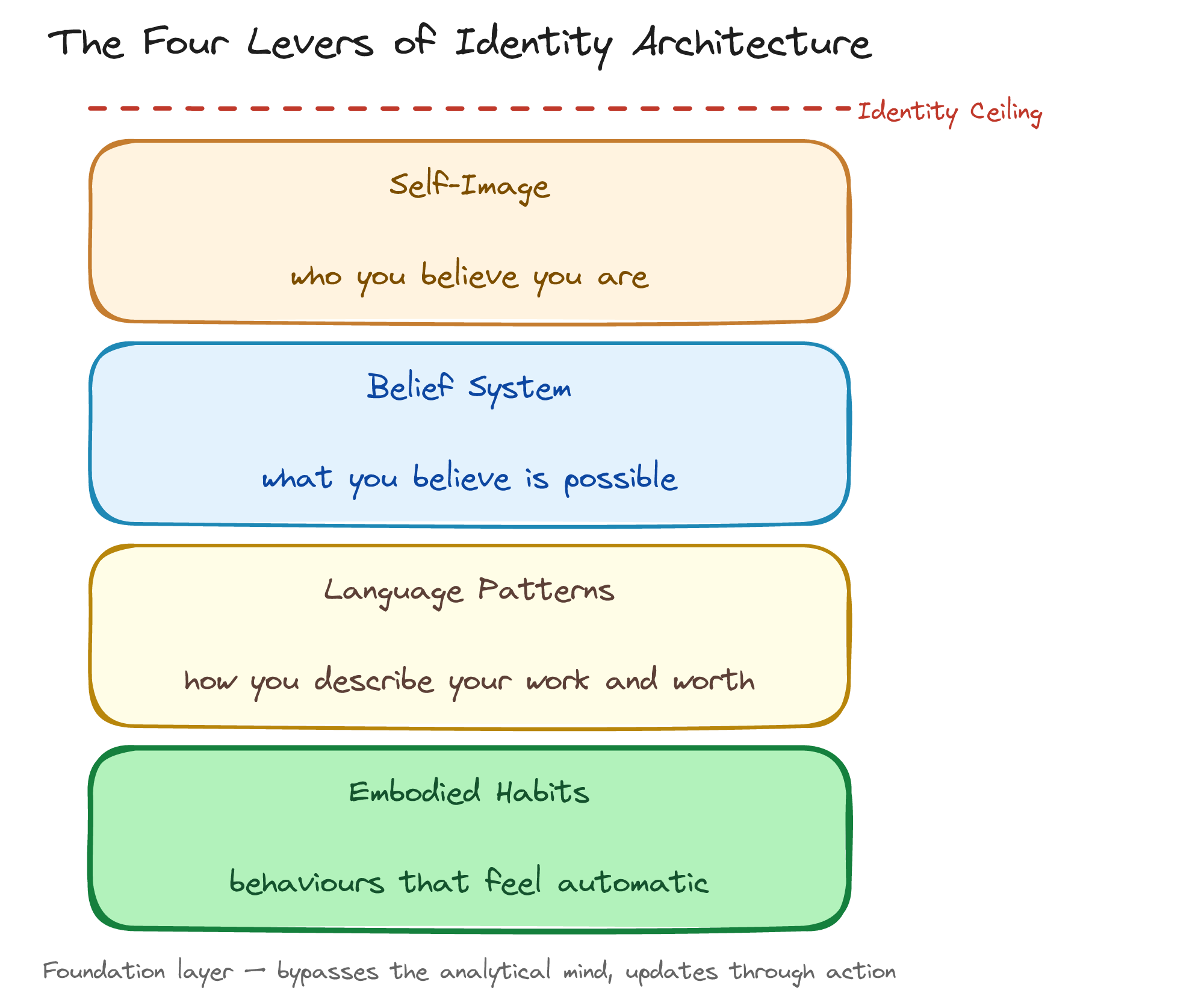
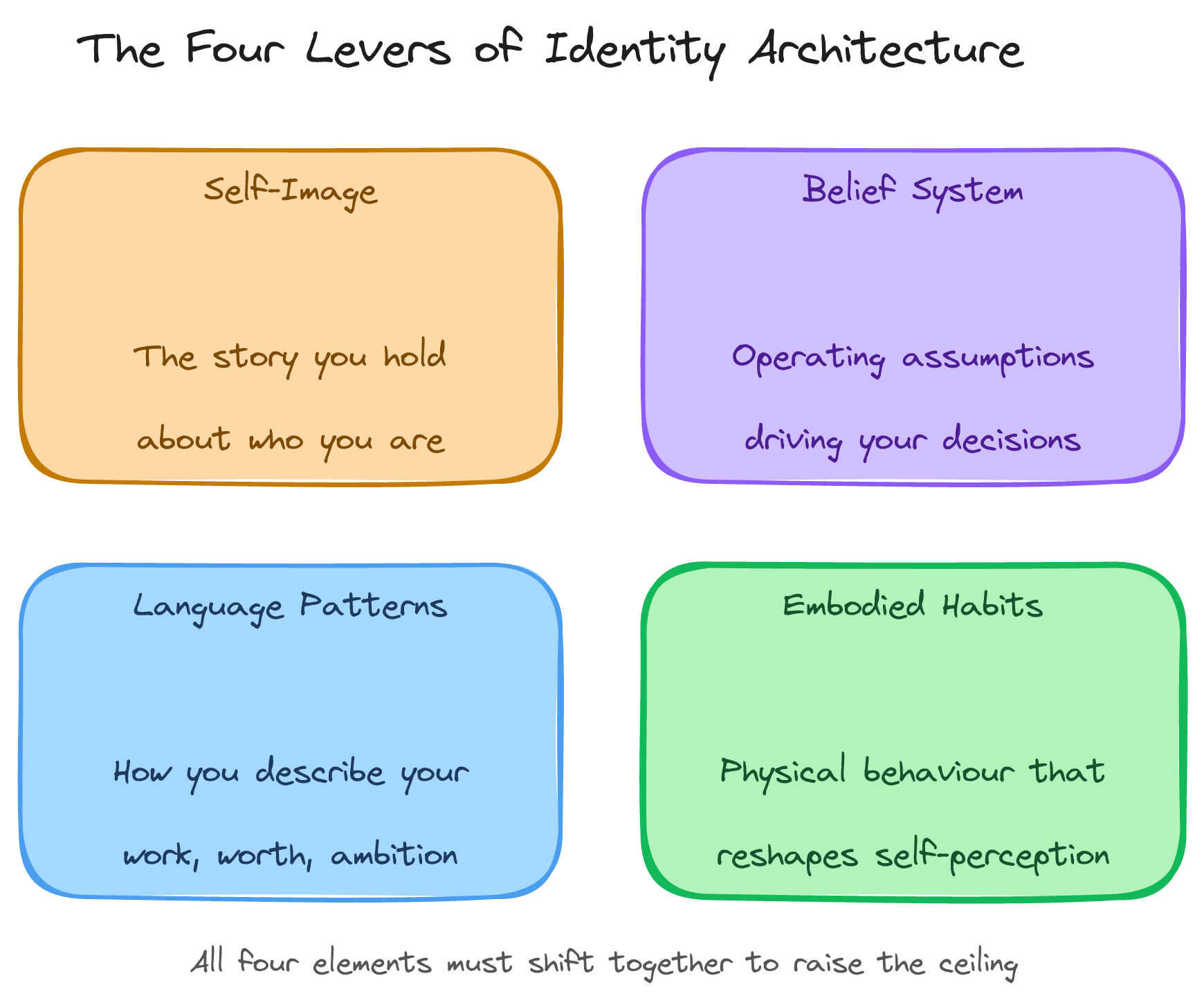
Your identity is a structure. It consists of your self-image (who you believe you are), your belief system (what you believe is possible for someone like you), your language patterns (how you describe yourself and your work), and your embodied habits (the behaviours that feel automatic and natural). Together, these four elements form what the Absolutely Awesome Framework calls your Identity Architecture.
That architecture has edges. When results approach those edges, the system creates friction. Not always consciously, but reliably.
Why the Identity Ceiling Is Not a “Mindset” Problem
The reason this concept gets dismissed is that it sounds like self-help woo. It isn’t. It’s a neurological and psychological mechanism that operates below conscious awareness, grounded in well-established science.
The Reticular Activating System, a bundle of nerves at the base of your brainstem, filters what information reaches your conscious attention. It’s a gatekeeper, and it’s calibrated in part by your self-image. When your self-image says “I’m a mid-size business owner,” the RAS filters out opportunities, signals, and relationships that belong to the next level. Not because they don’t exist. Because they don’t match the frequency.
Separately, self-verification theory (developed by William Swann at the University of Texas) shows that people actively seek information confirming their existing self-concept, even when that self-concept is negative. People with low self-worth choose partners who treat them poorly. Employees who believe they’re average seek negative performance reviews. The brain doesn’t want to be right. It wants to be consistent.
That consistency drive is what creates the ceiling.
How the Identity Ceiling Shows Up in Your Business
The ceiling doesn’t usually announce itself. It shows up indirectly, in patterns that are easy to rationalise and hard to connect to their real cause.
Undercharging for Your Work
You know your prices are too low. You’ve done the market research. You know what others charge. And yet, every time you consider raising them, something pulls you back. You write the new pricing page and then don’t publish it. You quote the old rate in discovery calls because “the timing isn’t right.” You tell yourself clients won’t pay more, but you’ve never actually tested that.
This is the Identity Ceiling in operation. Specifically, it’s your self-image of what you’re worth colliding with the number on the invoice. Until the identity shifts, the prices stay down.
Avoiding Visibility and Putting Yourself Out There
Your marketing strategy is sound. Your content is good when you actually create it. But you keep finding reasons not to post, not to pitch the podcast, not to run the event or launch the programme. “I need to get more clients first.” “I need a better website first.” “I’m not ready yet.”
The readiness feeling is real. The ceiling it’s protecting you from is also real. Visibility invites judgement, and judgement tests your self-image. Staying small feels safer, even when staying small is costing you everything.
Self-Sabotage Near Major Wins
This is the most unsettling pattern. A big opportunity materialises. Something real. A contract, a partnership, a deal that would genuinely change the business. And then something happens. You miss a follow-up. You underquote by enough to blow the margin. You oversell and under-deliver. The deal falls apart.
Afterwards, you can see exactly what went wrong. And you can’t quite explain why you did it.
Research by Roy Baumeister and colleagues on self-defeating behaviour shows that people routinely act against their own interests when those interests conflict with their self-concept. It’s not weakness or stupidity. It’s the architecture maintaining its coherence.
Your Business Can’t Outgrow You
Here’s where this moves from personal to organisational.
The Identity Ceiling isn’t just about what you personally achieve. It’s about what your business is allowed to become, because your business inherits your ceiling as its operating constraint.
The culture you build will reflect the level of self-worth you embody. The team you hire will be hired at a level you’re comfortable with, and that will either be slightly below you (because that feels safe) or at the level you believe you deserve to be surrounded by. The clients you attract will match the value you believe you deliver. The partnerships you pursue will reflect the level of success you consider realistic.
Every strategic decision you make passes through your Identity Architecture first. And if that architecture says “we are a $500k business,” the strategy will consistently produce $500k results, no matter how good the tactics are.
This is why businesses hit the same revenue ceiling year after year, even when the team is talented, the market is there, and the strategy looks solid. The ceiling isn’t in the market. It’s in the founder.
The Stage-by-Stage Inheritance
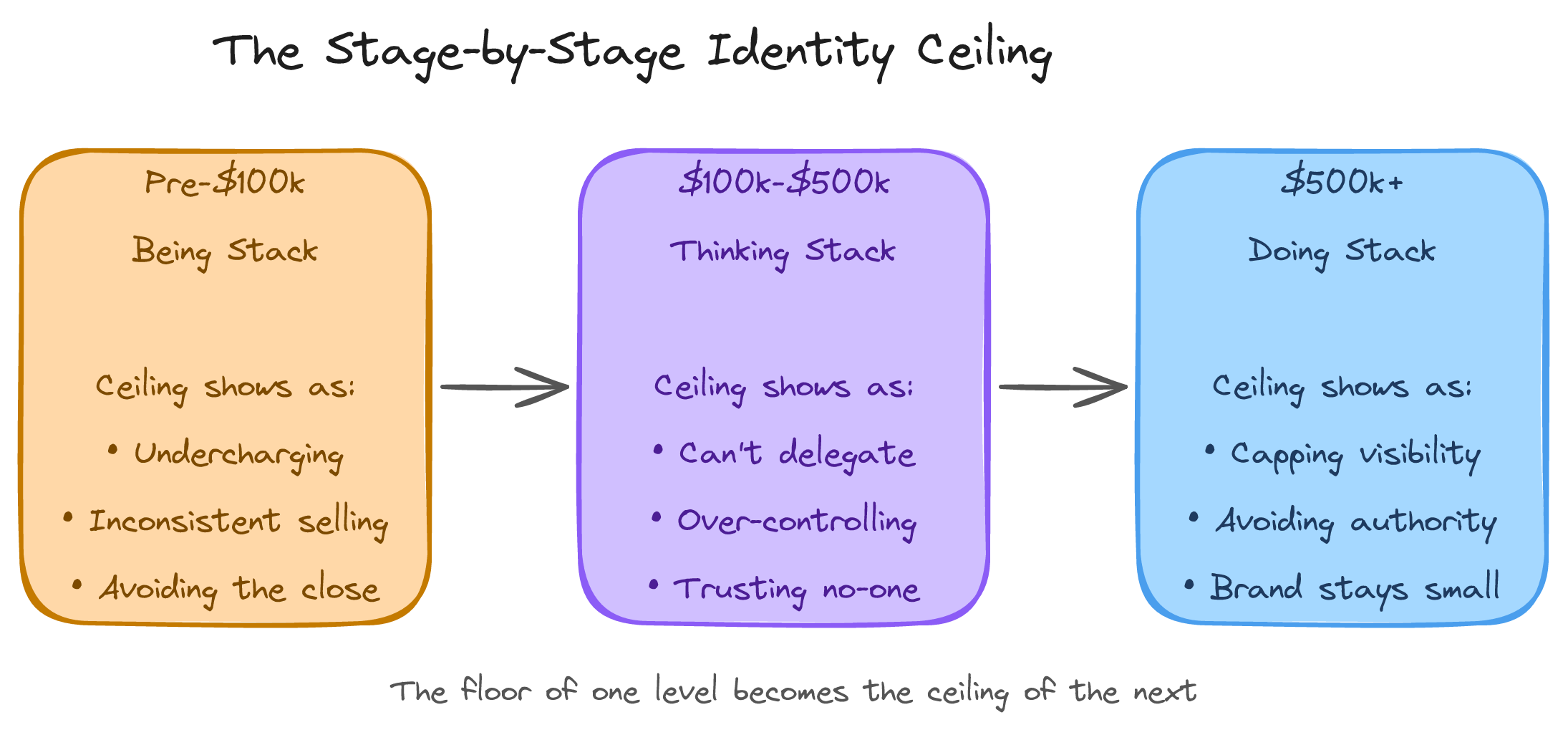
The Absolutely Awesome Framework tracks how this inheritance changes at different growth stages. At the early stages (pre-$100k), the Identity Ceiling typically shows up as undercharging and inconsistent selling. Between $100k and $500k, it usually appears as difficulty delegating, because trusting others to execute at a high level requires believing the work is worth executing at a high level. Beyond $500k, it often shows up as an unconscious cap on visibility and authority. The founder can’t quite let themselves be seen as a genuine category leader, so the brand stays smaller than the results warrant.
Each stage is the same mechanism. The floor of one level is the ceiling of the next.
What Actually Raises the Identity Ceiling
This is where most advice goes wrong.
The standard prescription is affirmations, repeating “I am a successful entrepreneur” until you believe it. Sometimes this gets packaged as visualisation, or vision boards, or journaling about your future self. These things aren’t useless, but they’re not targeting the architecture. They’re decorating the outside of the building.
Real identity work is structural. It operates on the four elements of your Identity Architecture: self-image, belief system, language patterns, and embodied habits.
The Four Levers of Identity Architecture
Self-image
Self-image is the story you hold about who you are. Raising the ceiling here means deliberately exposing yourself to evidence that contradicts the current story, not as affirmation, but as data. Track wins you’d normally minimise. Notice what you’d do if you already believed you were that person. Build a factual case for a different self-concept.
Belief system
Your belief system is the set of operating assumptions driving your decisions. Many of these were formed before you were old enough to evaluate them. The work here is inquiry, specifically surfacing the beliefs governing your ceiling and testing them against reality. Not “do I feel this is true?” but “is there actual evidence this is true, and is there evidence that it isn’t?”
Language patterns
Language patterns are underrated. The way you describe your work, your prices, your capabilities, and your ambitions either reinforces the current ceiling or begins to shift it. “I’m trying to build a business” and “I run a business” are different identity positions, and the brain responds to that difference over time.
Embodied habits
Embodied habits are perhaps the most powerful lever because they bypass the analytical mind entirely. Research on embodied cognition shows that posture, movement, and physical behaviour don’t just reflect self-perception. They shape it. Acting at the level of your next ceiling, before you feel ready, is one of the fastest ways to update the architecture.
Neuroplasticity research confirms that these patterns can shift with deliberate practice. The brain genuinely rewires in response to sustained new inputs. This isn’t motivational framing. It’s how neural circuits actually work.
Three Steps to Start Working With Your Identity Ceiling Today
You don’t need a six-month programme to begin this work. Here’s a genuine entry point.
Step 1: Map the ceiling. Where are you consistently stopping? Look for patterns, not incidents. Where does your revenue consistently cap? What level of visibility feels like too much? What type of client or opportunity makes you pull back even when it’s right there? These are the edges of your current architecture.
Step 2: Find the story. Beneath every ceiling pattern is a belief. Usually something like: “People like me don’t charge that much.” “I haven’t earned the right to be that visible.” “Success at that level would change who I am in ways I’m not sure I want.” Get specific. Vague discomfort is harder to work with than a clear belief you can actually examine.
Step 3: Take one action at the next level. Before you feel ready. The goal isn’t to feel different first and then act differently. The goal is to act differently and let the felt sense catch up. Raise the price on one offer. Pitch one podcast this week. Send the proposal at the real number. The architecture updates through action, not through thinking about action.
These three steps won’t dismantle a deep Identity Ceiling on their own. But they’ll start to show you where it lives and what it’s protecting. That’s the whole game.
What Most People Get Wrong About the Identity Ceiling
The biggest mistake is treating this as a personal development project separate from business strategy. It isn’t. Raising your Identity Ceiling is a business strategy, probably the most impactful one available to most founders.
Because tactics are abundant. Strategies are widely available. The thing that separates businesses that grow past certain levels from those that don’t isn’t usually the quality of the plan. It’s whether the founder can hold the result.
This is what the Absolutely Awesome Framework means when it places the Being Stack at the foundation of the architecture. Identity doesn’t just influence performance. At the level of ownership and leadership, identity is the constraint. Everything else builds on top of it.
If your business has a ceiling that strategy alone isn’t moving, this is where to look.
Frequently Asked Questions
What is an Identity Ceiling in business?
An Identity Ceiling is the maximum level of success a founder can sustain without their own psychology working against them. It’s set by their Identity Architecture (their self-image, belief system, language patterns, and embodied habits) and it acts as an unconscious cap on business growth.
How do I know if I have an Identity Ceiling?
Look for consistent stopping points: revenue that stalls at the same level each year, pricing you consistently underquote, visibility you consistently avoid, or opportunities that collapse at the final stage. Any repeating pattern at the edge of your current results is worth investigating.
Can an Identity Ceiling be permanently removed?
The ceiling doesn’t disappear. It moves. Raise the current ceiling and a new one will eventually emerge at the next level. This is normal and healthy. The goal isn’t a world without ceilings. It’s a world where the ceiling is always above where you currently are.
Is this the same as imposter syndrome?
Related but different. Imposter syndrome is the feeling of not belonging in a role you already hold. The Identity Ceiling is the structural mechanism that prevents you from reaching or sustaining the next role in the first place. Imposter syndrome is a symptom. The Identity Ceiling is the architecture producing it.
How long does it take to raise an Identity Ceiling?
It depends on the depth of the architecture and how consistently you’re working with it. Surface-level patterns, like language, habits, and deliberate exposure, can shift in weeks. Deeper belief system work typically takes months of sustained attention. There’s no shortcut, but there is a clear mechanism: deliberate action at the next level, sustained over time.
The Identity Ceiling is one of the nine layers in the Absolutely Awesome Framework. If you’d like to understand where your current ceiling is and which layer of the architecture it lives in, the AA Diagnostic is a good starting point.