Here is something most business advisors will never say to your face: your marketing problem isn’t a marketing problem.
Neither is your sales problem actually a sales problem. Your team problem probably isn’t a team problem. And your pricing problem, in the majority of cases, has nothing to do with pricing.
I know how that sounds. You’ve invested real time and real money. You’ve hired better people, redesigned the funnel, switched platforms, and rewritten the strategy document. And yet the needle barely moved.
The most frustrating part isn’t that the work failed. It’s that the work was often good. The new funnel was better. The consultant was sharp. The strategy made sense. But the results never arrived, or they arrived briefly and then disappeared.
That’s the tell. When results appear and then fade, when nothing sticks, you’re almost certainly solving the right problem in the completely wrong layer.
That one shift has changed more businesses than any tactic I’ve seen work in the past decade. And once you see it, you can’t unsee it.
You’re Not Bad at Business. You’re Solving the Wrong Problem.
Most entrepreneurs aren’t stuck because they lack skill or effort. They’re stuck because they’re working on a symptom and calling it the disease.
Think about how many times you’ve fixed something, only for the same problem to return six weeks later. You improve the landing page, conversion lifts briefly, then dips again. You restructure the team, dynamics feel better for a month, then the old patterns creep back. You raise your prices, lose two clients, and quietly revert.
The reason none of it sticks isn’t that you chose bad solutions. It’s that the constraint lives somewhere else entirely.
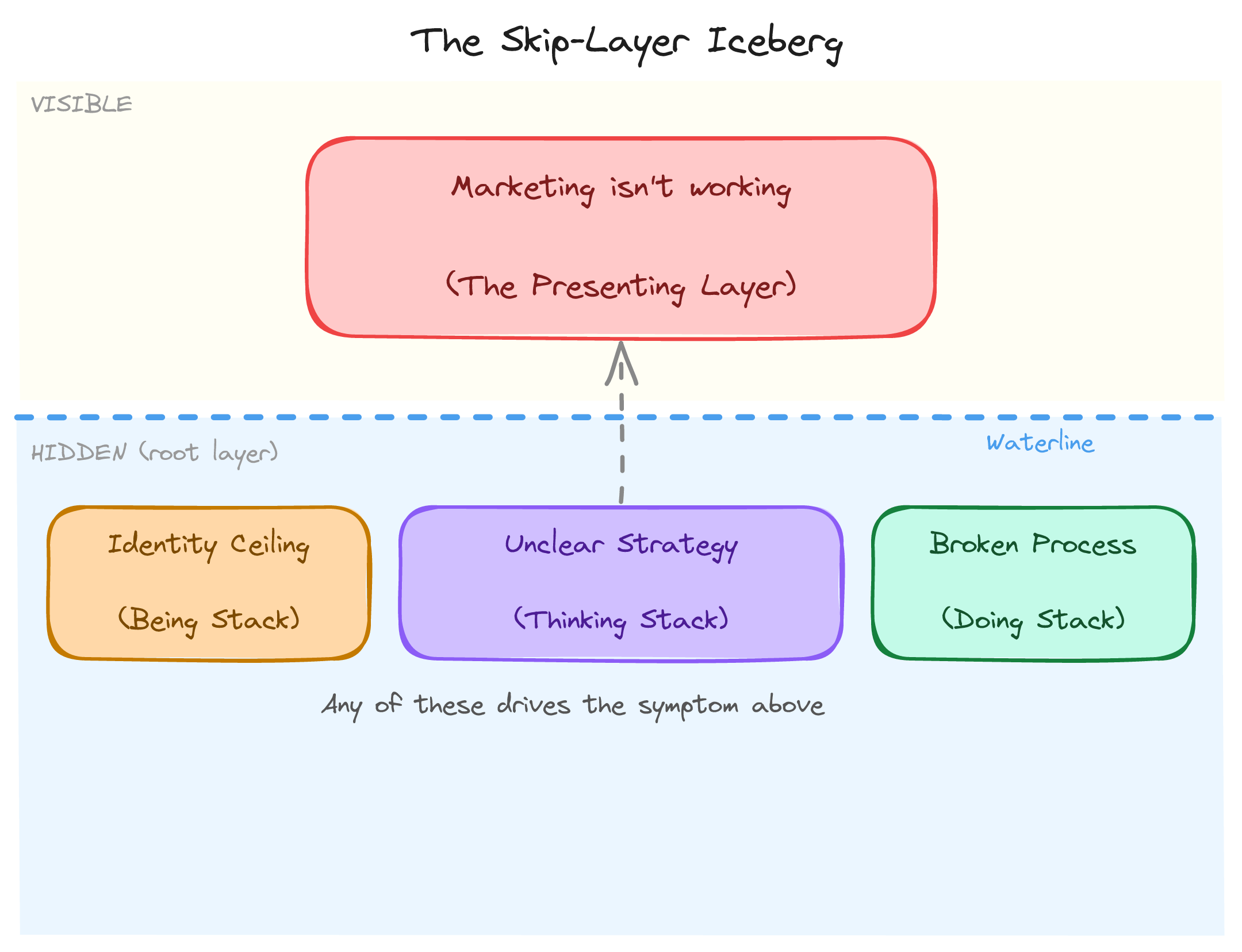
Every business problem has a layer where it shows up. But it almost always lives in a different layer altogether. Treat the layer where it shows up and you get temporary relief. Treat the layer where it actually lives and you get lasting change.
This is the core insight behind what we call Skip-Layer Failure: the breakdown that happens when you apply later-stage solutions to earlier-stage constraints. It’s quiet, it’s common, and it’s expensive.
The Stack You’re Working in, Whether You Know It or Not
The Absolutely Awesome Framework organises every aspect of business into three stacks.
Being (Identity, Safety, Energy): the internal operating system of the person running the business. This governs who you believe you are, what feels safe to do, and the biological capacity you have to hold pressure and complexity without your performance degrading.
Thinking (Meaning, Inquiry, Value): the strategic layer. Why the business exists, what questions it’s actually asking, and what transformation it genuinely delivers to the people it serves.
Doing (Scale, Influence, Life): the execution layer. How the business grows, how it leads, and whether it sustains itself without burning everything out in the process.
These stacks build in sequence. Being supports Thinking. Thinking supports Doing. And here is the part that matters for everything that follows:
You cannot sustainably fix a problem in a higher layer if the actual constraint lives in a lower one. Tactics applied above an unresolved constraint produce exactly the pattern you’ve been living: temporary lift, then reversion.
Most business advice operates at the Thinking and Doing levels. Better strategy. Better systems. Better marketing. That advice isn’t wrong. It’s just applied to the wrong layer.
Why Every Problem Looks Like a Downstream Problem
Skip-Layer Failure is so difficult to catch because problems don’t show up where they live.
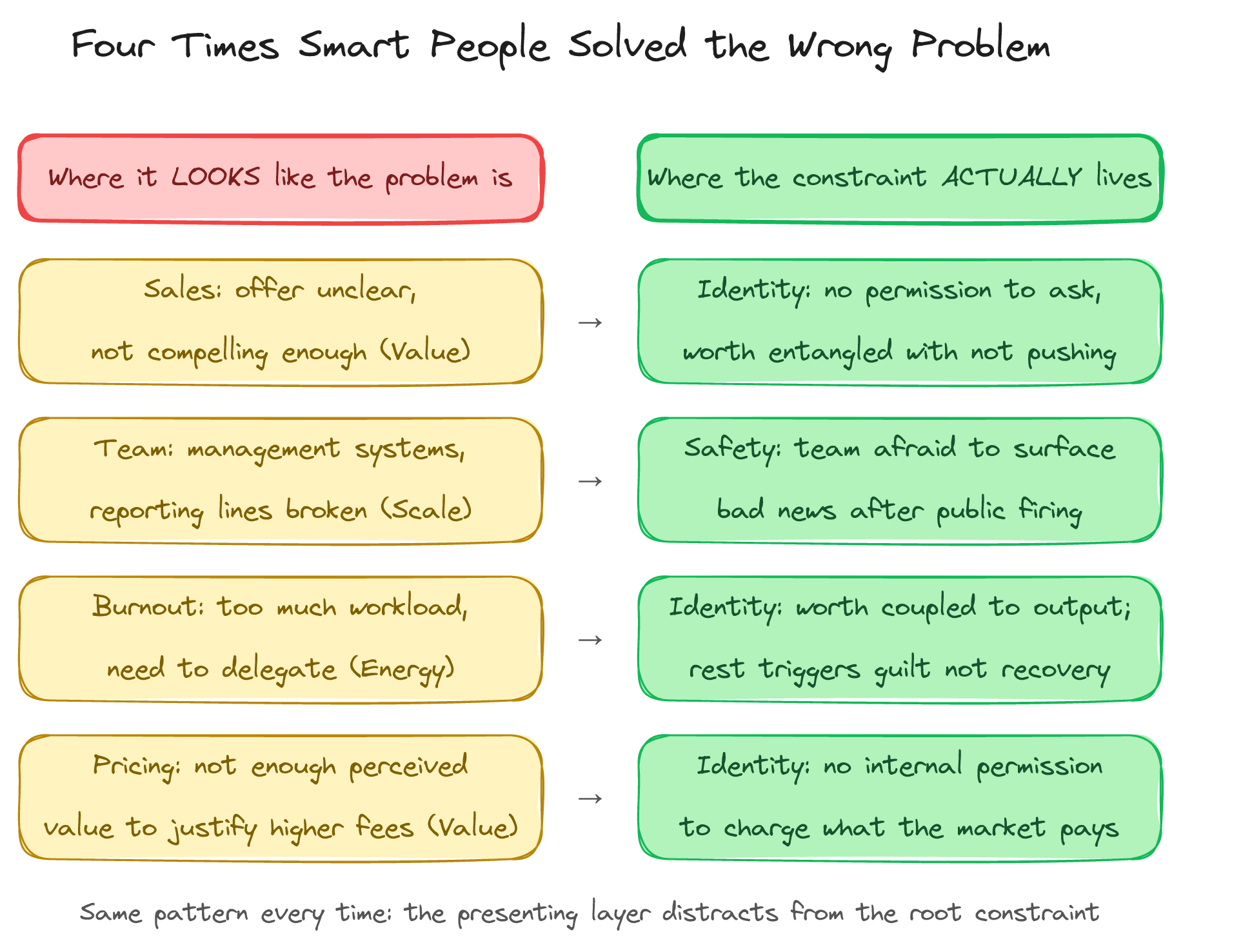
A constraint in your Identity layer doesn’t announce itself as an identity issue. It shows up as a sales problem. More specifically, it looks like a Value problem. Prospects aren’t buying, so clearly the offer needs work, right?
But the actual issue might be that asking for money triggers something deep around worth and permission. You undersell. You over-explain. You back away from the close. No amount of offer refinement addresses that, because the offer was never the problem.
This is why capable people can invest significant money in tactics and see minimal return. The tactics were often fine. They were simply applied two layers above the real constraint.
There is a consistent pattern to this. Here is what it looks like in practice.
Four Times Smart People Solved the Wrong Problem
The Sales Problem That Wasn’t a Sales Problem
Sarah runs a consulting firm. Her revenue had plateaued for eighteen months. Her conversion rate sat around 12%, despite excellent case studies, strong testimonials, and a clearly articulated process.
She had rewritten her sales page twice. She had tried a new discovery call script. She had even lowered her price to reduce friction.
Nothing moved.
When we reviewed her sales calls together, the pattern was unmistakable. Sarah was brilliant at articulating the transformation she created for clients. But she never actually asked for the business. She would lay out the entire proposal and then wait, slightly breathless, for the prospect to decide on their own.
The presenting problem looked like a Value issue: an unclear offer, not compelling enough. The actual constraint was Identity. Specifically, Sarah’s sense of worth was so entangled with not appearing pushy that she had removed herself from the close entirely. She didn’t believe, at a deep level, that she had the right to ask.
When she worked the Identity layer first, around permission and worth, her conversion rate moved to 31% within eight weeks. The offer didn’t change. Sarah did.
The Team Problem That Wasn’t a Team Problem
Marcus had built a four-million-dollar business with a team of eleven. On paper, everything looked functional. In practice, nobody would tell him when something was going wrong.
He had brought in a management consultant, restructured reporting lines, and run a full-team communication workshop. Three months later, the same patterns persisted. Information only ever flowed upward when it was good news.
The presenting problem looked like a Scale issue: management systems, specifically. But the actual constraint was Safety.
What nobody had told Marcus was this: his team was performing for him, not with him. Three years earlier, he had let a senior hire go in front of the team, without warning and without explanation. In that single event, he had created an invisible organisational rule: don’t be the person who brings bad news.
Harvard’s Amy Edmondson has spent decades researching psychological safety, and her findings are consistent. Teams that lack it don’t just communicate less. They actively filter what reaches leadership. Problems get buried until they become crises.
No communication framework changes an emotional memory. The work Marcus needed wasn’t a better org chart. It was rebuilding psychological safety, starting with genuine acknowledgment of what his team had experienced and had been quietly managing ever since.
The Burnout That Wasn’t About Working Too Hard
Tom came in running on empty. He had built a solid business with $2.5M in revenue, a capable team, and clients he genuinely loved working with. And he was exhausted to his bones.
The obvious diagnosis was workload. So he delegated more, reduced his hours, and took two weeks away. Within eight weeks of returning, he was just as depleted as before.
The presenting problem looked like an Energy issue. More precisely, it matched what the framework calls Capacity Debt: the accumulated cost of sustained overextension. But the actual constraint was Identity. Tom’s sense of worth was tightly coupled to his output. When he wasn’t producing, he felt worthless. Holidays created anxiety. Delegation triggered guilt. Rest felt like failure.
So his nervous system never actually recovered, even when his calendar cleared. He was physically still. But internally, he was working constantly, managing the low-grade hum of self-judgement that filled every space where output used to be.
Robert Sapolsky’s research on chronic stress helps explain why: sustained psychological activation degrades recovery even during physical rest. The body stays in survival mode because the internal narrative demands it.
The work wasn’t better boundaries or fewer meetings. It was separating worth from output, at the Identity level, first.
The Pricing Problem That Wasn’t About Price
This one is arguably the most common Skip-Layer Failure I see.
The business has a pricing problem. Clients push back, so the founder discounts. They watch competitors charge more for less. They know, intellectually, that their pricing is too low. And yet, whenever they try to raise prices, something invisible stops them.
The presenting problem looks like a Value issue: not enough perceived value to justify higher pricing.
But in most cases, the actual constraint is Identity. The founder hasn’t given themselves permission to be worth what the market would actually pay. So they price to their internal sense of worth, not to the external reality of the transformation they create.
This is what the framework calls the Identity Ceiling: the maximum level of success, income, or visibility a person can sustain without their internal operating system triggering a correction. Pricing is one of the most reliable places this ceiling shows up, because charging more requires genuinely believing you are worth more.
Fixing the offer doesn’t help. Repricing tactics don’t help. The Identity Ceiling needs to move first.
Notice the pattern across all four scenarios. The presenting layer looks like the problem. The real constraint is one or two levels upstream. And every intervention applied at the presenting layer produces the same result: brief improvement, then reversion.
The question, then, is how to find out which layer you’re actually dealing with.
Notice the pattern across all four scenarios. The presenting layer looks like the problem. The real constraint is one or two levels upstream. And every intervention applied at the presenting layer produces the same result: brief improvement, then reversion.
The question, then, is how to find out which layer you’re actually dealing with.
Three Questions to Find Your Real Constraint
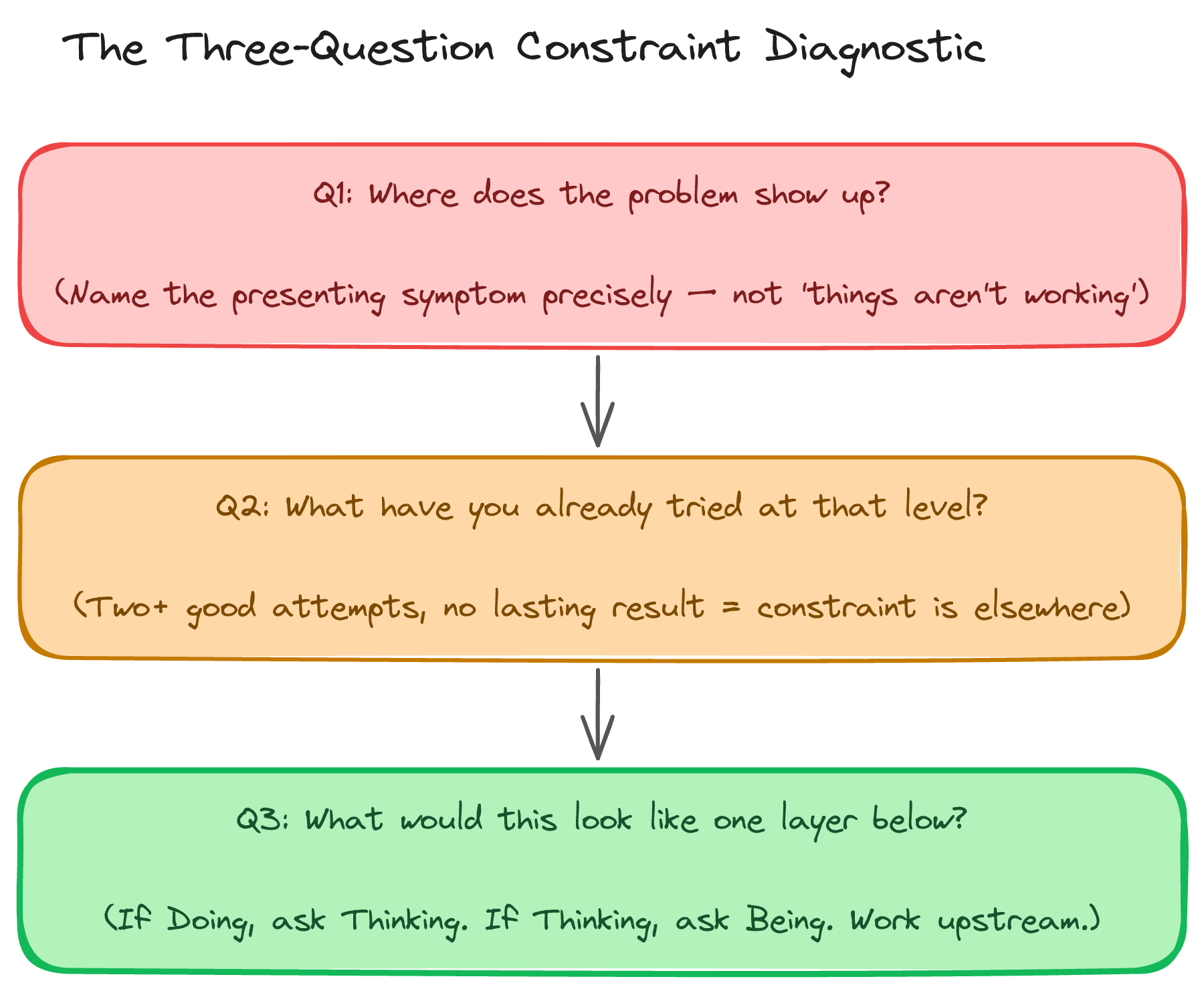
Question 1: Where Does the Problem Show Up?
Name the symptom clearly and specifically. Sales aren’t converting. The team is underperforming. Revenue has plateaued. You’re exhausted. Pricing isn’t holding.
Whatever it is, resist the urge to generalise. The more specific you are about the symptom, the more clearly you can test whether it’s the real problem or a downstream expression of something else.
Question 2: What Have You Already Tried at That Level?
List the solutions you’ve already applied at the presenting layer. If you’ve tried more than two reasonable interventions and haven’t seen lasting change, that is your signal. The constraint almost certainly isn’t where you’ve been working.
Lasting change at the right layer tends to be relatively rapid. Persistent frustration at the wrong layer is the system telling you something. Pay attention to that signal instead of doubling down.
Question 3: What Would the Upstream Version of This Problem Look Like?
Ask yourself: if this problem isn’t really about the layer where it’s showing up, what would it actually be about? Then move one level higher.
If it looks like a Value problem, ask what the Identity version of this problem would be. If it looks like a Scale problem, ask what the Safety or Energy version would look like. If it looks like a team performance problem, ask what the psychological safety version of this problem would be.
Most people never ask this question, because they’re so focused on fixing what’s visible that they never question where the real problem lives. The answer, in the vast majority of cases, is upstream.
Stop Fixing Downstream When the Problem Is Upstream
Before you hire the next marketing agency, rewrite the offer again, or restructure the team: run those three questions first.
The work that creates lasting change in business almost never lives at the tactical layer. It lives upstream: in who you believe you are, in the safety your team actually feels, in the genuine capacity of your nervous system to hold what you’re building.
That’s not a soft answer. It’s a precise diagnosis. And in my experience, it’s the one that finally makes the tactics work.
The full Absolutely Awesome Framework maps all nine layers, includes the complete Skip-Layer Failure table, and gives you the tools to run a proper constraint diagnosis on your business. That’s the place to start.