The Operating System for Spiritually Aligned, Commercially Ruthless Businesses
You do not have a tactics problem.
If you are already running a multi-six, seven, eight, or even nine-figure business, you have more than enough playbooks. You have read the books, bought the courses, been in the masterminds, and hired the consultants.
You have tried better funnels, new sales scripts, scaling agencies, “hire A-players“, OKRs, EOS, sophisticated AI implementations – you name it.
And yet, you keep hitting the same invisible ceiling:
- Revenue grows, then plateaus in the same band ($3M, $8M, $25M – different numbers, same pattern)
- You scale top-line revenue, but your personal freedom shrinks with every new million
- Team issues and culture drama show up at every new level, just wearing different costumes
- You know you are capable of more, but something in the system refuses to let it click
From the outside, it looks like a strategy or execution problem.
From the inside, it feels like you are doing everything “right”, and it still is not adding up the way it should.
This is the problem the Absolutely Awesome Framework™ was built to solve.
Why This Feels Different at Scale
At low revenue, say, under $500K annually, you can brute-force your way through most problems with hustle, talent, and caffeine. The constraints exist, but they are not yet structural.
At $1M, $5M, $20M, $100M and beyond, those same constraints become architectural.
The weak identity that used to show up as imposter syndrome now shows up as pricing you will not raise, acquisitions you will not pursue, and board-level conversations where you unconsciously make yourself small.
The lack of psychological safety that used to mean avoiding Instagram now means boardroom politics, VP-level talent churn, and leaders who tell you what you want to hear instead of what is real.
The capacity debt that used to mean “I am a bit tired“ now means you made a seven-figure strategic mistake because you were fried and impatient, and could not sit in uncertainty long enough to see the better option.
The stakes are simply higher.
When a $300K business is poorly architected, it is frustrating. When a $30M business is poorly architected, real people get hurt – employees, customers, families, communities.
What This Article Will Show You
This article will explain why brilliant strategies fail when the internal operating system cannot hold them, introduce the three-layer architecture that determines whether businesses scale or implode, and help you diagnose where your actual constraint lives right now.
Not tactics. Not another framework to “implement.“ An operating system that sits underneath everything else – the architecture that determines how decisions are made under pressure, how capacity is held at scale, how growth is sustained without collapse, and how integrity is maintained when commercial tension increases.
By the end, you will understand:
- Why most business frameworks stop working once you hit real scale
- The Being → Thinking → Doing architecture that governs sustainable growth
- How to diagnose your current constraint and work at the right layer
- Whether this framework is right for where you are and where you are going
Let’s begin.
Why Most Business Frameworks Stop Working Once You Hit Real Scale
Let me start with the uncomfortable truth that most business advice will not tell you.
Most popular frameworks fall into one of three categories, and all three break down predictably once you are operating at a meaningful scale.
The Three Types of Frameworks (and Why They Fail Past $1M)
Tactics-First Frameworks
A tactics-first framework gives you recipes: funnels, scripts, hiring scorecards, meeting cadences, and KPI dashboards. They work brilliantly – up to a point.
Then your internal operating system – your identity, your capacity, your team’s psychological safety – cannot hold the level of scale those tactics create. The system wobbles. You quietly sabotage your own growth. The culture starts to rot from the inside despite the impressive org chart.
Example: A $15M agency implements EOS perfectly. All the systems are there. The scorecard is colour-coded. But the founder still cannot delegate actual authority, so every VP hire either leaves within eighteen months or becomes a high-paid order-taker. The framework was not the problem. The founder’s identity architecture was.
Mindset-First Frameworks
Mindset-first frameworks focus on inner work: belief change, rewiring money stories, nervous system regulation, visualisation, and manifestation. Useful and often necessary – but frequently disconnected from the commercial machine you are actually running.
You feel clearer and more “aligned.“ Your morning practice is solid. But your offers are still poorly positioned, your pricing strategy is incoherent, and your systems are held together with duct tape and heroic effort.
Example: A $5M education business spends two years on deep inner work. The founder is genuinely more peaceful, more present, more conscious. Revenue stays flat. Why? Because they never translated that inner clarity into strategic repositioning, offer refinement, or building the team that could actually deliver at scale. Consciousness without commercial execution is just expensive therapy.
Strategy-First Frameworks
Strategy-first frameworks teach positioning, category design, business models, flywheels, and competitive moats. Essential – and they almost universally assume the decision-maker is a rational, well-rested robot with unlimited capacity.
They do not know what to do with the founder, who is exhausted and making decisions from a depleted nervous system. Or the leadership team that is terrified of being visible at the next level. Or the CEO who is secretly not sure they even want the $50M version of the business.
Example: A $20M SaaS company hires a top-tier strategy firm. The positioning is sharp. The category is clear. The three-year plan is brilliant. Six months later, execution is stalled because the executive team cannot have honest conversations about what is and isn’t working. Every meeting optimises for looking good, not getting real. The strategy was perfect. The environment could not hold truth, so nothing stuck.
The Pattern That Keeps Repeating
At lower revenue levels – say, $100K to $1M – you can often power through these gaps with willpower, talent, and long hours.
At $1M, $10M, $100M and beyond, those gaps become structural bottlenecks:
- Weak identity shows up as pricing you will not raise, C-suite roles you will not hire for, and strategic bets you will not take, even when the data says you should
- Lack of safety shows up as politics, information silos, talent exodus, and leaders who carefully manage what you hear instead of telling you what you need to know
- Capacity debt shows up as poor strategic calls, emotional reactivity in high-stakes situations, health issues, and a founder who becomes the bottleneck instead of the multiplier
And here’s what makes it insidious: None of this looks like an internal problem. It all looks like business problems.
The $8M founder who cannot break through to $15M thinks they have a marketing problem. What they actually have is an identity problem – they cannot hold the self-image of someone who runs a $15M company, so they unconsciously make decisions that keep them at $8M.
The $40M company with constant VP turnover thinks they have a hiring problem. What they actually have is a safety problem – the culture punishes honesty, so high-performers either conform and diminish, or they leave.
The $12M CEO who keeps making impulsive strategic pivots thinks they have a focus problem. What they actually have is a capacity problem: their nervous system is so depleted that they cannot sit with uncertainty long enough to see the signal through the noise.
You are not missing better tactics. You are missing the operating system that allows tactics to actually work.
What Makes the Absolutely Awesome Framework Different
Let me be direct about what this framework is not, because understanding what it is not matters as much as understanding what it is.
This is not a mindset framework. Changing your thoughts does not rebuild your nervous system’s capacity or resolve identity constraints that have been calcifying for decades.
This is not a strategy framework. Brilliant positioning and tactical execution fail when the internal system cannot hold them. You can have a perfect business model and still sabotage it unconsciously.
This is not a productivity system. You do not need better time management. You need to diagnose which layer your constraint actually lives in.
This is not spiritual bypassing. Consciousness without execution is self-indulgence. Inner work that never translates to commercial results is not mastery – it is avoidance.
This is not hustle culture. Force without capacity is burnout. Pushing harder when you are already depleted does not create growth – it creates collapse.
So What Is It?
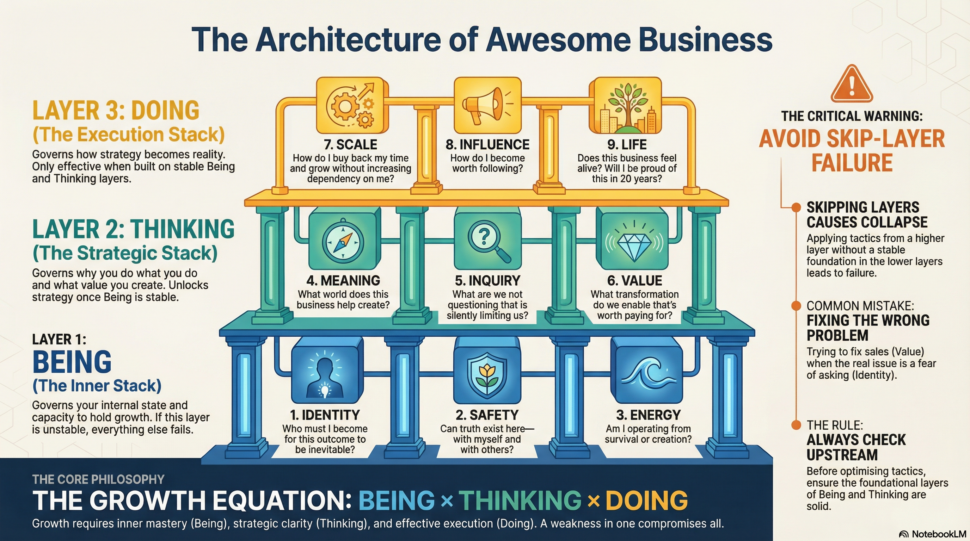
The Absolutely Awesome Framework is an operating system – the coherent architecture underneath your tactics, strategy, and execution that determines whether your business expands sustainably or eventually implodes.
At its core, the framework is built on a simple mathematical truth:
Transformation = BEING × THINKING × DOING, guided by INTEGRITY
Notice the multiplication. If any one of those variables approaches zero, your outcomes collapse. No amount of clever tactics can save you if your identity refuses to let you hold success (Being), your strategy is incoherent (Thinking), or your execution is chaotic (Doing).
This is why so many businesses plateau. One multiplier is broken, so they optimise the other two frantically and wonder why nothing changes.
The framework breaks your business and leadership into three layers and nine pillars:
Layer 1: BEING (The Inner Stack)
- Identity
- Safety
- Energy
Layer 2: THINKING (The Strategic Stack) 4. Meaning 5. Inquiry 6. Value
Layer 3: DOING (The Execution Stack) 7. Scale 8. Influence 9. Life
All of it sits inside a container called Ethical Stewardship – so you do not become “successful“ in a way that breaks you, your team, or the world you are operating in.
If you remember nothing else, remember this:
Self → Strategy → Scale
Get Self wrong (Being), and you distort Strategy (Thinking). Get the strategy wrong, and your Scale efforts (Doing) become very expensive experiments that do not compound.
Why “Spiritually Aligned, Commercially Ruthless“?
This positioning can be confusing at first, so let me clarify what it actually means in practice.
“Spiritually aligned“ does not mean vague, passive, or “good vibes only.“ At the $1M+ level, it means:
- You have done enough inner work to recognise when you are lying to yourself
- You can hold complexity and paradox without collapsing into binary thinking
- You care about integrity, impact, and building something you would be proud of in twenty years
- You understand that your inner world and your business are not separate systems
“Commercially ruthless“ does not mean aggressive, extractive, or willing to compromise values for profit. At scale, it means:
- You have absolute clarity about what creates value, and you do not avoid conversations about money
- You are willing to make hard calls – about pricing, about people, about strategy – even when they are uncomfortable
- You do not use “alignment“ or “purpose“ as excuses for poor business fundamentals
- You want the $1M to $10M jump, the $10M to $100M jump, and you are willing to do the actual work to get there
Most founders land on one side or the other:
- The spiritually aligned entrepreneur running a $2M business who secretly resents money and cannot scale without feeling like they are betraying themselves
- The commercially ruthless operator building $40M in revenu,e who feels empty and questions what all this effort is actually for
This framework is for people who refuse that false choice. Who wants both consciousness and capital. Who understands that real alignment does not mean avoiding commercial reality – it means bringing full integrity to how you create and capture value at scale.
The Three-Stack Architecture (Being → Thinking → Doing)
At the foundation of this framework is a structural truth that most people get backwards:
Growth breaks when Being is unstable. Thinking distorts when Being is unstable. Doing fails when Thinking is distorted.
Let me walk you through what that means and why the sequence matters at every stage of growth.
Understanding the Three Stacks
The framework consists of nine pillars organised into three stacks: Being, Thinking, and Doing. Each stack builds on the one before it. Skip layers, and the system breaks – this is called Skip-Layer Failure, and it explains most business dysfunction past $1M.
Think of it architecturally. You cannot construct the tenth floor if the foundation is compromised. You can design the most sophisticated tenth floor in the world, hire the best architects, use premium materials – but if the structure underneath cannot hold the load, it collapses.
That is exactly what happens when you try to scale tactics (Doing) without strategic clarity (Thinking), or when you try to implement strategy (Thinking) without internal stability (Being).
The system breaks. And it breaks in predictable ways.
Stack One: Being (the Inner Stack)
This stack governs your internal state – who you believe you are, how much capacity your nervous system holds, and whether your environment can tolerate truth.
This is the foundation. Not because it is “spiritual“ or “soft,“ but because it is structural and biological. If you do not have the internal stability to hold a $10M outcome, you will sabotage it. If your nervous system is depleted, your judgment fails at exactly the moments it matters most. If your environment punishes honesty, collaboration collapses, and you get expensive politics instead of performance.
The three Being pillars:
1. Identity: Your Invisible Performance Thermostat
Core question: Who must I become for this outcome to be inevitable?
Your self-image determines the ceiling of what you allow yourself to achieve and hold. This is the Identity Ceiling – and most founders do not realise they have one until they hit it repeatedly at the same revenue band.
Here’s how it shows up at scale:
A business crosses $3M, then mysteriously slides back to $2.2M. Or hits $12M, then plateaus there for three years despite multiple attempts to break through. Or reaches $45M and the founder starts making strange decisions – turning down opportunities, creating unnecessary complexity, unconsciously sabotaging momentum – because $50M feels threatening to their core identity.
Real-world example:
A founder running a $15M creative agency has a hidden identity of “the talented freelancer who got lucky.“ That identity – held unconsciously – cannot comfortably sit across from Fortune 500 clients, hire true executive talent, or make seven-figure strategic bets.
They know, intellectually, that they should raise prices, build the C-suite, and pursue larger contracts. But every time the opportunity appears, they find reasons why “now is not the right time.“ They hire VP-level talent, then unconsciously undermine them. They pitch enterprise clients, then price themselves 40% below market.
Until that core identity shifts from “freelancer who got lucky“ to “CEO of a world-class firm,“ no amount of sales training, strategic planning, or tactical execution will break the ceiling. The identity thermostat keeps pulling them back to $15M.
At $1M, identity constraints show up as hesitation and imposter syndrome. At $20M, they show up as strategic self-sabotage that costs real money and opportunities. At $100M, they show up as an inability to make the board-level moves that would take the company to $500M.
2. Safety: Can Truth Exist Here?
Core question: Can truth exist here – with me, with my team, in this organisation?
Safety is not comfort. Safety is the capacity for reality without punishment.
Personally, it looks like:
- Being able to own mistakes without collapsing into shame spirals
- Being able to look at brutal financial data, hard feedback, and scary conversations without emotional flooding
- Being able to tell yourself the truth about what you actually want, not what you think you should want
Inside the company, it looks like:
- People telling you when something is broken early, when it is still cheap to fix
- Leaders giving you honest feedback, even when you will not love hearing it
- Debates that are sharp on ideas, gentle on people
- Problems surfacing at the VP level before they explode into company-wide issues
Without Safety, you get:
- Errors hidden until they become catastrophic
- Organisational politics and information silos
- Silent resentment that eventually explodes
- “Yes“ culture that yields “no“ results
- High-performers who quietly check out, then leave and tell the industry why
Real-world example:
At around $30M annual revenue, a founder notices that every leadership meeting feels performative. Nobody brings real problems. Everyone agrees in the room, then goes back to their departments and does whatever they want.
The founder thinks they have a “strategy alignment“ issue. They bring in consultants. They run off-sites. They build OKRs and dashboards. Nothing changes.
What they actually have is a Safety problem that developed over the years. Early in the company’s history, the founder reacted poorly to bad news. They did not yell or punish overtly – but their energy shifted. They got defensive. They explained why the person bringing the problem was wrong or did not understand.
The leadership team learned: bringing problems equals emotional labour with no benefit. So they stopped. Now the founder wonders why “nobody tells me anything until it is on fire.“
Until Safety is rebuilt – through behaviour change, not policy documents – no strategic framework will stick. The team has learned that truth is punished, so they optimise for keeping the founder comfortable, not for business outcomes.
At $500K, safety issues mean you avoid difficult conversations. At $5M, they mean your management team is not really managing. At $50M, they mean you have an expensive layer of executives who carefully curate what information reaches you, and you are flying blind as a result.
3. Energy: Your Actual Capacity to Hold Growth
Core question: Am I operating from survival, or from creation?
Energy is not motivation or “being hyped.“ Energy is biological capacity:
- Can your nervous system hold the pressure, complexity, and visibility that come with $10M, $50M, $200M?
- Can you make clear decisions under stress, or do you flip into old reactive patterns?
- Can you keep showing up strategically when the fun of early wins has worn off, and it is just hard work?
This is Capacity Debt versus Capacity Wealth.
Capacity Debt is the accumulated cost of years of overextension, poor recovery, and white-knuckling through pressure. It manifests as:
- Deals you did not see because you were in tunnel vision
- People you pushed away because you snapped when you were exhausted
- Strategic calls you rushed because you could not sit in uncertainty
- Health issues that eventually force you to slow down anyway
Capacity Wealth is built when you deliberately design recovery, nervous system regulation, and energy rituals into your operating system – not as “self-care“ but as infrastructure.
Real-world example:
A $10M founder has been “on“ for a decade. Every quarter is a sprint. Every product launch feels life-or-death. They keep making micro-pivots, changing strategic direction, and burning out senior hires who cannot keep up with the volatility.
They think they have a strategy problem – “Maybe we are in the wrong market.“ What they actually have is an Energy problem. The nervous system driving every decision is permanently in sympathetic arousal (fight-or-flight). When you are in a survival state, you cannot access long-term strategic thinking. You optimize for immediate threat reduction, not compounding value creation.
They bring in a COO to “take things off their plate.“ It does not help. Why? Because the problem is not task load – it is that their biology cannot hold the complexity. Until the nervous system is regulated, every new complexity trigger will create the same reactive pattern.
At $1M, capacity debt means you are tired and making okay-ish decisions. At $10M, it means you are making seven-figure mistakes because you cannot see clearly. At $100M, it means you are the liability the board is working around.
Stack Two: Thinking (the Strategic Stack)
Once Being is stable – once you have identity clarity, environmental safety, and nervous system capacity – Thinking becomes possible. But if Being is unstable, Thinking distorts predictably and expensively.
This stack governs how you make sense of reality and create value at scale.
4. Meaning: What World Are You Creating?
Core question: What world does this business help create, and why does that matter enough to go all in?
Meaning in this framework is not a vague mission statement you put on the website and forget. It is Meaning Gravity – the attractive force that pulls in talent, customers, and capital when mission and execution align.
At $1M, you can get away with fuzzy meaning. At $10M, $50M, $100M, fuzzy meaning becomes a structural constraint:
- It becomes harder to hire and keep A-players because they do not understand why this work matters
- It becomes harder to say no to misaligned opportunities, so you dilute focus chasing revenue
- It becomes harder to maintain long-term direction – you chase tactics quarterly instead of building compounding value
Meaning is also where positioning lives:
- What would your ideal customers do if you did not exist?
- What do you bring that nobody else brings at your level of depth and scale?
- Who cares deeply about that difference and will pay premium rates for it?
- What category makes it effortless for them to understand you?
Real-world example:
A $7M marketing agency serves “mid-market B2B companies who need marketing help.“ Technically accurate. Completely generic. Every sales conversation starts from zero. Every pitch requires extensive education. Margins are okay, but not exceptional, because they cannot command premium pricing.
They refine to: “We help B2B SaaS companies in fintech turn compliance requirements into customer trust and competitive advantage through strategic content.“ Suddenly, every conversation is different. The right prospects recognise themselves immediately. They can charge 40% more because the value is obvious to exactly the right people. Competitors who lack fintech compliance depth cannot compete.
The operations did not change. The Meaning clarity changed, which changed positioning, which changed who they attracted and what they could charge.
If your revenue has plateaued between $3M and $15M for more than two years, there is a strong likelihood that your Meaning and positioning are insufficiently sharp. You may be “successful,“ but you are not inevitable in your niche.
5. Inquiry: The Questions That Change Your Trajectory
Core question: What are we not questioning that is silently limiting us?
Most leaders optimise for better answers. This framework trains you to optimise for better questions.
At $1M, better questions save you time and money. At $100M, better questions save you companies.
Examples of question shifts that change everything:
- Instead of “How do we get 10% more revenue this quarter?“ ask “What would it take to 10x this business over three years, and what would we have to stop believing for that to be possible?“
- Instead of “How do we reduce churn?“ ask “What are we doing – or not doing – that makes staying with us an absolute no-brainer for the customers we actually want?“
- Instead of “How do I find better people?“ ask “In what ways am I, or is this environment, actually repelling the calibre of talent I say I want?“
Real-world example:
A $25M services business asks, “How do we improve delivery efficiency?“ They spend a year optimising processes, implementing new PM software,and reorganising teams. Efficiency improves by 8%. Revenue impact is minimal.
Then one executive asks a different question: “Why are we optimising delivery efficiency on projects that should not exist in the first place? What if the real problem is we are saying yes to the wrong clients?“
They analyse which 20% of clients create 80% of the operational chaos. They raised prices 35% on that segment. Half leave. The other half stays and becomes dramatically more profitable. The team’s capacity suddenly opens up. They use it to pursue larger, better-fit clients. Revenue grows to $40M over eighteen months with the same team size.
The Inquiry pillar includes:
- Learning to think in 10x, not just 10% incremental gains
- Red-teaming your own strategies before the market does it for you
- Mapping assumptions explicitly so you can test them cheaply instead of betting seven figures on unexamined beliefs
6. Value: The Transformation You Are Actually Selling
Core question: What transformation do we enable that is worth serious money to the right people?
At scale, “we sell [product/service]“ is not good enough.
You are not “an agency“ or “a SaaS tool“ or “a consultancy.“ You are selling a specific, measurable, meaningful before-and-after:
- “We take overwhelmed $5M founders and give them calm, leveraged companies that can double revenue without doubling their hours“
- “We help nine-figure consumer brands remove 80% of the friction in customer support so they can scale internationally without the usual operational chaos“
- “We help e-commerce brands turn one-time buyers into customers with 5x lifetime value without discount dependency or margin erosion“
Value Clarity is the degree to which the benefit is obvious and compelling to exactly the right buyer.
If you have to do heroic selling on every deal – if every close requires extensive convincing – one of three things is true:
- Your Value is not clear enough
- Your Identity does not let you state it cleanly and ask for appropriate pricing
- Your offers are not designed for the people who feel the pain most acutely
Real-world example:
A $12M business intelligence consultancy sells “better data infrastructure and reporting.“ True, but generic. Sales cycles are six to nine months. Win rates are 35%. Pricing is middle-of-market.
They shift Value positioning to: “We help private equity firms de-risk acquisitions by building data infrastructure that reveals operational reality within 90 days of close, so they can execute value creation plans with confidence instead of guessing.“
Suddenly, they are not competing with every BI consultancy. They are solving a very specific, very expensive problem for a segment with serious budgets and urgent timelines. Sales cycles drop to three months. Win rates jump to 68%. They can charge a 60% premium because the value is crystal clear to the exact right buyer.
At $1M, you can survive with fuzzy value and a charismatic founder doing all the selling. At $10M, $50M, $100M, you cannot. The founder becomes the bottleneck, margins compress, and growth stalls.
Stack Three: Doing (the Execution Stack)
Only once Being is stable and Thinking is clear does Doing become truly effective. This is why the framework intentionally arrives at execution last – not because execution does not matter, but because execution without the right foundation is just expensive thrashing.
This stack governs how you scale without collapse.
7. Scale: Buying Back Your Time and Multiplying Impact
Core question: How do we grow without increasing dependency on me?
For most founders, “scale“ quietly means “more of the same work, but bigger, more stressful, and with more people asking me questions.“
This framework defines Scale as:
- You work fewer hours on lower-leverage tasks, more hours on the few things only you can do
- The company operates and grows when you disappear for a month
- Margins improve – or at minimum stay healthy – as revenue grows, instead of being consumed by operational chaos
Scale includes:
- Leverage architecture: Systems, people, capital, and media that give you non-linear output
- Time architecture: What you specifically stop doing, start doing, and never do again
- Flywheels: Loops where one win makes the next win easier, instead of every month feeling like you are starting from zero
Real-world example:
A $7M online education company is built entirely on the founder’s content and personality. Every course delivery requires them. Every sales conversation escalates to them. Every customer issue needs their input.
They try to solve it with better funnels and more ads. Revenue grows to $9M. The founder is working more hours than ever and contemplating selling because they are exhausted.
The real work is Scale architecture: Turning their IP into products and systems that can be delivered by trained facilitators. Redesigning the team so they are the creator of core frameworks and strategic direction – not the bottleneck for every customer interaction.
They spend six months rebuilding. Revenue temporarily dips to $8M. Then climbs to $14M over the next year, with the founder working 25 hours per week instead of 65. Margins improve from 22% to 38% because the delivery model is no longer founder-dependent.
At $1M, founder dependency is normal. At $10M, it is limiting. At $50M, it is a liability that suppresses valuation and makes the business unsellable.
8. Influence: Becoming Worth Following
Core question: How do I become worth following in ways that create the conditions I actually want?
Influence is not “building a personal brand“ or “getting followers.“ Influence in this framework is your Influence Field – the environment you create through your presence, decisions, and behaviour.
It includes:
- The emotional and energetic environment you create when you enter a room
- The way people feel after interacting with you
- The behaviour your presence unconsciously permits or shuts down
- The cultural norms that emerge from watching how you operate
At $500K, you can get away with being a genius who is difficult to work with. At $10M, $50M, and $200M, the wake you leave behind you matters more than the cleverness of your ideas.
Real-world example: A $40M tech services CEO is brilliant strategically. But their Influence Field is corrosive. They are impatient in meetings, dismissive of questions they consider obvious, and withholding of praise.
They do not yell. They are not abusive. But the micro-signals are clear: “If you are not at my level, you are wasting my time.“
The result: High performers leave within two years. The people who stay are either exceptional at managing up, or they have stopped trying to grow. Innovation declines. The company plateaus.
The CEO thinks they have a “talent acquisition“ problem. They raise compensation by 15%. It does not help.
What they actually have is an Influence problem. The environment they create repels exactly the kind of confident, high-agency talent they need at the next level. Until they rebuild their Influence Field – learning to combine fierce will with genuine humility – no hiring strategy will work.
Influence work includes:
- Becoming the kind of leader who can hold high standards and deep care simultaneously
- Learning Candour with Care – saying the hard thing in a way that lands as service, not attack
- Building thought leadership that is genuinely useful, not just noisy
9. Life: Building Something That Feels Alive
Core question: Does this business feel alive, and will I be proud of it twenty years from now?
This is the capstone. Plenty of people have built eight and nine-figure businesses they secretly cannot wait to escape from.
Life in this framework is about turning your company into a Living Organisation:
- Culture that energises people instead of draining them
- Rituals that keep people connected to the mission, not just quarterly OKRs
- Growth that is regenerative, not extractive – it leaves people, communities, and the planet better, not worse
Questions this pillar asks:
- If you sold this tomorrow, would you actually be proud of what you created?
- If your children or closest friends joined this company, would you feel good about the environment they would experience?
- If the world had ten more companies exactly like yours, is that a net positive or negative?
Real-world example:
A $60M logistics company is profitable, growing, and – according to every external metric – successful. The founder is miserable. Turnover is high. The culture is transactional. People show up for paychecks, not purpose.
The founder considers selling. Before they do, they run the Life diagnostic and realise: They built a machine that extracts value efficiently, but it does not feel alive to anyone involved.
They spend a year rebuilding culture, implementing profit-sharing, creating development pathways, and genuinely asking what would make this a company people are proud to be part of. Revenue stays flat that year. But eighteen months later, it is at $85M with half the turnover, higher margins, and offers from acquirers that reflect the cultural strength, not just the EBITDA.
If the honest answer to “Am I proud of this?“ is “I am not sure“ or “probably not,“ the Life pillar is where you do your real work.
The Two Hidden Mechanics: Constraint Migration and Skip-Layer Failure
There are two ideas that make this framework extremely practical as you scale. Understanding these prevents frustration and helps you diagnose faster.
1. Constraint Migration
In any complex system, there is always a constraint – the bottleneck that limits further growth.
When you remove one constraint, the system does not become constraint-free. The constraint simply migrates somewhere else.
Examples:
- You fix your Identity Ceiling, and suddenly Energy and capacity become the obvious limit
- You fix Energy, now Meaning and positioning are clearly what is holding you back
- You fix Meaning and Value, and now Scale architecture and team structure become the constraint
This is called Constraint Migration. It is not a failure. It is progression.
Real-world example:
A $2M founder works on Identity for six months. Their pricing improves. They start claiming their expertise more confidently. Revenue grows to $4M.
Then they hit a new wall – they are exhausted. They realise the constraint has migrated from Identity to Energy. Their nervous system cannot hold the new complexity. So they work on capacity building, recovery rituals, and delegation. Six months later, they are at $6M and working fewer hours.
Then they hit another wall – they are not sure what the business is really for anymore. The constraint has migrated to Meaning. They do strategic clarification work, sharpen their positioning, and suddenly, growth accelerates again.
If you expect Constraint Migration, you stop taking new problems personally. You stop sayin,g “Why is this still not working?“ and start saying, “Good – we have graduated to the next constraint. That means we resolved the last one.“
2. Skip-Layer Failure
Most founders and teams try to fix problems at the wrong layer.
Examples:
- Sales slowing? They immediately look at scripts and funnels (Value or Scale layer)
- Team underperforming? They immediately reorganise roles and hire more people (Scale layer)
- Founder burning out? They immediately try to delegate and hire an assistant (Scale layer)
But often the real constraint lives upstream:
- Sales slowing → Check Value clarity (Thinking), then check Identity (Being) – can the founder claim full value without apology?
- Team underperforming → Check Safety (Being) – can people tell the truth about what is actually broken?
- Founder burning out → Check Energy (Being) – is the nervous system depleted? Then check Identity (Being) – is worth, tied to constant output?
When you try to solve a downstream problem with a downstream fix while the upstream layer is broken, you get Skip-Layer Failure.
You can recognise it because:
- You keep solving the same problem in different costumes
- Every time you “fix it,“ the pattern returns within one or two quarters
- Your tactics change, but the feeling of the problem stays exactly the same
Example:
A $15M company has chronic team issues. They reorganise the team (Scale solution). It helps for three months, then the problems return. They reorganise again with different reporting structures. Same pattern.
Finally, they diagnose upstream and realise: The real issue is Safety (Being layer). The culture punishes dissent, so people smile in meetings and then work around each other. Until Safety is rebuilt, no org chart will solve it.
Diagnostic shortcut: Before optimising downstream, always check upstream. The constraint is almost never where it first appears.
Who This Framework Is Really for (and Why the Magic Shows up at Higher Levels)
Could an early-stage founder use this framework? Absolutely. The principles work at any level.
But the real power of the Absolutely Awesome Framework shows up in the $100K to $1M, $1M to $10M, $10M to $100M, and even $100M to $1B leaps.
Here is why.
Why Early-Stage Vs. Scale Changes Everything
At lower revenue – say, under $500K annually – the game is mostly “Can you sell anything to anyone at all?“ Identity, Safety, and Energy show up, but you can still grind through with willpower and caffeine. The business is small enough that one person can hold most of it in their head.
At higher revenue bands:
$1M to $10M:
- Your Identity Ceiling becomes a seven-figure problem, not a “failed launch“ problem
- Unresolved Safety issues show up as early team dysfunction and talent you cannot retain
- Capacity Debt stops being “I am tired“ and becomes “I made a $200K mistake because I was fried and impatient“
- Weak Meaning shows up as positioning that is not sharp enough to command premium pricing
- Poor Scale architecture means you are working more hours at $5M than you were at $1M
$10M to $100M:
- Identity constraints show up as board-level conversations where you unconsciously make yourself small, strategic bets you will not take, and C-suite roles you will not fill
- Safety issues become boardroom politics, VP-level talent churn, and leadership teams that tell you what you want to hear instead of what is real
- Capacity Debt manifests as seven-figure strategic errors and health issues that eventually force slowdowns
- Fuzzy Value positioning means you are in commodity competition instead of category leadership
- Scale problems become existential – if you are still the bottleneck, the business is unsellable, and growth is capped
$100M+:
- Every pillar operates at a completely different level of complexity and consequence
- Identity work is about how you handle real power, public scrutiny, and generational wealth
- Safety is about managing board dynamics, regulatory pressure, and organisational cultures across geographies
- Scale is about building systems that can operate across continents without you
The stakes are simply higher.
When a $200K business is poorly architected, it is frustrating. When a $20M business is poorly architected, real people get hurt – employees lose stability, customers lose value, and communities lose economic opportunity.
This Framework Is for You If:
You are already at $1M, $5M, $20M, $100M or beyond and want to go further without:
- Blowing yourself up (health, relationships, sanity)
- Blowing your company up (culture implosion, talent exodus, catastrophic strategic errors)
- Building something you resent (financially successful but spiritually hollow)
You have built a commercially successful but secretly hollow business and want to make it feel alive again without sacrificing performance.
You keep hitting the same revenue band ceiling no matter how much you “fix“ – the same plateau at $3M, $8M, $25M, or wherever your invisible thermostat is set.
You are a conscious entrepreneur who cares about impact but you are tired of people assuming that means you should stay small, charge less, or avoid real commercial ambition.
This Framework Is Not for You If:
You have not started yet and are not willing to start. This is a diagnostic framework for businesses in motion, not preparation for businesses not yet begun.
You are looking for quick hacks or shortcuts. This is operating system work. It requires intellectual honesty, self-awareness, and sustained effort.
You want someone to tell you exactly what to do without having to think. This framework helps you diagnose where your actual constraint lives. You still have to do the work of resolving it.
You are optimising purely for extraction – maximum revenue with minimum concern for impact, integrity, or regeneration. This framework will feel like unnecessary friction. That is intentional.
How to Actually Use This Framework (Without Turning It Into Homework)
This is not meant to be another massive thing you “study“ instead of running your business.
Here is how to use it like an operator, not a student.
Step 1: Start Where You Are, Not Where You “Should“ Be
Pick your current revenue band and reality:
- $100K to $1M
- $1M to $5M
- $5M to $20M
- $20M to $100M
- $100M+
Ask: “Where does the pain actually show up right now?“
Then run a quick diagnostic across the three layers:
Being:
- Am I self-sabotaging, under-asking, or stuck at a familiar revenue band? (Identity)
- Are people really telling me the truth? Am I telling myself the truth? (Safety)
- Do I feel mostly creative and resourced, or mostly reactive and depleted? (Energy)
Thinking:
- Do we have a mission and category that actually pull the right people in? (Meaning)
- Are we asking serious questions about why we do what we do the way we do it? (Inquiry)
- Could our best customers explain our value better than we can? (Value)
Doing:
- Does this business require me to be everywhere for it to work? (Scale)
- Does my presence create the culture I say I want? (Influence)
- Does this company feel alive, and am I proud of it? (Life)
Where you feel the most tension is usually where your current constraint lives.
Step 2: Work the Right Layer for a Season
Pick one pillar for the next 90 days that would make everything else easier or irrelevant if you improved it.
Example focuses by stage:
$1M to $5M:
- Identity work for the founder who keeps bouncing off the same revenue ceiling
- Safety and Energy work for the team that is burning out or not speaking truth
$5M to $20M:
- Meaning and Value work for the company that is busy but not differentiated
- Scale work for the founder who is still the bottleneck in every decision
$20M to $100M:
- Safety work for the leadership team stuck in politics instead of performance
- Influence work for the founder whose personal brand limits how others can lead
$100M+:
- Life work for the founder who has built something financially successful but spiritually hollow
- Scale work for organisations that need to operate across geographies without founder dependency
Then:
- Define three to five practices, changes, or projects tied to that pillar
- Put them in your actual calendar and operating rhythms
- Review progress at 30, 60, and 90 days
Step 3: Expect the Constraint to Move (That Is Growth)
After a quarter or two of deliberate work, expect that:
- Some problems just stop appearing
- New kinds of problems start emerging
That is the system telling you: “You resolved the last constraint. Here is the next one.“
Instead of getting frustrated that there is “always something,“ hold it as evidence that you are playing a bigger game with more interesting problems.
This is Constraint Migration. It is not a failure. It is progression.
Diagnostic Shortcut Table
Use this when you encounter a business problem and want to find the upstream constraint quickly:
| Symptom (What You See) | Surface Layer | Check Upstream First |
|---|---|---|
| Sales closing slowly | VALUE (Thinking) | IDENTITY (Being) – Can you claim full value? |
| Team underperforming | SCALE (Doing) | SAFETY (Being) – Can truth exist? |
| Founder burnout | ENERGY (Being) | IDENTITY (Being) – Is worth tied to output? |
| Strategy unclear | MEANING (Thinking) | INQUIRY (Thinking) – Are you asking the wrong questions? |
| Growth plateaued | SCALE (Doing) | ENERGY (Being) – Capacity Debt limiting decisions? |
| Culture problems | LIFE (Doing) | SAFETY (Being) – Can people speak truth without punishment? |
| Cannot delegate | SCALE (Doing) | IDENTITY (Being) – Control, trust, or worth issues? |
| Pricing too low | VALUE (Thinking) | IDENTITY (Being) – Permission to claim value? |
| VP talent leaves | SCALE (Doing) | SAFETY (Being) or INFLUENCE (Doing) – What is the environment? |
| Strategic pivots every quarter | MEANING (Thinking) | ENERGY (Being) – Nervous system in survival state? |
Before optimising downstream, always check upstream. The real constraint is almost never where it first appears.
Frequently Asked Questions
Do I Need to Work Through All Nine Pillars in Order?
No. The framework shows the architecture, not a linear sequence.
Start by diagnosing where your actual constraint is right now. That is the pillar to work on. When that resolves, the next constraint will reveal itself through Constraint Migration.
Most businesses at $1M to $5M bump into Identity, Energy, and Value constraints. Mid-stage companies at $5M to $20M hit Safety, Meaning, and Scale constraints. Advanced organisations at $20M+ work on Influence, Life, and the subtler aspects of all nine pillars at higher complexity.
How Long Does It Take to “Master“ the Framework?
You do not master it. You use it to diagnose, solve, and progress.
Think of it like a diagnostic instrument, not a curriculum. A cardiologist does not “complete“ cardiology – they use diagnostic frameworks to identify and treat what is actually wrong with each patient.
Same principle. You are always diagnosing where your current constraint lives. Always working on the layer that matters most right now. Always discovering the next meaningful constraint as the previous one resolves.
What if I Am Not Particularly “Spiritual“ or Conscious?
The framework does not require you to meditate, do plant medicine, or have a daily spiritual practice.
“Spiritually aligned“ in this context means: You can recognise when you are lying to yourself. You do not avoid hard truths. You can hold complexity without collapsing into binary thinking. You care about building something you would be proud of in the long term.
If you can do that, the framework will work for you.
Is This Framework Only for Founders? What About Executives Inside Organisations?
The framework is designed for founders because they face the full stack of constraints. But the principles apply to anyone leading, building, or creating value at scale.
Executives can use the Being and Thinking stacks to diagnose their own leadership constraints and team dynamics. Operators can use the framework to understand why certain initiatives keep failing despite good execution.
The architecture is universal. The application adapts to your role and level.
How Is This Different from EOS, Scaling up, or Good to Great?
Those frameworks focus primarily on the Doing layer – systems, processes, organisational execution. They are excellent at what they do.
This framework includes Doing but starts upstream at Being and Thinking. Because without internal stability and strategic clarity, execution frameworks break down under real pressure. You get the motions without the outcomes.
They are not mutually exclusive. You can use both. But if you are hitting ceilings that tactics cannot solve, you need to work upstream first. Once Being and Thinking are solid, execution frameworks work dramatically better.
What if I Work on a Pillar and Nothing Changes?
Two possibilities:
- You are working on the wrong pillar. Re-diagnose using the upstream check. The constraint often lives one or two layers above where the symptom appears.
- You are treating symptoms, not root causes. Identity work is not affirmations. Safety work is not just “being nice.“ Energy work is not bubble baths and morning routines. Go deeper. Get support from someone who understands the framework at the level you are operating.
Can I Use This Framework with My Team or Clients?
Yes, with a critical caveat:
You can use it as a diagnostic lens to understand where teams or clients are constrained. You can guide the process. You can create conditions that support the work.
But you cannot do someone else’s Being work for them. You cannot make someone feel safe. You cannot resolve their identity constraints. You can point to where the work needs to happen and support the process, but the work itself is personal.
Use it to diagnose. Guide with questions. But respect the boundaries of what you can do for someone else versus what they must do themselves.
At What Revenue Level Does This Framework Become “Worth It“?
The framework is valuable at any level, but the ROI changes dramatically with scale.
At $500K, working on Identity might save you six months of stalled growth and $50K in wasted tactics. Valuable, but not massive.
At $5M, working on Identity might unlock the move to $12M and prevent a catastrophic hire that would have cost you $300K and eighteen months. Much higher ROI.
At $50M, working on Identity might be the difference between selling for $200M versus $500M, or between building something you are proud of versus something that makes you miserable despite the financial success.
The framework scales with you. The stakes increase. The return on doing this work properly increases exponentially.
What Happens Next
If you have read this far, you already know whether this framework resonates with you.
You will either recognise yourself in these patterns or you will not. You will either feel the pull to go deeper or you will not.
This is not about persuasion. It is about recognition.
Your Next Steps
If this framework resonates, here is what to do:
1. Diagnose your current constraint. Use the diagnostic questions and table earlier in this article. Where is the real friction? Not where it appears – where it actually is.
2. Pick one pillar to work on for 90 days. Not all nine. One. The one that, if resolved, would unlock everything else or make other problems irrelevant.
3. Define three to five concrete practices or projects. Not thirty. Three to five. Things you will actually do, not things that sound good in theory.
4. Put them in your operating rhythms. Calendar them. Make them real. Integrate them into how you actually run your week, your quarter, your year.
5. Observe what changes. At 30, 60, 90 days, notice what is different. What problems stopped appearing? What new constraints revealed themselves?
6. Expect Constraint Migration. As you resolve one layer, the next will become obvious. This is not failure. This is the system working. You are graduating to more interesting problems.
The Real Invitation
This framework exists because most business advice optimises tactics without upgrading the operating system underneath.
It assumes strategy happens in a vacuum, disconnected from the person designing it and the team executing it.
It treats Being, Thinking, and Doing as separate domains when they are actually one integrated system.
At $1M, $10M, $100M and beyond, that misalignment becomes expensive.
Not just financially expensive – though it absolutely is. But expensive in terms of what it costs you personally. The health you sacrifice. The relationships that deteriorate. The years spent building something you are not proud of.
You are not missing better tactics. You are missing the operating system that makes tactics actually compound.
This framework is that operating system.
If you are ready to diagnose honestly, work intelligently, and build with integrity – not perfectly, but progressively – this framework will show you exactly where you are constrained and how to resolve it.
Not with hype. Not with shortcuts. With clarity, structure, and real progression.
That is the promise. That is the framework.Now the only question is: Are you ready to find out where your real constraint lives?