84% of people have never used AI in any meaningful way.
Not once.
In a world where AI is supposedly changing everything, that stat should stop you for a second. Because it means the competitive landscape right now is almost wide open.
I’ve had some version of this conversation with almost every business owner I sit down with. They’ve tried a few tools, got some use out of them, and concluded they’re doing fine with AI.
Most of them are asking the wrong question.
They’re asking: “How can I add AI to what we already do?”
The right question is different. And once you hear it, you won’t be able to stop seeing it everywhere.
Tokens or humans?
For any task in your business that happens on a computer: drafting, researching, analysing, creating, communicating. Should the default be to spend tokens (AI compute, often a few cents) or to spend human hours?
That’s the question. And the businesses that learn to answer it strategically are going to build an advantage over the next 12 to 18 months that will be almost impossible to close.
By the end of this piece, you’ll have a clear framework for thinking tokens-first, an honest audit of where your business actually sits right now, and a practical picture of what changes when you get this right.
Let’s get into it.
Most Businesses Are Three Levels Behind. And Don’t Know It.
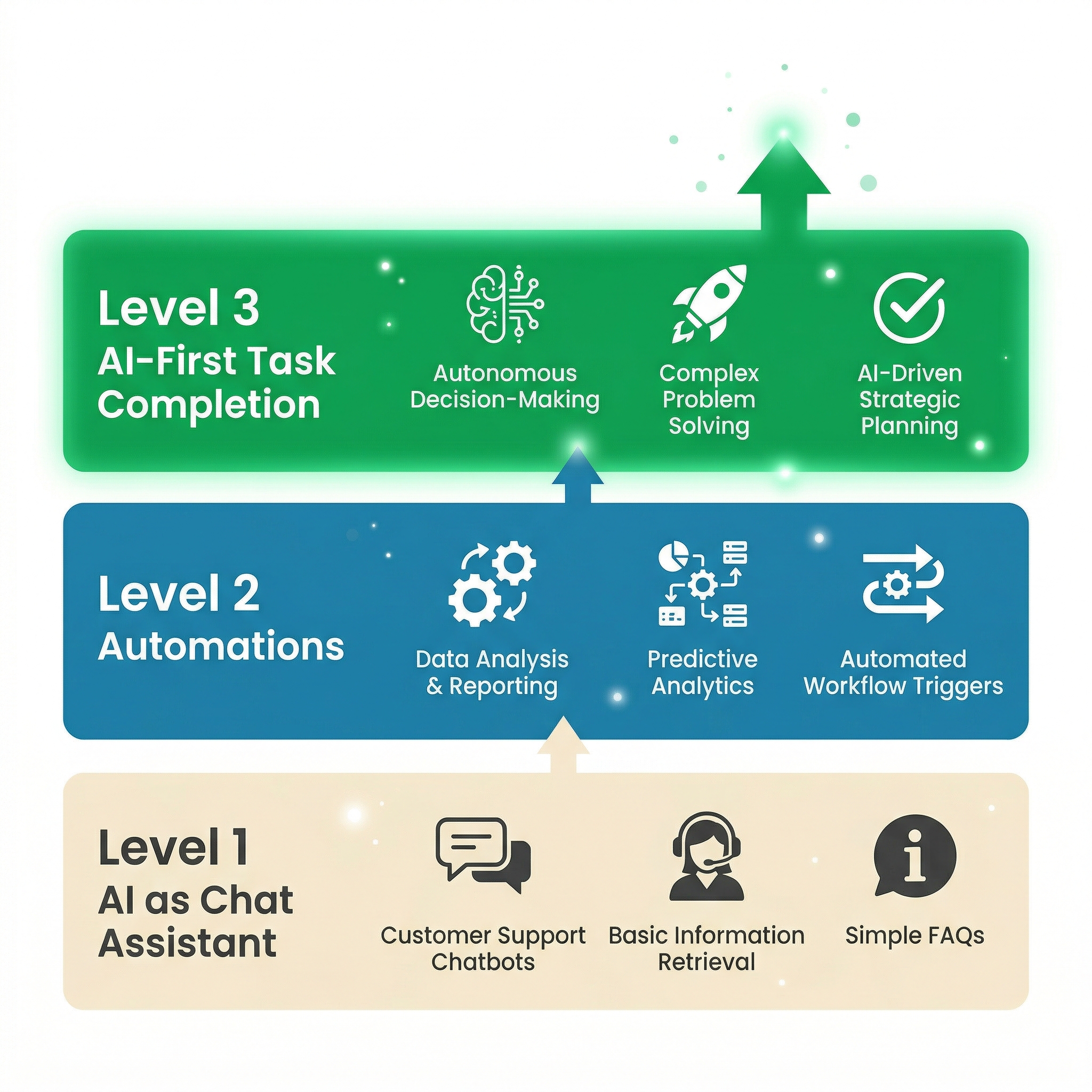
When I look at how businesses actually use AI, it almost always fits one of three levels.
Level 1: AI as a chat assistant.
Someone opens ChatGPT to write an email or tighten a paragraph. Useful. But the business hasn’t changed. It’s a slightly smarter search engine and nothing more.
Nearly half of all US workers say they never use AI at work. And most businesses sitting at Level 1 think they’re further along than they are.
Level 2: Automations.
Some workflows are automated. An enquiry triggers a sequence. Reports generate without someone building them manually. Real time savings start showing up here.
But AI is still sitting beside the business, not inside it. The machinery has improved. The structure hasn’t.
Level 3: AI-first task completion.
This is where everything changes.
The whole business is restructured so AI completes tasks first, with humans setting direction, approving outputs, and handling the work that genuinely requires a person. The default question isn’t “who does this?” It’s “can tokens do this first, and a human check and approve?”
The difference in output, speed, and cost between Level 1 and Level 3 is not small. OECD research found that 62% of small businesses that moved to AI-first approaches saw significant productivity gains within six months. Content production time dropped 50 to 70%. Customer service costs dropped 40 to 60%.
Read those numbers again. That’s not an efficiency improvement. That’s a different business.
“The difference in output, speed, and cost between Level 1 and Level 3 is not small. Content production time drops 50 to 70%. Customer service costs drop 40 to 60%. That’s not an efficiency improvement. That’s a different business.”
Quick self-audit: which level are you at?
Be honest. Most people who think they’re at Level 2 are really at Level 1.
- Do you use AI for specific tasks, but your processes and workflows haven’t changed? Level 1.
- Do you have at least two or three automated workflows that save meaningful hours each week? You’re moving toward Level 2.
- Does your team default to AI first for computer-based tasks, with humans reviewing and approving? That’s Level 3.
Almost no small or medium business is at Level 3 yet. Anyone who gets there in the next twelve months has essentially no competition.
Tokens or Humans? Here’s How to Think About It
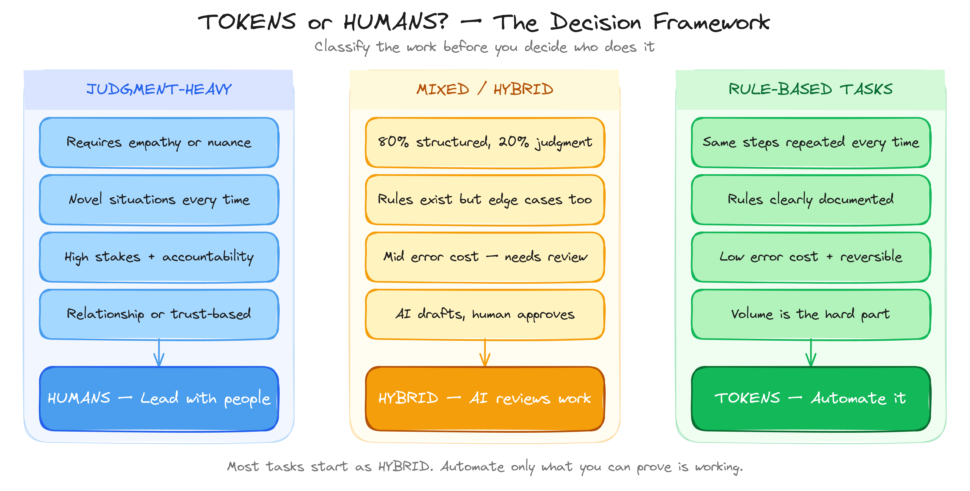
Quick answer: For any computer-based task with a defined output, documentable context, and a human available to review, that’s a tokens task. Default to AI. Have a person check. Everything else stays human for now.
Here’s the shift that changes everything.
For most of business history, the constraint was time. You could only produce as much as your team could handle. Headcount was the solution to every capacity problem. Need more proposals? Hire. Need more content? Hire. Need more reports? Hire.
That logic is breaking down.
Think about it this way. Photography didn’t kill portrait painters. But it permanently changed the question. Before photography, the question was: who do I hire to capture this moment? After photography, the question became: what’s the vision, and how do I direct it? Execution cost dropped to almost nothing. The skill shifted to clarity of direction.
The same thing is happening to every computer-based task in your business right now.
The tokens-first framework:
For any task your team does on a computer, ask three questions:
- Does it have a defined output? (A proposal, a report, a piece of copy, an analysis. Something with a shape.)
- Can the context for it be documented? (Background on the client, the brief, the standards, the brand voice.)
- Is there a human available to review and approve the result?
If yes to all three: that’s a tokens task. Default to AI. Have a human check.
If no to any of them: still human. But be honest with yourself about which “no” is actually “I haven’t built the context yet.”
The more you build that context, the more tasks move from the human column to the tokens column.
The practical reality right now: what used to need five people working for a week can be done by one person with the right AI systems in a day. I think we’ll see solo operators turning over hundreds of millions possibly this year, certainly within the next few. One person, excellent AI systems, and the strategic clarity to direct them well. I intend to be one of them.
The Speed Difference Is Bigger Than You Think
Here’s something that doesn’t get said enough.
The departments you have, and the number of staff in them, exist partly because of time.
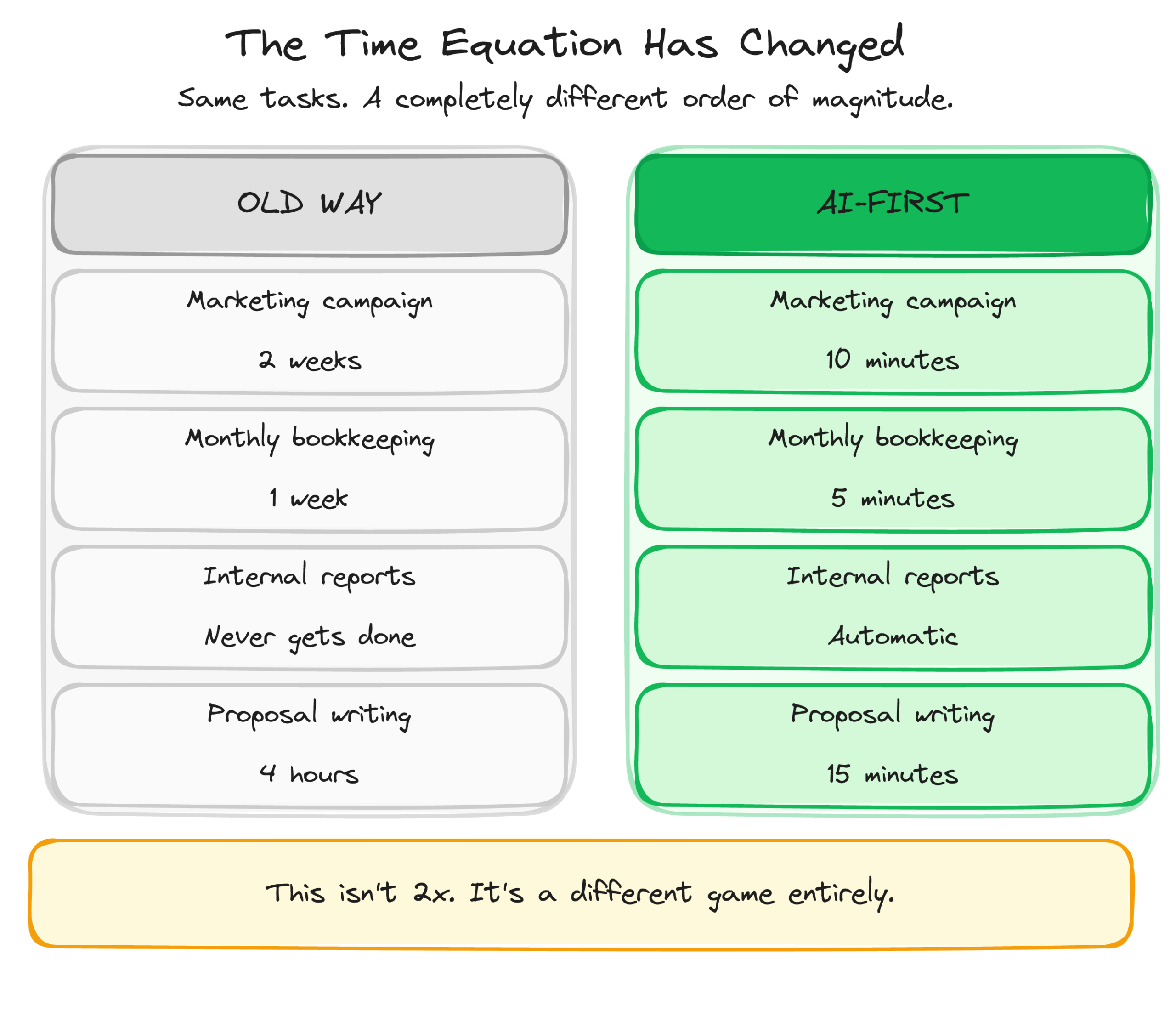
Your accountant needs a week to do the bookkeeping. Your content team needs two weeks to build a campaign. Your operations manager spends their whole week coordinating moving parts and synthesising information. You hire people because tasks take time, and one person can only work so fast.
AI doesn’t have that problem.
Dan Sullivan and Dr. Benjamin Hardy make this case in 10x Is Easier Than 2x: transformational leaps don’t come from doing more of the same thing faster. They come from identifying which constraints you assumed were fixed and discovering they aren’t. Time was one of the biggest constraints in business. For computer-based work, that constraint has effectively gone. Going from two weeks to ten minutes isn’t a 2x improvement. It isn’t close to 2x.
“A complete marketing campaign – video script, website copy, email sequences, social content – can be produced in ten to fifteen minutes with the right systems. Not low-quality. At a level that used to require a team working for two weeks.”
A complete marketing campaign (video script, website copy, email sequences, social content) can be produced in ten to fifteen minutes with the right systems. Not low-quality. At a level that used to require a team working for two weeks.
Bookkeeping that takes a week? Five minutes. Internal reports that nobody has time to write? They run automatically.
This doesn’t mean you fire everyone immediately. Your trades team still needs to be on site. Your account managers still need to be in front of clients. The human work that requires a person in a room stays.
But a significant part of why your org chart looks the way it does is a direct result of time constraints that no longer exist.
The businesses that see this clearly are going to be restructuring how they operate over the next twelve months. The ones that don’t will be outproduced by leaner, faster competitors who figured it out first.
Why AI Keeps Giving You Generic Results
Most businesses using AI are making one specific mistake.
They treat it like a generic tool.
No brand context. No values. No history of what’s worked. No understanding of the client. Just a question, and whatever output comes back gets used.
Research published in 2025 found that when large language models are given open-ended questions, they produce responses measurably more homogeneous than human responses. More averaged. More conventional. AI defaults to the most statistically likely answer.
Think about what that actually means. Every company using AI without giving it proper context is generating the same content, the same proposals, and the same emails as every competitor using the same tool. I see this constantly. Two businesses in the same industry, both using AI, both producing work that reads like it came from the same source. Because it did.
“Every business using AI without giving it proper context is generating the same content, the same proposals, the same emails as every competitor. There is no competitive advantage in average.”
There is no competitive advantage in average.
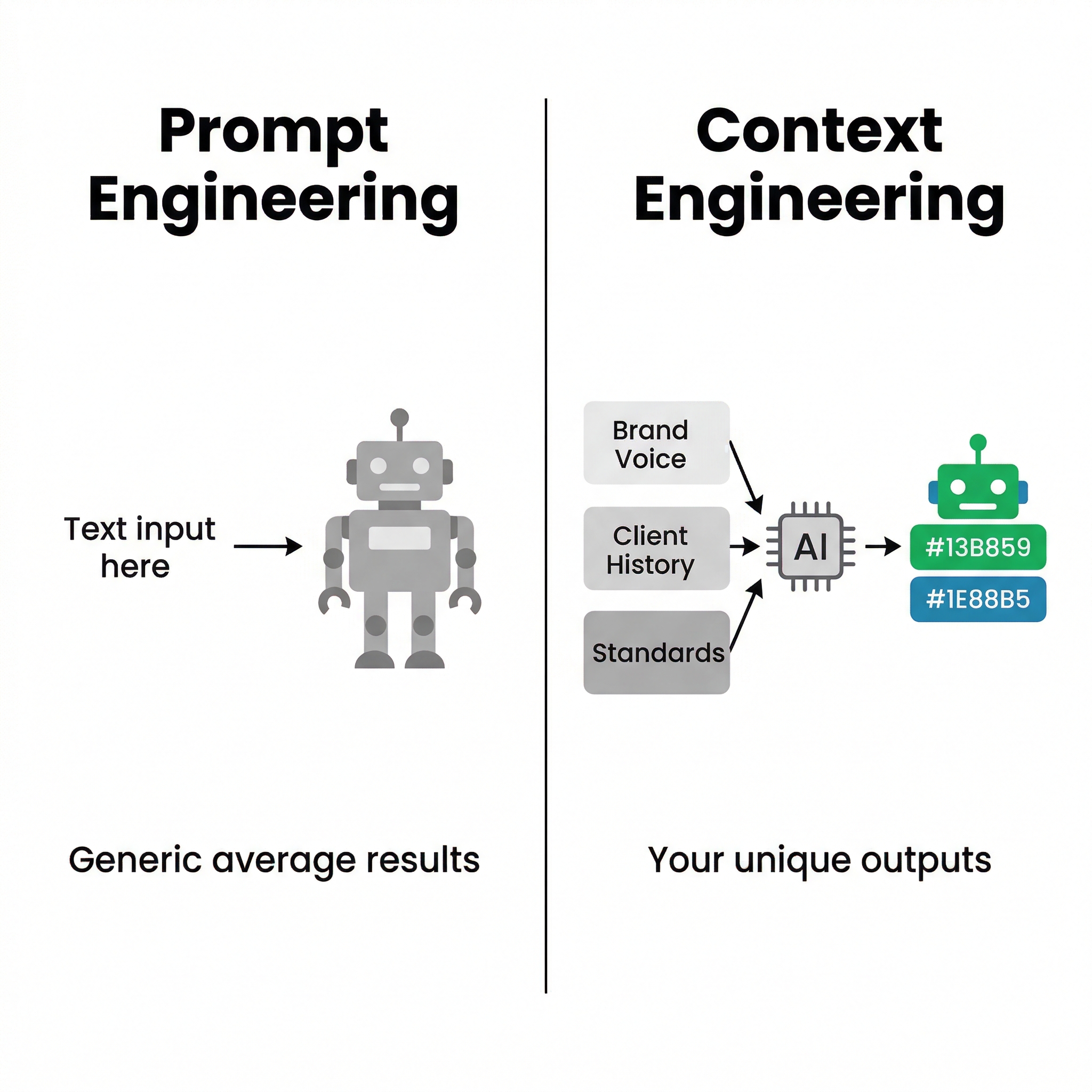
This is the difference between prompt engineering and context engineering.
It’s also, in the language of the Awesome Framework, an Inquiry layer question — the second-order thinking shift that separates businesses optimising what they already do from those restructuring around what’s now possible. The first-order question is “how do I get better outputs from AI?” The second-order question is “what does it mean for my entire business structure if AI can handle the majority of computer-based work with the right context in place?” That’s the question worth sitting with.
Quick answer – what is context engineering? Context engineering is building the systems that sit behind every AI interaction in your business: brand voice, client knowledge, decision frameworks, quality standards. It’s the difference between a new hire with zero onboarding and one who’s been properly briefed on everything that matters.
Prompt engineering, the idea that writing a clever enough input gets you a better output, is largely solved. Anyone can do it. It stopped being a meaningful skill about two years ago.
Context engineering is different. And before I explain what it is, let me be clear about what it isn’t.
It’s not uploading your brand guidelines PDF into a ChatGPT conversation and hoping for the best. Dumping a 50-page document at an AI and expecting it to find the three relevant paragraphs isn’t context engineering. It’s hoping. AI isn’t good at that kind of needle-in-a-haystack retrieval, and the output quality reflects that. More files isn’t better context. Precisely the right information at precisely the right moment: that’s context engineering.
It also helps to understand that “tokens” actually means two different things in practice, and the distinction matters.
The first tier is automation-level. AI gets called upon at a specific point in a workflow: an n8n or Zapier automation routes a task to an AI model, gets a response, and passes it on. Real time savings. Useful. But a human or a trigger still initiates each step. This is where most Level 2 businesses operate.
The second tier is agent-level. AI agents act autonomously across multiple steps, making decisions and completing whole tasks end-to-end without someone managing each handoff. A brief comes in, the agent pulls the client history, checks the brand standards, drafts the proposal, and files it for human review. Nobody orchestrated each step. That’s Level 3.
Both tiers need context. But autonomous agents need context engineered at the company level, not just the task level. An agent working on a client proposal needs to know the brief, but also the relationship history, the pricing guardrails, the tone the client responds to, and who to flag for approval. That’s not a conversation with a document attached. That’s an information architecture built deliberately across the whole business.
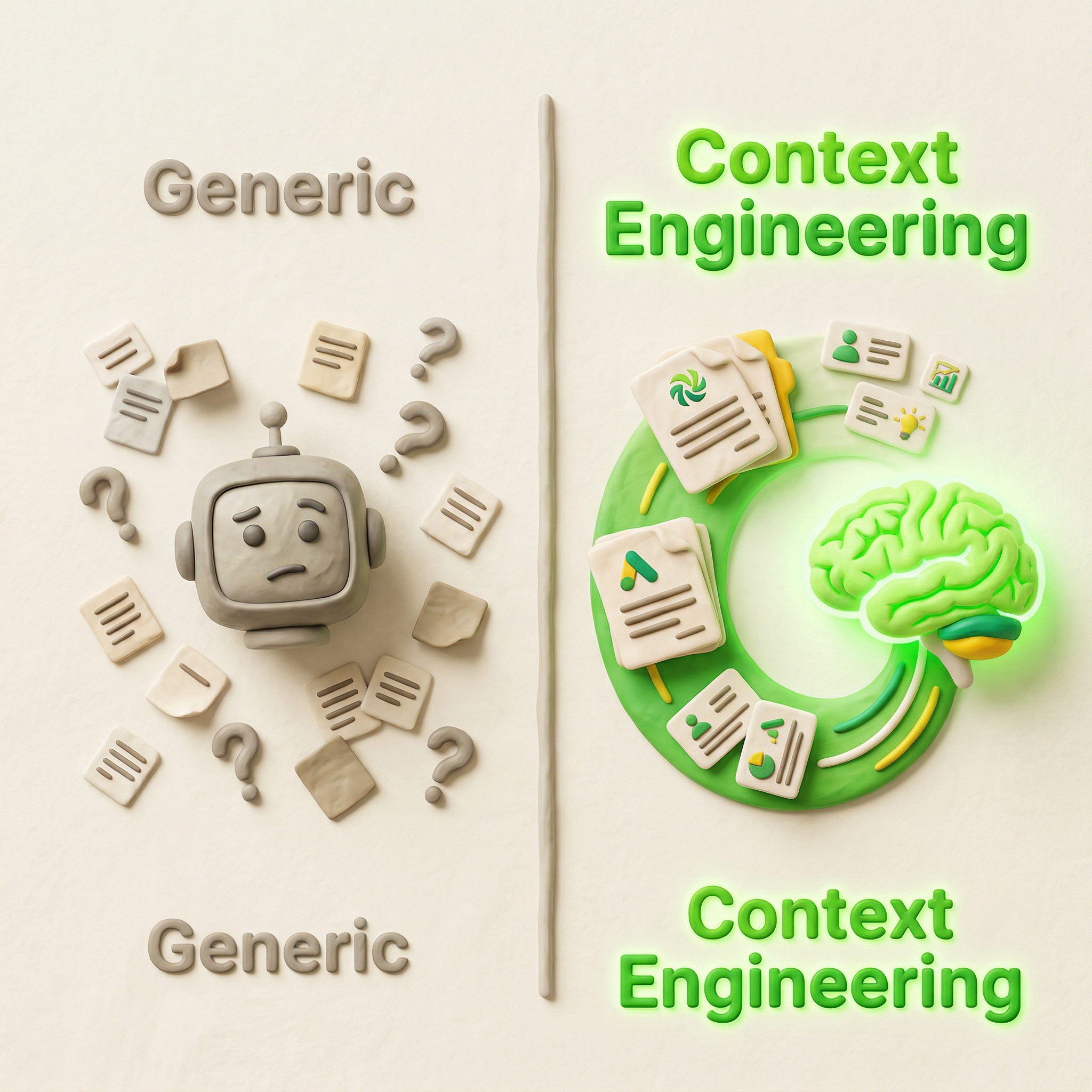
Picture a brilliant new hire on their first day. You give them zero background on your business. No client history. No brand voice. No examples of your best work. Just a task and a deadline.
They’d produce technically competent work. But it wouldn’t feel like yours. It’d be generic.
That’s most businesses right now with AI. Context engineering is what changes that.
What this looks like at scale:
Take a twenty-person agency at Level 3. A new brief lands. An AI agent reads it, pulls the client’s project history, cross-references the brand guidelines, drafts three creative directions, and routes them to the account manager for review. All before anyone’s made their morning coffee. What used to be a briefing meeting, a creative kickoff, and a three-day turnaround is now same-day.
At fifty staff, you have multiple departments with multiple knowledge bases. Context engineering means each AI agent draws on exactly the right slice of information for its role. Sales agents know the pricing logic and objection responses. Delivery agents know the service standards and client preferences. They don’t all have access to everything. They have access to exactly what they need, structured properly.
At a hundred people, the compounding effect becomes the whole story. Every AI-first process runs faster than the equivalent human process. Every department produces more. The information architecture holds the system together. The person who built and maintains it is one of the most valuable people in the business.
What This Actually Does to Your Staffing and Bottom Line
This is worth being direct about.
If you have a team of ten people, and most of their computer-based work is context-rich and repeatable, good context engineering can mean the same output gets produced by six or seven people. Some of that margin shows up as capacity freed up for higher-value work. Some shows up as pure cost saving.
Every dollar you save on operational costs matters in two ways.
First: immediate margin improvement. That’s obvious.
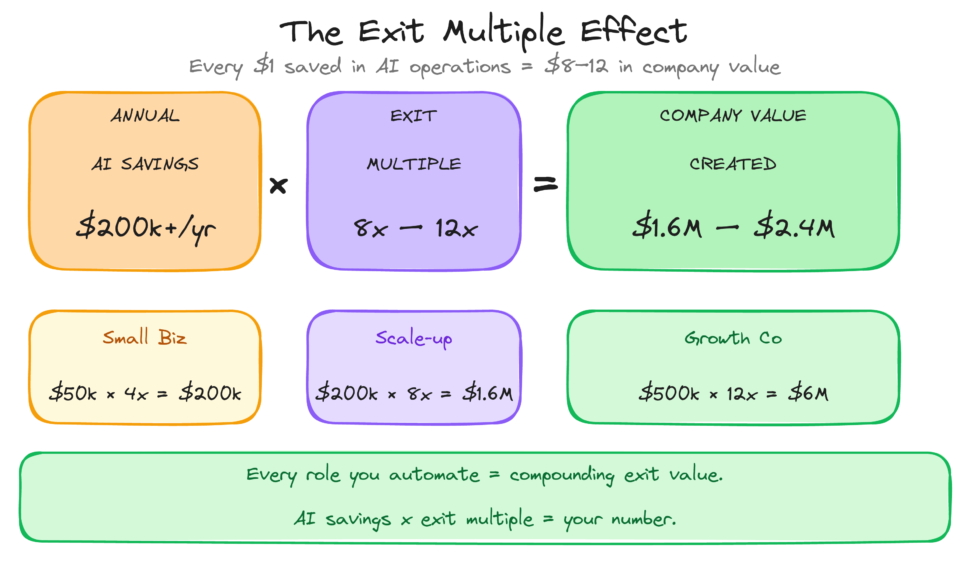
Second: exit multiple. If you’re planning to sell your business in the next 12 to 24 months, this is worth doing the maths on properly.
Most SME acquisitions are priced at a multiple of profit. Typically three to six times profit for smaller businesses, sometimes higher. Slash $200,000 in annual operational costs through AI-first systems, and at a four-times multiple, you’ve added $800,000 to your exit price. At six times: $1.2 million. If your business is operating at a higher multiple, even more.
“Slash $200,000 in annual operational costs through AI-first systems, and at a four-times profit multiple, you’ve added $800,000 to your exit price. At six times: $1.2 million.”
That’s not marginal. That’s a reason to move on this right now rather than next year.
The two directions AI improves your bottom line are distinct, and both are real:
Operational cost reduction through doing the same work with fewer human hours.
Revenue growth through producing more output with the same team, faster.
Most businesses can access both. But you won’t access either without someone actually implementing the systems.
You Need One Person Whose Job Is This
Here is something that trips up a lot of business owners.
You cannot make context engineering everyone’s responsibility. When something is everyone’s job, it’s nobody’s job.
“Context engineering is a company-wide structural change in how information flows and how tasks get handled. No single department head can implement it across departments they don’t own. When something is everyone’s job, it’s nobody’s job.”
Context engineering is a company-wide structural change in how information flows and how tasks are handled. No single department head can implement it across departments they don’t own. A team member cannot build company-wide AI infrastructure while also doing their actual job.
And here’s the other reality: right now, there are roughly 200 new AI tools and feature releases every week. Not a figure I’m exaggerating. Some of them are genuinely useful. Most are toys. Knowing which is which, and actually implementing the ones that matter for your specific business, is effectively a full-time job. Most business owners don’t have time for that on top of everything else.
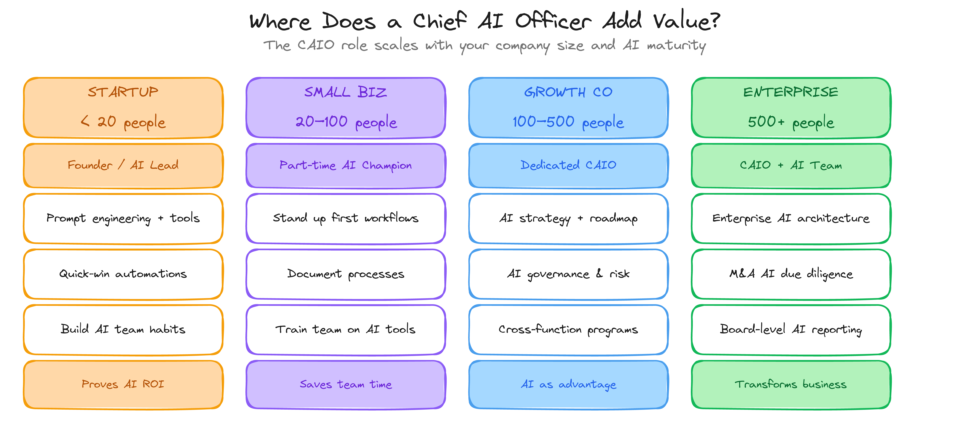
Large companies have started calling the person who does this the Chief AI Officer, or CAIO.
IBM published data in 2025 showing 26% of large enterprises now have one, up from 11% two years earlier. The average salary for the role in the US sits around $354,000 a year. LinkedIn data shows CAIO roles have tripled in five years. That trajectory tells you something: the organisations that are serious about AI have figured out they need dedicated ownership, not just good intentions.
But here’s the thing. The conversation is almost entirely at the enterprise level.
Your twenty-person agency? Your fifty-person firm? Your two-hundred-person business with multiple departments? Almost certainly no version of this person.
And here’s what I think is important to say clearly: the value of a CAIO scales directly with the size of your business.
With one or two staff, there aren’t enough processes to optimise. The leverage isn’t there yet, and it’s probably the owner’s job to stay on top of this themselves.
At five to ten staff, things start to shift. Multiple workflows, multiple roles, multiple people doing things slightly differently. That’s where context engineering starts to matter.
At twenty-five to fifty staff, rolling out AI-first systems without someone dedicated to it is a real risk. You’ll get inconsistent results, confused teams, and tools that get used for two weeks then abandoned.
At a hundred or more, this is a major implementation project. The upside is enormous, but so is the complexity of getting it right.
The Chief AI Officer’s job is two things working in parallel: implementing what’s possible now, and mapping where the business can be in six to twelve months as the technology advances. Because what AI can do in Q4 2026 will be materially different from what it can do today. Someone needs to be watching that horizon.
For most small and medium businesses, this won’t be a full-time hire. A fractional CAIO, a board-level adviser working across a handful of companies, gives you that expertise without the full-time cost. A DataIQ survey found that 77% of organisations believe the role either already exists or should be created at their company.
We don’t even have a universally agreed name for this yet. That tells you everything about how early we are.
One Thing Worth Saying Before We Wrap
AI doesn’t just accelerate your business.
It accelerates everything.
Including the rate at which bad decisions compound, unclear strategy shows up, and the gaps in your leadership get tested.
“AI doesn’t just accelerate your business. It accelerates everything. Including the rate at which bad decisions compound, unclear strategy shows up, and the gaps in your leadership get tested. Speed without clarity is just arriving at the wrong destination faster.”
Rapid growth has always been a mirror. Founders find out who they actually are when things move fast. The money beliefs they didn’t know they had. The leadership patterns that never got tested. The places where their thinking wasn’t as solid as they assumed.
AI compresses that from years to months. Speed without clarity is just arriving at the wrong destination faster.
The businesses that win this era aren’t just the most AI-capable. They’re the most intentional. Clear on what they’re building, why they’re building it, and what decisions should default to tokens versus the ones that need a human in the room.
That’s the frame that makes all of this land properly: tokens or humans isn’t just a task management question. It’s a question about what your business is actually for.
Sullivan and Hardy’s 10x Is Easier Than 2x frames it this way: 10x growth requires letting go of the 80% that’s just maintaining your current structure, to focus entirely on the 20% that creates exponential value. Tokens-first thinking is exactly that applied to work itself. The 80% that AI handles — the drafting, the researching, the reporting, the formatting — frees your team for the 20% that only humans can do. Judgment. Relationships. Direction. That’s not a 2x business. That’s a fundamentally different one.

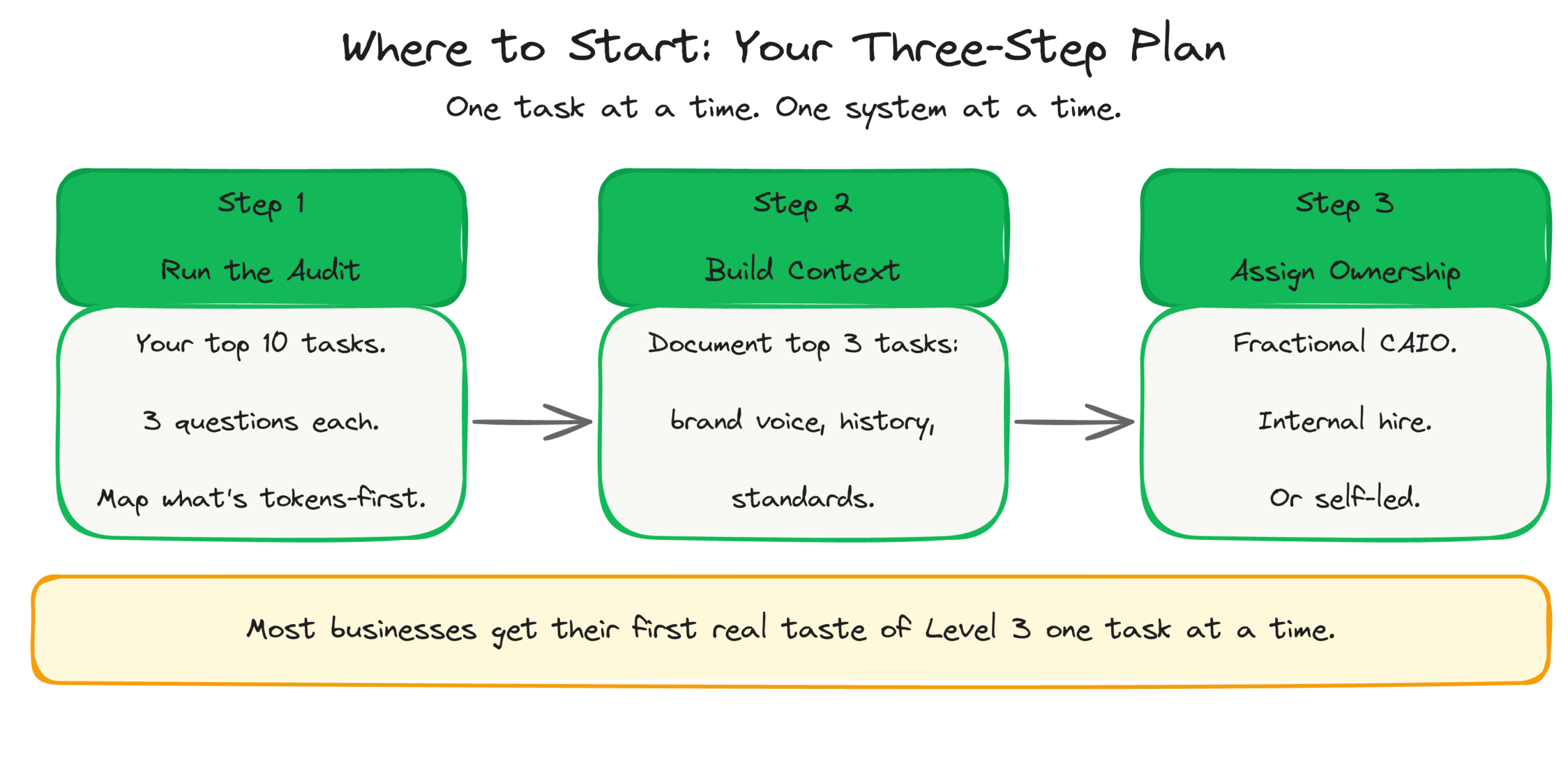
Where to Start: Your Three-Step Action Plan
Step 1: Run the Tokens or Humans Audit on your business.
Take the ten most time-consuming computer-based tasks in your business right now. For each one, ask: does it have a defined output? Can the context be documented? Is a human available to review the result? Every “yes to all three” is a tokens task you’re not yet running as tokens. That’s your priority list.
The free download below walks you through this in about twenty minutes.
Step 2: Build context for your top three tasks.
Don’t try to restructure everything at once. Pick the three highest-value tokens tasks you identified. For each one, document the context: the brand voice, the standards, the client knowledge, the examples of what “great” looks like. Run them through AI with that context. See what comes back.
This is how most businesses get their first real taste of Level 3. One task at a time.
Step 3: Make it someone’s actual job.
Whether that’s a fractional CAIO, a dedicated internal hire, or six months of becoming more AI-fluent yourself, this function needs to belong to a specific person. Not everyone’s job. Not nobody’s job. One person, accountable for the tokens-or-humans question across the business.
Tokens or Humans. That’s the Question.
Every computer-based task in your business will run through this question. Not just today. For the rest of your career.
Most businesses right now are answering it by accident. They’re paying human hours for things that should be tokens. They’re generating generic AI output because they haven’t built the context that makes it theirs. They’re at Level 1 thinking they’re at Level 2, missing the compounding advantage that’s sitting right in front of them.
The CAIO role exists to make sure your business answers the question well, consistently, and across the whole company. It’s a new role. The name isn’t even agreed on yet. But the function is real, and the businesses that build it deliberately over the next six to twelve months will be genuinely difficult to compete with.
There are two ways to move on this now.
Grab the free audit below and work through it with your team. It takes twenty minutes and gives you a clear picture of where your highest-value tokens opportunities are right now.
Or book a call and we’ll map it together: your specific workflows, your biggest bottlenecks, the places where going tokens-first would have the most immediate impact.
Either way: the question is tokens or humans. The time to start answering it on purpose is now.
Frequently Asked Questions
What does “tokens or humans” mean in business?
Every task in your business can be handled by a human or by AI (tokens). For computer-based tasks with a defined output and documented context, AI is often faster, cheaper, and just as good, with a human checking the result. The “tokens or humans” framework is a decision process for identifying which tasks should be AI-first in your business.
What does a Chief AI Officer do in a small business?
A Chief AI Officer (CAIO) is a strategic role, not a technical one. Their job: stay on top of AI developments so the business owner doesn’t have to, identify where AI-first task completion applies to the specific business, build the context systems that make AI outputs trustworthy and on-brand, and train and audit the team. In most small businesses this will be fractional rather than full-time.
What is context engineering and why does it matter?
Context engineering is the practice of building the systems that sit behind every AI interaction in your business: your brand voice, client knowledge, decision frameworks, and quality standards. Without it, AI produces generic, averaged outputs. With it, AI produces your outputs. It’s the difference between a new hire with zero onboarding and one who’s been properly briefed on everything that matters.
How quickly can I see results from moving to AI-first?
Quickly. OECD research from 2025 found 62% of small businesses that adopted AI-first approaches saw significant productivity gains within six months. Content production typically drops 50 to 70% in time. Customer service costs typically drop 40 to 60%. The fastest results come from identifying three high-value tokens tasks and implementing them properly, rather than trying to restructure everything at once.
Do I need a full-time CAIO or can I use a fractional adviser?
For most small and medium businesses, fractional makes more sense. A fractional CAIO works across multiple companies, brings cross-industry perspective, and can move fast. Full-time CAIO salaries in the US average around $354,000 a year. Fractional puts that expertise within reach without the full-time overhead.