The Operating System for Spiritually Aligned, Commercially Ruthless Businesses
If you are already running a multi-six, seven, or eight-figure business, you have consumed more than enough content. You have read the books, hired the consultants, and implemented the systems.
You have tried better funnels, new org structures, OKRs, EOS, scaling playbooks, all of it.
And yet, you keep hitting the same invisible ceiling. Revenue plateaus in the same band. Team issues appear at every new level. Growth happens, then stalls. And you cannot quite name what is actually wrong.
This is the problem the Absolutely Awesome Framework™ was built to solve.
“Most business problems are not business problems.
They are identity, capacity, or safety problems showing up as business symptoms.”
Why I Created This Framework
The pattern behind repeated plateaus, burnout, and invisible ceilings that tactics never fix.
I did not set out to create a framework. I set out to understand a pattern that kept repeating across every business I worked in, at every scale.
Brilliant strategists whose plans collapsed under pressure. Conscious entrepreneurs who could not scale without burning out. High-performers who self-sabotaged right at the threshold of breakthrough.
The tactics were not failing. The execution was solid. Something else was breaking down.
I noticed three patterns:
First: The strategy failed when identity could not support it. A founder would develop a clear plan, then unconsciously sabotage it. They would underprice by 30%. Play small in their positioning. Abandon campaigns right before the breakthrough. Why? Because the outcome threatened their self-image.
Second: Growth failed when capacity collapsed. Leaders would override every biological signal, push through exhaustion, and wonder why their decision-making deteriorated. The business did not slow down because the market shifted. It slowed because the founder hit a wall that their nervous system could not sustain.
Third: Culture failed when safety was missing. Teams would say the right things in meetings, then work around each other in practice. Not from lack of competence, but because the environment could not hold the truth.
And here’s what I realised: These are not three separate problems. They are all expressions of the same structural gap.
The business and the founder are not two systems that need to be “balanced.“ They are one organism. And when that organism is misaligned – when identity cannot hold the outcome, when capacity cannot sustain the load, when safety cannot support truth – no amount of tactics will fix it.
The Absolutely Awesome Framework emerged from this observation. It is the operating system underneath the tactics – the architecture that determines whether your business expands sustainably or eventually implodes.
“The business and the founder are not two systems to be balanced.
They are one organism.”
What the Framework Actually Is
An operating system that determines whether strategy compounds or collapses under pressure.
At its core, the Absolutely Awesome Framework is built on a simple mathematical truth:
Transformation = BEING × THINKING × DOING, guided by INTEGRITY
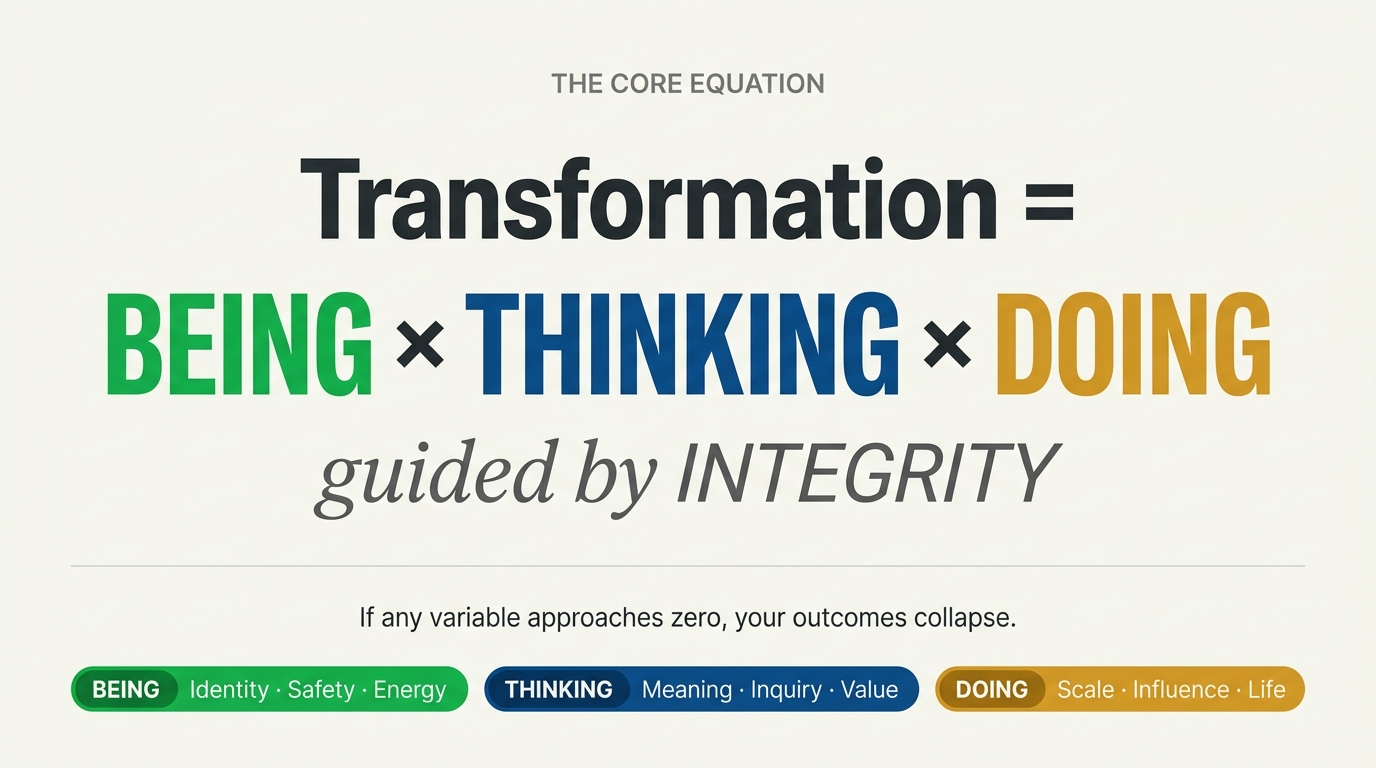
Notice the multiplication. If any one variable approaches zero, your outcomes collapse. No amount of brilliant strategy can save you if your identity refuses to hold success (Being), your strategic clarity is fuzzy (Thinking), or your execution is chaotic (Doing).
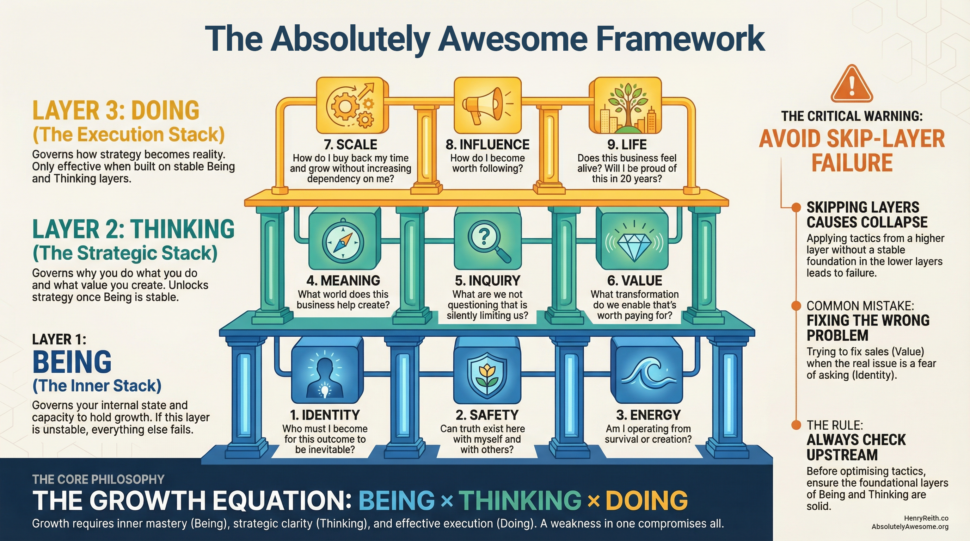
The framework breaks your business and leadership into three layers and nine pillars:
Layer 1: BEING (the Inner Stack)
- Identity – Who must I become for this outcome to be inevitable?
- Safety – Can truth exist here?
- Energy – Am I operating from survival or creation?
Layer 2: Thinking (the Strategic Stack)
- Meaning – What world am I creating?
- Inquiry – What question changes everything?
- Value – What transformation do we enable?
Layer 3: DOING (the Execution Stack)
- Scale – How do I buy back time?
- Influence – How do I become worth following?
- Life – Does this feel alive?
All of it sits inside Ethical Stewardship, the container that ensures you do not become “successful“ in a way that breaks you, your team, or the world.
If you remember nothing else, remember: Self → Strategy → Scale
“Get Self wrong and Strategy distorts.
Get Strategy wrong and Scale breaks.”
Get Self wrong (Being), and you distort Strategy (Thinking). Get Strategy wrong, and your Scale efforts (Doing) become expensive experiments that do not compound.
Why “Spiritually Aligned, Commercially Ruthless”?
Why consciousness without execution stalls, and execution without integrity eventually breaks.
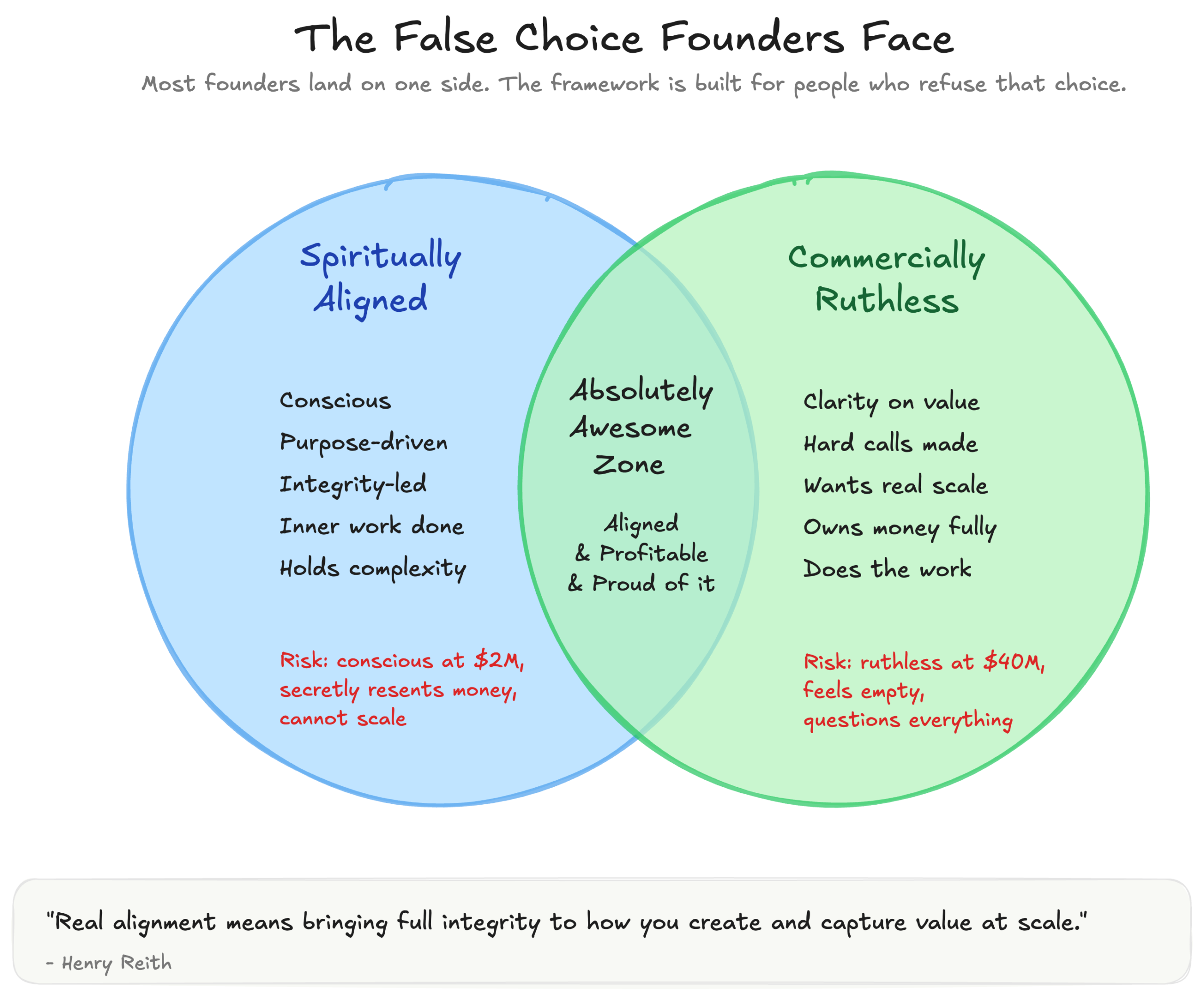
This positioning confuses people initially, so let me clarify.
“Spiritually aligned“ at the $1M+ level means:
- You have done enough inner work to recognise when you are lying to yourself
- You can hold complexity without collapsing into binary thinking
- You care about building something you would be proud of in twenty years
- You understand your inner world and your business are not separate systems
“Commercially ruthless“ at scale means:
- You have clarity about what creates value, and you do not avoid money conversations
- You are willing to make hard calls – about pricing, people, strategy – even when uncomfortable
- You do not use “alignment“ as an excuse for poor business fundamentals
- You actually want the $1M to $10M jump, the $10M to $100M jump, and you will do the work
Most founders land on one side:
- The conscious entrepreneur at $2M who secretly resents money and cannot scale
- The ruthless operator at $40M who feels empty and questions what it is all for
This framework is for people who refuse that false choice. Who wants both consciousness and capital. Who understand real alignment means bringing full integrity to how you create and capture value at scale.
How This Shows up in Real Business
Three real constraints, three different scales, one underlying architecture.
Let me show you what this looks like in practice with three examples at different scales.
Example 1: The $15M Identity Ceiling
A founder runs a creative agency generating $15M annually. On paper, everything looks good. Strong client list. Profitable. Growing steadily.
But they cannot break through $15M. They have been stuck in the $13M-$17M band for three years.
They try new marketing tactics. Hire a sales consultant. Rebuild the website. Nothing changes.
When we diagnose, the constraint is not marketing or sales. It is Identity (Being layer).
The founder has an unconscious identity of “talented freelancer who got lucky.“ That identity cannot comfortably sit across from Fortune 500 clients, hire true executive talent, or make seven-figure strategic bets.
Intellectually, they know they should raise prices, build the C-suite, and pursue larger contracts. But every time the opportunity appears, they find reasons why “now is not the right time.“ They hire VP-level talent, then unconsciously undermine them. They pitch enterprise clients, then price themselves 40% below market.
The tactics were never the problem. The identity architecture was.
Until that core identity shifts from “freelancer who got lucky“ to “CEO of a world-class firm,“ no amount of sales training or marketing sophistication will break the ceiling. The identity thermostat keeps pulling them back to $15M.
This is Skip-Layer Failure™ – trying to solve a downstream problem (sales, marketing) when the real constraint lives upstream (identity).
“Skip-Layer Failure is trying to solve a downstream problem
when the real constraint lives upstream.”
Example 1: $15M Identity Ceiling
Revenue Context
$15M ARR — stuck in the $13M–$17M band for three years
What They Tried
New marketing tactics, sales consultant, website rebuild — nothing changed
Real Constraint
Identity
BEING layer
The Real Problem
An unconscious self-image of “talented freelancer who got lucky” placed an invisible ceiling on every hire, client conversation, and strategic bet. No sales tactic can override an identity thermostat. The constraint wasn’t external — it was the founder’s unexamined story about who they were allowed to become.
Example 2: The $30M Safety Crisis
A tech services company hits $30M in revenue. The leadership team looks strong on the org chart. Everyone has impressive resumes. Meetings are professional and well-run.
But growth has stalled. The founder cannot figure out why.
When we diagnose, we notice a pattern: Nobody brings real problems to leadership meetings. Everyone agrees in the room, then goes back to their departments and does whatever they want. Critical issues surface only when they are already on fire.
The founder thinks this is a “strategy alignment“ issue. They bring in consultants. Run off-sites. Build OKRs and dashboards. Nothing changes.
“Safety is not a soft value.
It is infrastructure.”
The real constraint is Safety (Being layer).
Years earlier, when the company was smaller, the founder reacted poorly to bad news. They did not yell or punish overtly – but their energy shifted. They got defensive. They explained why the person bringing the problem was wrong.
The leadership team learned: bringing problems equals emotional labour with no benefit. So they stopped.
Now the founder wonders why “nobody tells me anything until it is catastrophic.“ They have an expensive layer of executives who carefully curate what information reaches them. The founder is flying blind.
Until Safety is rebuilt – through actual behaviour change, not policy documents – no strategic framework will stick. The team has learned that truth is punished, so they optimise for keeping the founder comfortable, not for business outcomes.
This is also Skip-Layer Failure™ – trying to solve a downstream problem (strategy, alignment) when the real constraint lives upstream (safety, truth-telling capacity).
Example 2: $30M Safety Crisis
Revenue Context
$30M ARR — strong org chart, but growth stalled and leaders were flying blind
What They Tried
Strategy consultants, off-sites, OKRs, dashboards — alignment never landed
Real Constraint
Safety
BEING layer
The Real Problem
Years of subtle negative reactions to bad news trained the leadership team that truth is punished. They optimised for keeping the founder comfortable — not for business outcomes. Safety is not a soft value. It is infrastructure.
Example 3: The $7M Scale Architecture Problem
An online education company generates $7M annually, built entirely on the founder’s content and personality. Every course delivery requires them. Every sales conversation escalates to them. Every customer issue needs their input.
They try to solve it with better funnels and more advertising. Revenue grows to $9M. The founder is now working more hours than ever and contemplating selling because they are exhausted.
When we diagnose, the constraint is not marketing. It is Scale (Doing layer).
But before we can fix Scale, we need to check upstream. Why did the founder build a business this way in the first place?
We discover two upstream constraints:
- Identity (Being): The founder’s worth is unconsciously tied to being needed. Delegating feels like becoming irrelevant.
- Value (Thinking): The offers are built around the founder’s delivery, not around a transformation that others could enable.
The work happens in three phases:
First, we address the Identity constraint. The founder does deliberate work on decoupling worth from being needed. They rebuild their self-image around “creator of frameworks“ rather than “deliverer of content.“
Second, we rebuild Value clarity. Instead of “courses taught by [founder name],“ the offers become “transformation X enabled through methodology Y.“ The methodology can be delivered by trained facilitators.
Third, we fix Scale architecture. They turn IP into systems. Redesign the team so the founder creates core frameworks and strategy – not bottlenecks for every customer interaction.
Revenue temporarily dips to $8M during the rebuild. Then climbs to $14M over the next year with the founder working 25 hours per week instead of 65. Margins improve from 22% to 38%.
This is solving at the right layer. Scale was the visible problem. But the real constraints lived upstream in Identity and Value. Fix those first, and the Scale problems often resolve themselves.
“Scale was the visible problem.
The real constraints lived upstream.”
Example 3: $7M Scale Architecture Problem
Revenue Context
$7M ARR — founder-dependent on every sale, delivery, and decision
What They Tried
Better funnels and more advertising — grew to $9M but founder was exhausted
Real Constraint
Scale (Doing) — but upstream: Identity + Value (Being + Thinking)
DOING layer
The Real Problem
Scale was the visible problem, but upstream constraints drove it. The founder’s worth was tied to being needed (Identity), and offers were built around founder delivery rather than a transferable methodology (Value). Fix the roots and the scale architecture falls into place.
Outcome
Revenue grew from $7M to $14M. Founder hours fell from 65 to 25 per week. Margins improved from 22% to 38%.
The Two Hidden Mechanics That Make This Practical
The two patterns that explain why smart founders keep solving the wrong problems.
1. Constraint Migration
In any complex system, there is always a constraint – the bottleneck limiting growth.
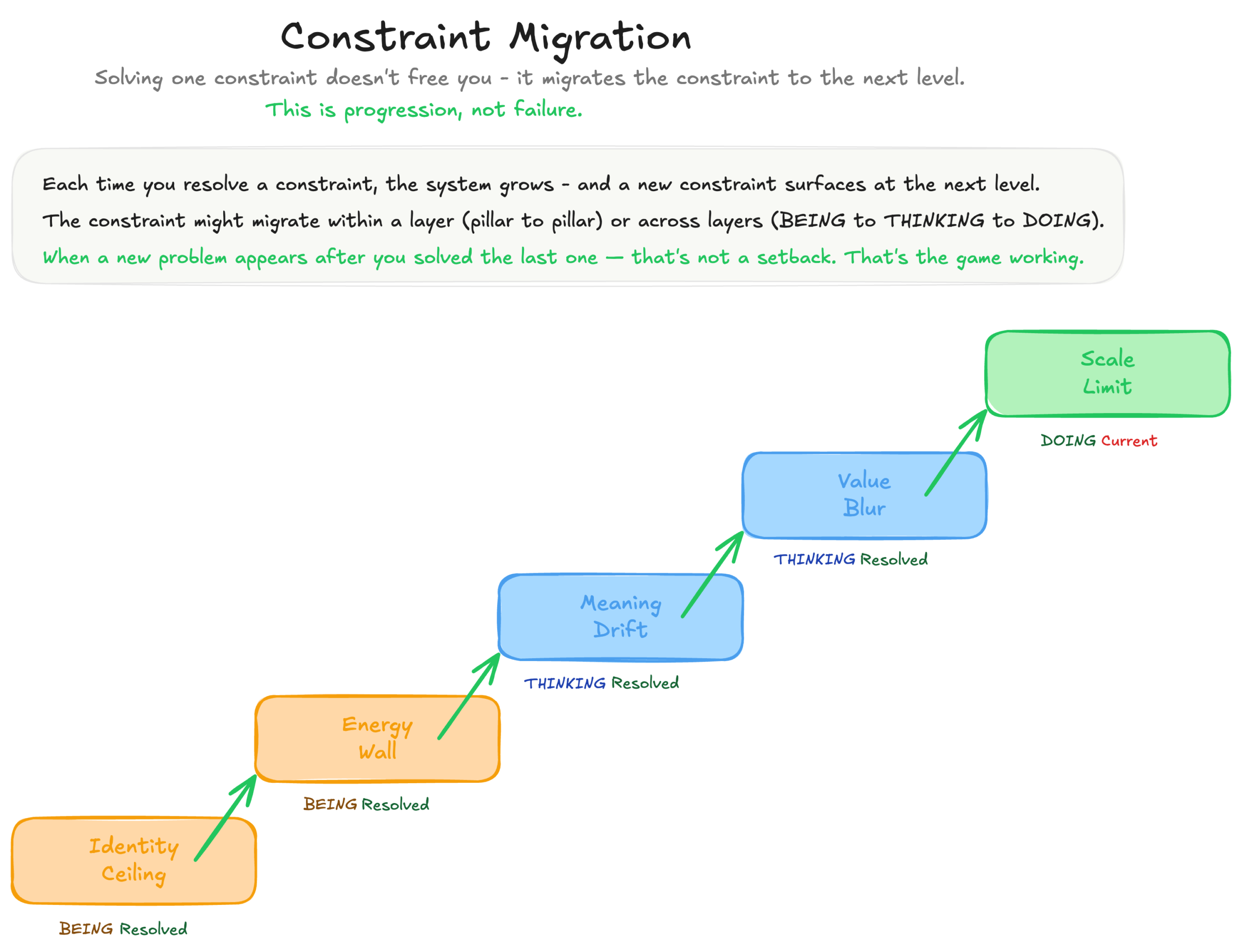
When you remove one constraint, the system does not become constraint-free. The constraint simply migrates somewhere else.
Example: You fix your Identity Ceiling. Revenue grows. Then you hit a new wall – you are exhausted. The constraint migrated from Identity to Energy. You fix Energy through capacity building and delegation. Then you hit another wall – you are not sure what the business is really for. The constraint migrated to Meaning.
This is not failure. This is progression.
If you expect Constraint Migration, you stop taking new problems personally. You start saying, “Good – we resolved the last constraint and graduated to the next one. That means we are playing a bigger game.“
“Constraint Migration is not failure.
It is progression.”
2. Skip-Layer Failure™
Most founders try to fix problems at the wrong layer.
Examples:
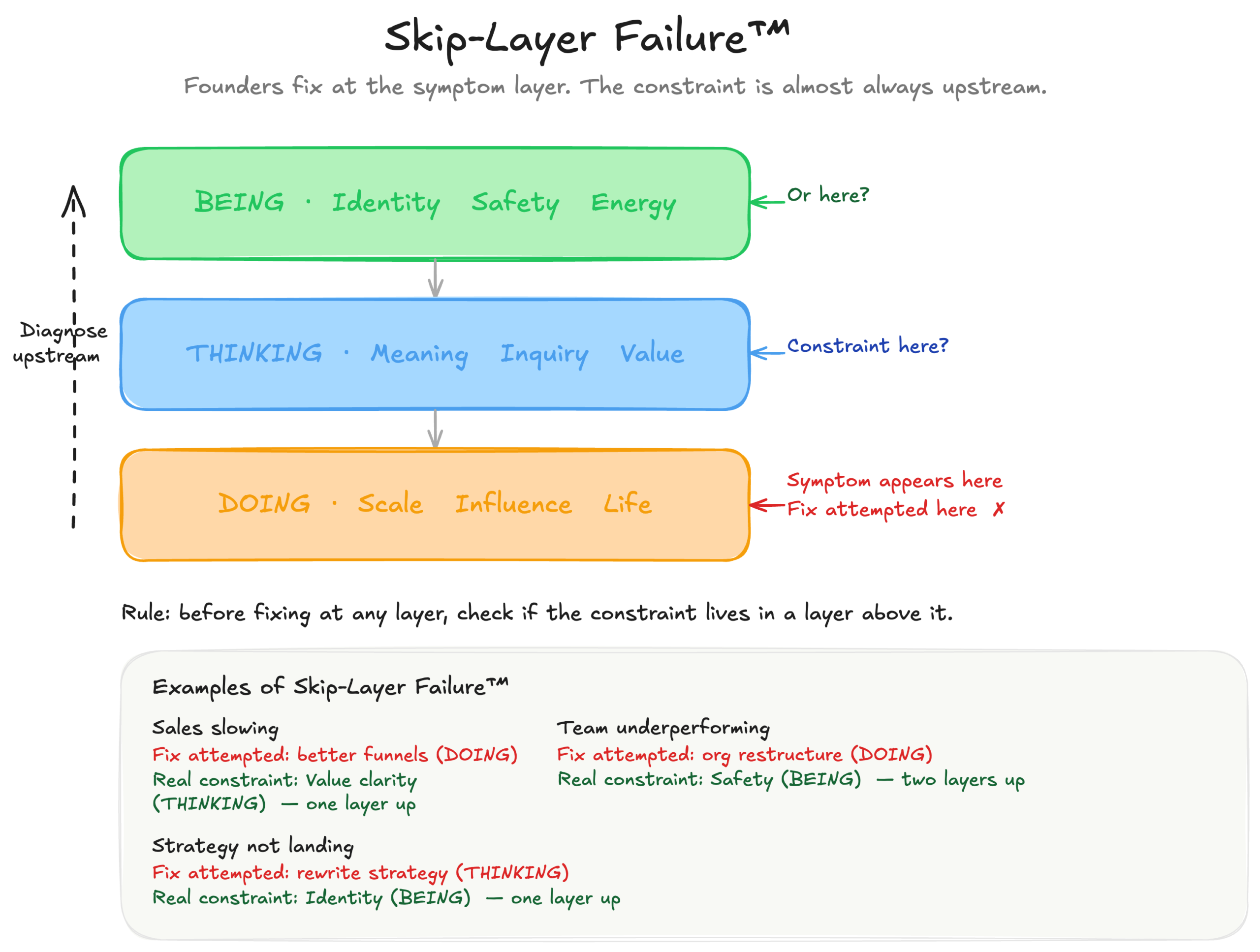
- Sales slowing? They look at scripts and funnels (Value or Scale)
- Team underperforming? They reorganise and hire more people (Scale)
- Founder burning out? They try to delegate and hire assistants (Scale)
But the real constraint often lives upstream:
- Sales slowing → Check Value clarity, then Identity (can you claim full value?)
- Team underperforming → Check Safety (can people tell the truth?)
- Founder burning out → Check Energy (is the nervous system depleted?) then Identity (is worth tied to constant output?)
When you try to solve downstream while upstream is broken, you get Skip-Layer Failure.
You recognise it because:
- You keep solving the same problem in different costumes
- Every time you “fix it,“ the pattern returns within a quarter or two
- Your tactics change but the feeling stays exactly the same
Diagnostic shortcut: Before optimising downstream, always check upstream.
How to Actually Think About Using This
A diagnostic lens, not a playbook, for identifying where growth is actually blocked.
This is not a framework you “implement“ like EOS or OKRs. It is a diagnostic lens.
“Before optimising downstream, always check upstream.”
Here is the practical process:
Step 1: Diagnose where your current constraint actually lives
Ask yourself across the three layers:
Being:
- Am I self-sabotaging or stuck at a revenue ceiling? (Identity)
- Can people tell me the truth? Can I tell myself the truth? (Safety)
- Do I feel creative and resourced, or reactive and depleted? (Energy)
Thinking:
- Do we have a mission and positioning that pulls the right people in? (Meaning)
- Are we asking the right strategic questions? (Inquiry)
- Is our value obvious and compelling? (Value)
Doing:
- Does this business require me everywhere for it to work? (Scale)
- Does my presence create the culture I want? (Influence)
- Does this feel alive, or am I building something I resent? (Life)
Where you feel the most tension is usually where your constraint lives.
Step 2: Pick ONE pillar to work on for 90 days
Not all nine. One. The one that, if resolved, would unlock everything else.
Examples by stage:
- $1M-$5M: Often Identity (ceiling) or Value (clarity)
- $5M-$20M: Often Safety (truth-telling) or Scale (founder dependency)
- $20M-$100M: Often Influence (leadership environment) or Life (regenerative vs extractive)
Where Is Your Constraint? Find Your Stage.
| Revenue Stage | Most Common Constraint | Layer | What It Looks Like |
|---|---|---|---|
| Under $1M | Identity or Energy | Being | Underpricing, fear of visibility, running on empty |
| $1M – $5M | Identity or Value | Being / Thinking | Revenue ceiling won’t break, unclear on what transformation you actually sell |
| $5M – $20M | Safety or Scale | Being / Doing | Leadership team not surfacing real problems, founder still the bottleneck |
| $20M – $100M | Influence or Life | Doing | Culture not self-sustaining, founder questioning if this is worth it |
Step 3: Expect the constraint to migrate
After 90 days of focused work, some problems will stop appearing. New ones will emerge.
That is the system working. You resolved one layer. The next constraint became visible.
This is growth, not failure.
Common Questions
Is This Only for “Spiritual“ Founders?
No. “Spiritually aligned“ simply means you care about integrity and can recognise when you are lying to yourself. You can be deeply analytical, data-driven, and use this framework fully.
Does This Work Below $1M?
Yes, but the constraints show up differently. Under $1M, Identity and Energy dominate. At $1M-$10M, Safety and Value become critical. At $10M+, Scale and Influence matter enormously. The framework applies at any level – the stakes just change.
How Is This Different from EOS, Scaling up, or Other Execution Frameworks?
Those frameworks live primarily in the Doing layer (Scale pillar). They are excellent at what they do. But they assume Being and Thinking are stable. If they are not, execution frameworks break down under pressure. Use both. But if you are hitting ceilings that tactics cannot solve, work upstream first.
What if I Work on a Pillar and Nothing Changes?
Two possibilities: (1) You are working on the wrong pillar – re-diagnose upstream, or (2) You are treating symptoms, not root causes. Identity work is not affirmations. Safety work is not just being nice. Energy work is not bubble baths. Go deeper.
How Long Does This Take?
This is not a weekend hack. You can understand the concepts in an hour. Actually wiring them into how you operate takes months and years. The good news: you apply it in the business you already have, one pillar at a time, starting where your current constraint is loudest.
What This Actually Means for You
Why this matters more as the stakes, responsibility, and consequences increase.
If you are running a business at real scale – $1M, $5M, $20M, $100M or beyond – you already know that tactics are not the problem.
You have plenty of playbooks. What you are missing is the operating system underneath those playbooks that determines whether they actually work.
This framework is that operating system.
It does not replace your execution frameworks. It sits underneath them. It tells you whether your internal architecture can hold what you are trying to build.
Because here is the truth most business advice will not tell you:
At $1M, you can brute-force through misalignment with hustle and talent. At $10M, $50M, $100M, misalignment becomes structural. Identity constraints show up as strategic self-sabotage. Safety issues show up as boardroom politics and talent exodus. Capacity debt shows up as seven-figure mistakes.
The stakes are simply higher.
When a $300K business is poorly architected, it is frustrating. When a $30M business is poorly architected, real people get hurt – employees, customers, communities.
You are not missing better tactics. You are missing the clarity to diagnose where your actual constraint lives so you can solve the right problem instead of just treating symptoms.
That is what this framework gives you.
Not perfection. Not a guarantee. Just a coherent diagnostic system that helps you see what is actually blocking you, work at the right layer, and build something you are proud of – not just something that looks good on paper.
The question is not whether this framework is “good.“ The question is: Do you recognise yourself in these patterns?
If you read about the $15M identity ceiling and thought, “That is me,“ this framework will help you.
If you read about the $30M safety crisis and thought, “That explains what is happening in my leadership team,“ this framework will help you.
If you read about the $7M scale problem and thought, “I am exhausted and do not know how to get out of this,“ this framework will help you.
And if you are ready to find out where your real constraint lives – not where it appears to be, but where it actually is – then you are ready to use this framework.
The work is not easy. But it is clear. And that clarity is worth more than another set of tactics you already know how to execute.
So: Where is your current constraint? Being, Thinking, or Doing?
That is where you start.
Want to read an in-depth article on the intricacies of the framework and how it shows up in real-world business. Here is an extended blog post on the Absolutely Awesome Framework.