You finally solve the problem.
It took months. It cost real money. You rebuilt the offer, hired the right person, fixed the process, updated the system. And for a while, things are better. There’s breathing room. Momentum returns.
Then, a few months later, a new problem shows up. Different shape, different department, different person involved, but the same weight. The same sense of “this is the thing standing between where we are and where we need to be.”
Most entrepreneurs interpret this as a sign that something is fundamentally broken. That they’re bad at this. That business is just an endless treadmill of problems with no actual progress.
It’s not. And understanding why is one of the most liberating shifts in how you think about growth.
What Constraint Migration Actually Is
Every system has a constraint. One factor, at any given moment, is the primary thing limiting the system’s output. Remove that constraint, and the output increases, but only until the next limiting factor becomes the new bottleneck.
This isn’t a failure of the system. It’s the system working exactly as designed.
The idea was formalised by Eliyahu Goldratt in his Theory of Constraints, originally applied to manufacturing and project management. Goldratt’s foundational work showed that in any complex system, a small number of constraints determine the overall throughput. Fix the top constraint and the constraint migrates to the next bottleneck. Every time.
This is what Constraint Migration is: the predictable movement of the primary bottleneck as each constraint gets resolved.
The reason this matters for entrepreneurs is that almost nobody knows this principle. So every time the constraint migrates, they experience it as a fresh crisis. They change strategy, restart the sales process, hire a consultant, overhaul the team. They interpret new problems as evidence of fundamental dysfunction, when they’re actually evidence of genuine progress.
If your problems are getting more sophisticated, you’re winning. You just don’t know it yet.
Why New Problems Mean You’re Growing, Not Failing
Think about the specific nature of the problems at each stage of a business.
At the very beginning, the constraint is usually belief and action. The founder hasn’t proven the idea. Revenue is zero. The problem is: will anyone pay for this?
Once they answer that question and start generating consistent revenue, the constraint migrates. Now it’s: can we deliver consistently? The challenge shifts to operations and fulfilment.
Once delivery is reliable, the constraint migrates again. Now it’s: can we grow? Sales, marketing, and positioning become the challenge.
Once growth is working, the constraint migrates to team. The founder can no longer do everything. Now the challenge is: can we build an organisation that doesn’t depend entirely on one person?
Once the team is functional, the constraint often migrates to culture and systems. Then to leadership capability. Then to identity and vision at the founder level.
Each of these problems is genuinely harder than the one before. And that’s exactly the point. The game is getting more sophisticated because you’re playing at a higher level.
The Founder Who Thought They’d Failed
Consider a founder who spent twelve months building their sales process. They invested in coaching, refined their messaging, trained their team. Sales began to convert consistently. Revenue hit $500k.
Six months later, they’re stressed again. This time, it’s delivery. The team is stretched. Clients are frustrated with timelines. The founder is back in operational mode, putting out fires they thought they’d left behind.
Their first instinct is to assume the sales work was wasted. In reality, the sales work was so successful that it revealed the next constraint. The problem didn’t migrate because they failed. It migrated because they succeeded.
Where the Constraint Lives at Each Stage of Growth
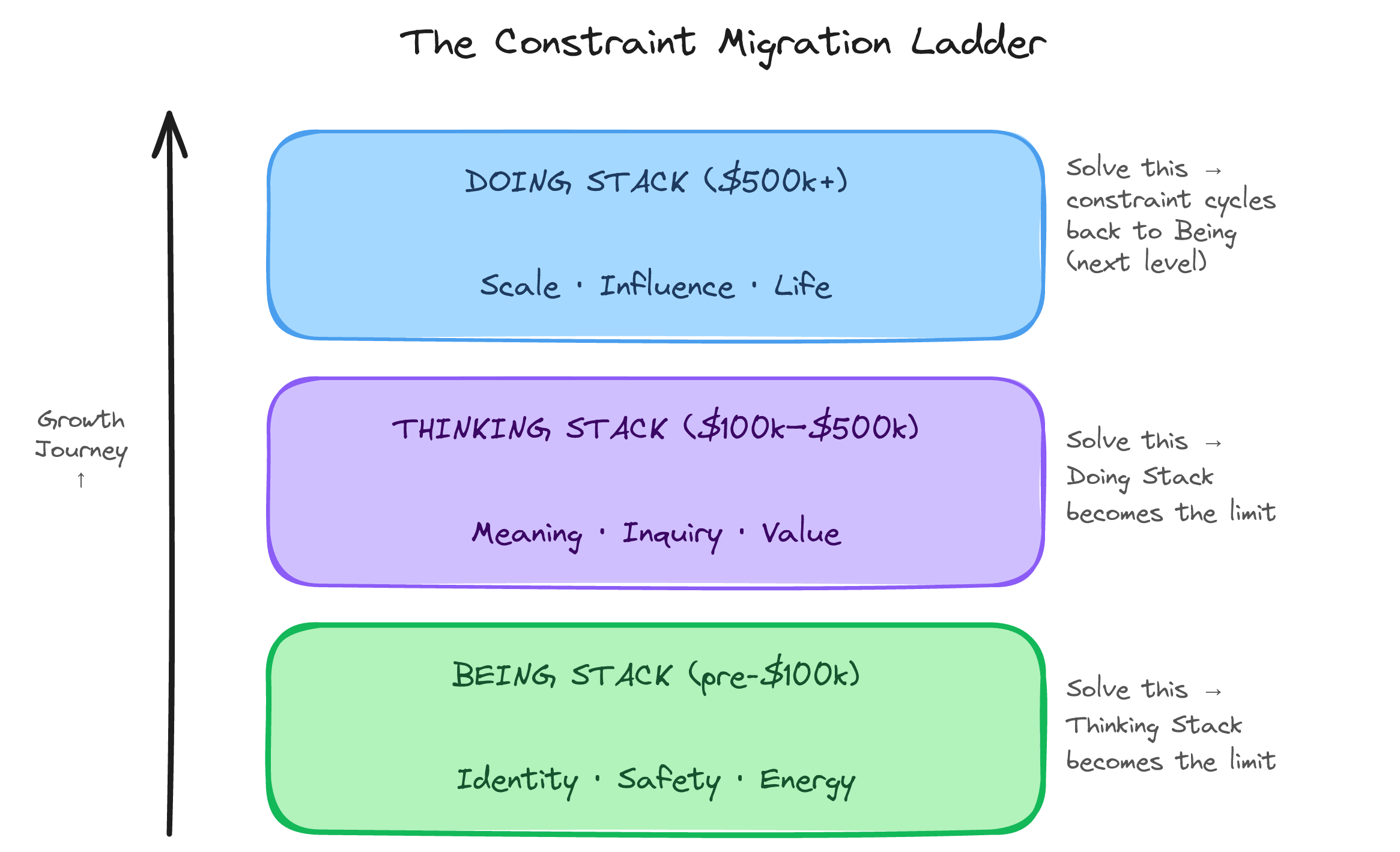
The Absolutely Awesome Framework maps constraint migration across the nine layers of the Being/Thinking/Doing stack. The pattern is consistent across hundreds of businesses.
At the early stages, roughly pre-$100k, the constraint almost always lives in the Being Stack. Identity (whether the founder believes they can do this), Safety (whether they’ll take the actions that feel risky), and Energy (whether they have the capacity to sustain consistent effort) are the primary limiting factors. More strategy at this stage rarely helps. The constraint is upstream.
Between $100k and $500k, the constraint typically migrates to the Thinking Stack. Meaning (why does this business exist?), Inquiry (are we asking the right questions about what the market actually needs?), and Value (are we pricing and positioning in a way that reflects what we deliver?) become the primary bottlenecks. The founder can execute, but they’re executing a partially-formed strategy.
Beyond $500k, the constraint often migrates to the Doing Stack. Scale (systems and processes), Influence (leadership and communication), and Life (sustainability and structure) are the challenges. The identity and thinking work has been done well enough. Now the question is whether the execution can match the vision.
And then, at the next level, the constraint migrates back to Being again. A more sophisticated version of the same question: can the founder hold the identity of leading a significantly larger business? This cycling is normal. It’s how growth actually works.
The Diagnostic Question to Ask at Each Stage
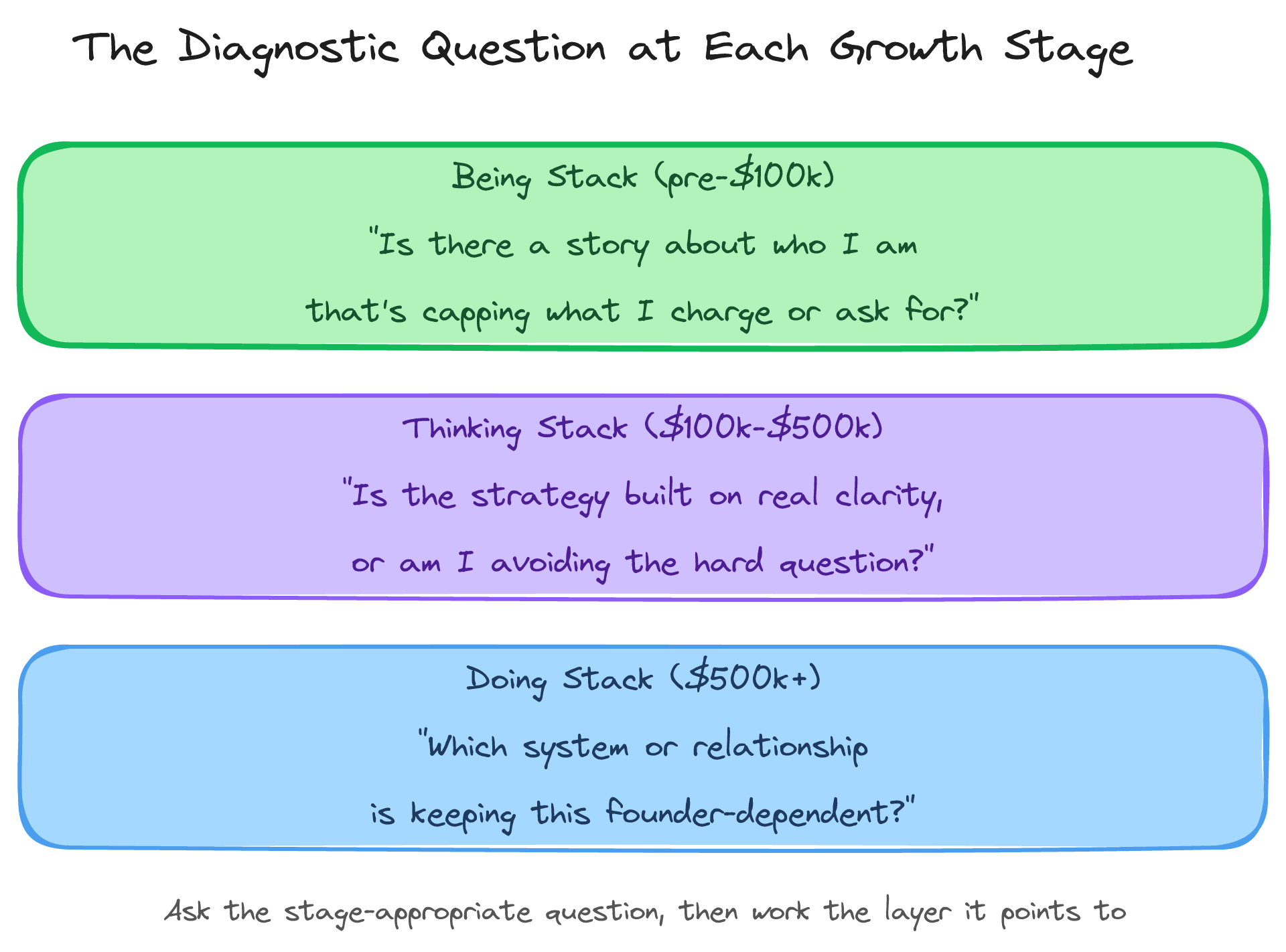
When a new constraint appears, the most useful question isn’t “how do I fix this?” It’s “which layer does this actually live in?”
Because the fix for a Being constraint looks completely different from the fix for a Doing constraint. If you’re undercharging and the underlying constraint is an Identity Ceiling (a Being layer issue), then hiring a better sales trainer (a Doing layer intervention) will produce marginal results. You’re working on the wrong layer.
This is the skip-layer failure problem. Solving the constraint at the layer where it appears, rather than at the layer where it lives, is why many well-resourced businesses stay stuck.
The Right Response When the Constraint Migrates
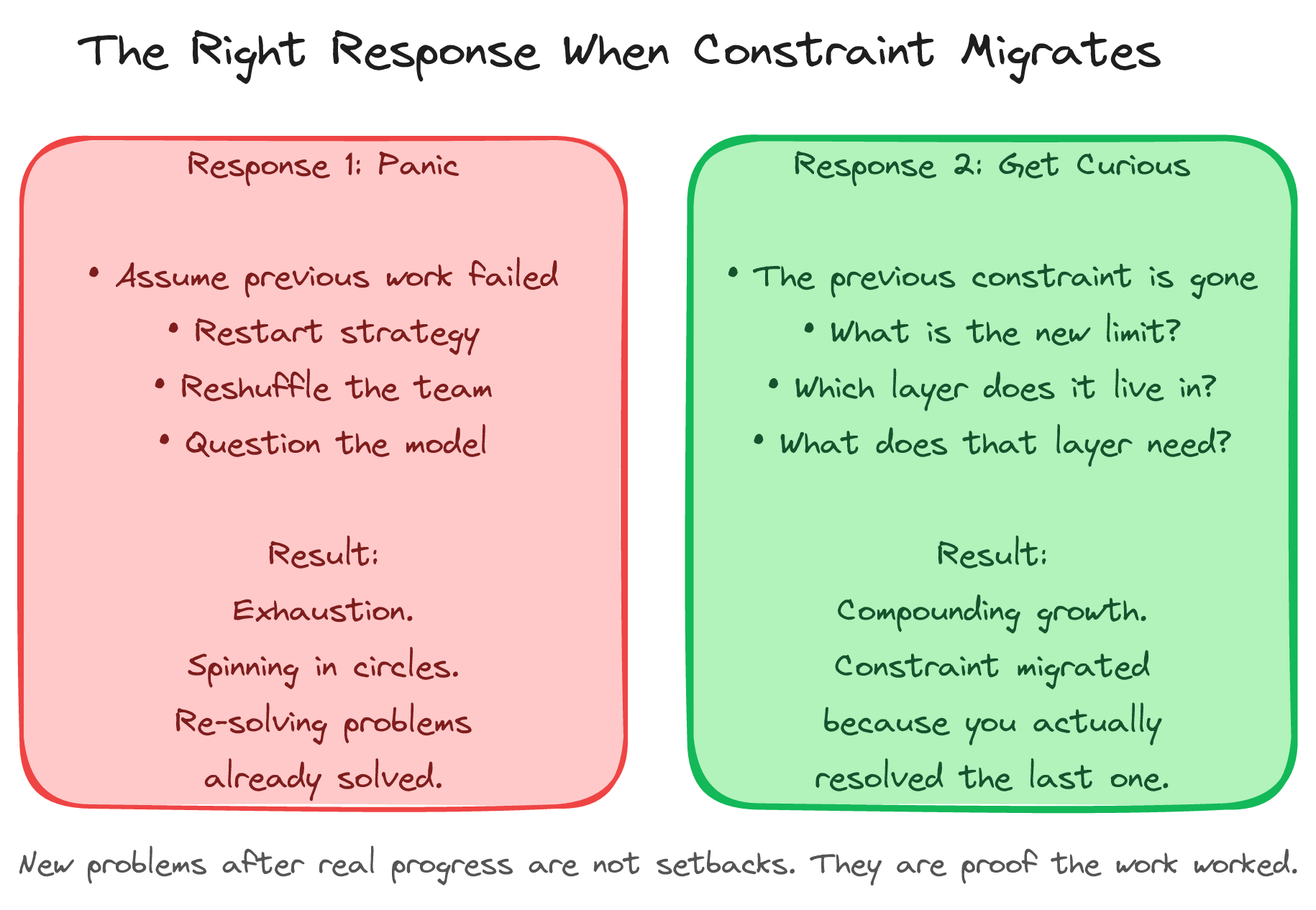
When a new constraint appears, there are two responses. Most founders choose the first one.
The first response is to panic, assume the previous work was wrong, and restart. The strategy changes. The team gets reshuffled. The business model gets questioned. Enormous energy gets invested in re-solving problems that were already solved, while the actual new constraint doesn’t get addressed at all.
The second response is to get curious. Something along the lines of: the previous constraint is gone. So what is the current limiting factor? Which layer does it actually live in? What would it take to address it at that layer?
The second response produces compounding growth. The first produces exhaustion and the appearance of spinning in circles.
Here’s what makes this genuinely hard: the new constraint usually looks like a failure of the previous solution. Your sales work succeeded, so now you have a delivery problem, but it presents as a delivery problem, so it looks like the business has a delivery problem that the sales investment didn’t fix. It takes some distance to see that you’re on the second constraint, not still fighting the first.
Harvard Business Review’s overview of the Theory of Constraints notes that most managers focus on local efficiencies rather than the system constraint, which means they improve parts of the system without actually moving throughput. The same pattern appears at the business level: founders fix the visible symptoms rather than finding the true constraint.
The Mindset Reframe That Changes Everything
Here’s the model that makes this workable.
Think of your business as a series of levels. Each level has one door. That door is locked by the current constraint. When you find the right key (the intervention that addresses the constraint at the right layer), the door opens and you move to the next level. That level has a new door, locked by a different constraint.
The goal is not to find a level without a door. There is no such level. The goal is to always know which door you’re working on, so you don’t spend your energy on the wrong walls.
Sophisticated problems are not bad news. They’re evidence that you’ve moved up a level. They deserve respect, not panic. They require diagnosis, not despair.
A Practical Diagnostic to Identify the Current Constraint
When a new problem appears, work through these three questions before you decide on a response.
Question 1: Where is it showing up? Name the layer as precisely as you can. Is this a revenue problem, a people problem, a systems problem, an identity problem? Get specific about where in the business the friction is appearing.
Question 2: Where does it actually live? Ask whether the layer where it’s showing up is really where the constraint lives. A revenue problem might actually live in pricing (Thinking Stack). A people problem might actually live in your tolerance for certain behaviours (Being Stack). A systems problem might actually live in clarity of vision (also Thinking Stack). Diagnose before you prescribe.
Question 3: What would it mean to address it at the right layer? Once you’ve identified the true layer, what’s the actual intervention? Sometimes the answer is operational. Often it’s not. Being willing to work at the layer where the constraint actually lives, rather than the layer where it’s visible, is the whole skill.
The constraint will migrate. It always does. The question is whether you meet the new constraint with a response that matches it.
Frequently Asked Questions
What is constraint migration in business?
Constraint migration is the predictable movement of a business’s primary bottleneck as each constraint gets resolved. Based on Goldratt’s Theory of Constraints, it describes why solving one major problem reveals the next limiting factor in the system. It’s not failure. It’s how growth works.
Why do I keep hitting new problems every time I solve the last one?
Because that’s what progress looks like. Every constraint you remove reveals the next one. The fact that your problems are changing means you’re actually moving forward. If you had the same problems year after year, that would be the concerning sign.
How do I know which layer my current constraint lives in?
Use the diagnostic: where is the problem showing up, and is that actually where it lives? Sales underperformance can live in the Being Stack (Identity Ceiling, undercharging), the Thinking Stack (unclear value proposition, wrong positioning), or the Doing Stack (poor follow-up process, inconsistent activity). The visible symptom and the real constraint are often in different places.
Is it possible to address constraints out of order?
You can try, but the results tend to be poor. Applying a Doing Stack solution to a Being Stack constraint is like fixing the symptoms of an illness without treating the illness. Results improve temporarily, then the original constraint reasserts itself. Accurate diagnosis before intervention is what makes the work compound.
How long does it take to resolve a constraint at each stage?
It varies, but Being Stack constraints typically take longest because they involve identity and belief change. Thinking Stack constraints can shift relatively quickly with good inquiry and outside perspective. Doing Stack constraints are usually the most operational and can often be addressed through systems and process work within weeks to months.