You’ve done everything right. You hired the consultant, redesigned the process, ran the training, relaunched the campaign. And for a few weeks, things looked like they were turning. Then the same problem came back.
Sound familiar?
This isn’t bad luck. It’s not a strategy problem. And it almost certainly isn’t a sign that you’re bad at business.
It’s Skip-Layer Failure. And once you understand it, you’ll see it everywhere.
What Skip-Layer Failure Actually Is
Skip-Layer Failure happens when you apply a solution at the layer where a problem appears, rather than the layer where it actually lives.
Every business problem has a presenting layer: the place where it shows up, where it’s visible, where it causes pain. But almost every business problem also has a root layer: the upstream constraint generating the symptom in the first place.
When the two layers are the same, your interventions work. You fix what’s broken, the problem goes away, and it stays gone. Most people assume this is always how it works.
But when the presenting layer and the root layer are different, when you’re solving a symptom that’s being caused by an upstream constraint you haven’t touched, you get something specific and predictable: temporary relief, then reversion. The symptom clears. The underlying constraint remains untouched. And the problem regenerates from the source.
That pattern of fix, improve, revert is the signature of Skip-Layer Failure.
It’s common, it’s expensive, and the reason it persists is that the symptom is real. The presenting problem isn’t invented. Sales really aren’t converting. The team really is underperforming. The founder really is burning out. So it makes complete sense to address those things. The problem is simply that you’re addressing them in the wrong place.
The Architecture Skip-Layer Failure Operates Within
To understand why problems almost always present downstream from where they live, you need to understand the architecture of the business itself.
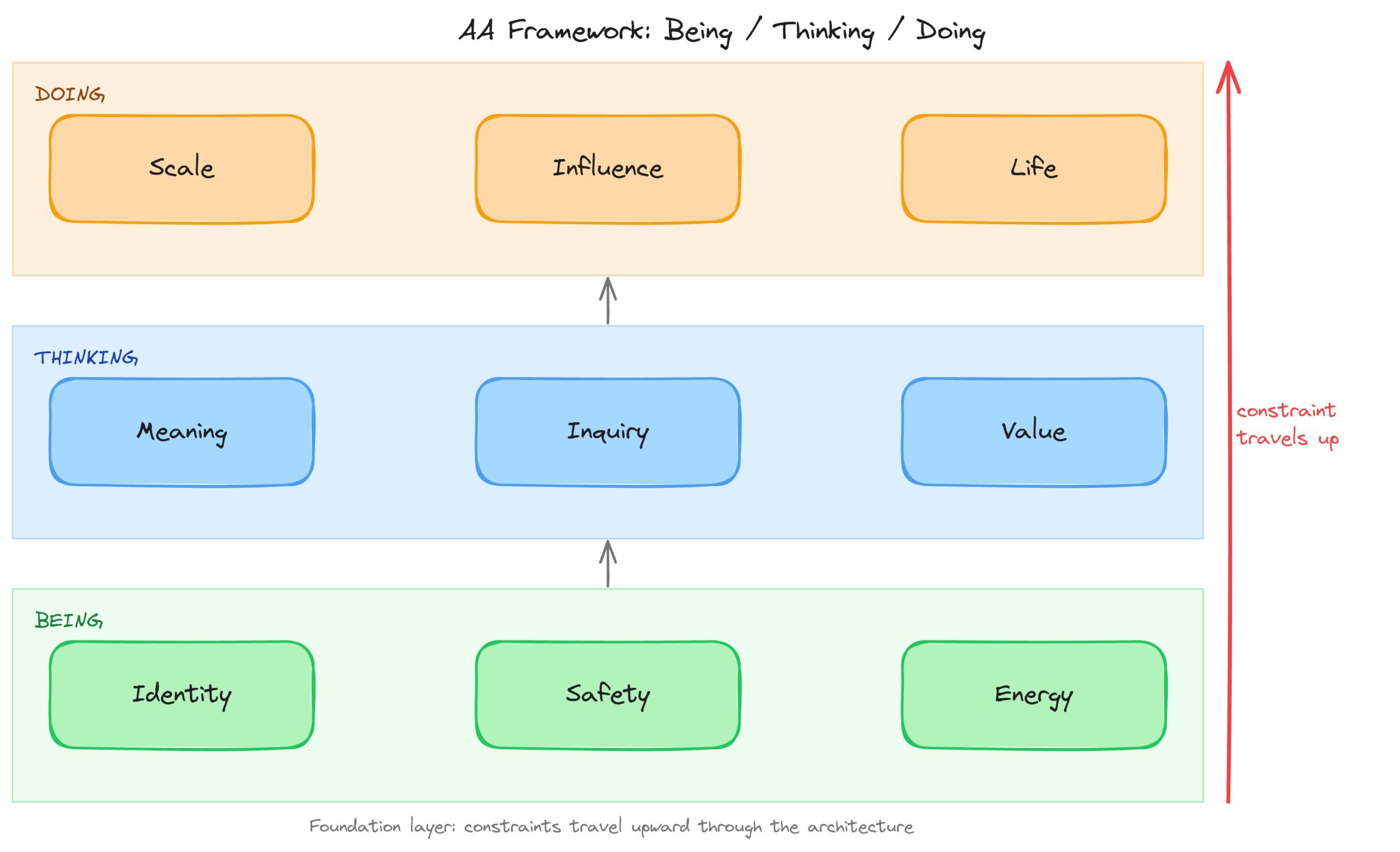
The Absolutely Awesome Framework maps every dimension of business across nine layers, organised into three stacks:
Being (Identity, Safety, Energy): the internal operating system of the founder and the people running the business. This governs who they believe they are, what feels psychologically safe, and the biological capacity available to hold pressure and make quality decisions.
Thinking (Meaning, Inquiry, Value): the strategic layer. Why the business exists, what questions it’s asking, and what transformation it creates for the people it serves.
Doing (Scale, Influence, Life): the execution layer. How the business grows, how it leads, and whether it becomes a living system or a founder-dependent machine.
The architecture flows in one direction: Being supports Thinking, Thinking supports Doing. Each layer depends on the stability of the layers beneath it.
This is why Skip-Layer Failure is so structurally inevitable. When a foundation layer is unstable, every layer above it is compromised. But the instability doesn’t show up at the foundation. It travels upward and expresses itself as a symptom in a higher layer. The higher the layer, the more tactical and fixable the problem appears. That’s exactly why people keep fixing the wrong thing.
You cannot sustainably resolve a constraint in a higher layer if the actual problem lives in a lower one. You can manage the symptom temporarily. But the constraint remains, the symptom regenerates, and the cycle continues.
Why Problems Always Present Downstream
There’s a specific reason constraints travel upward through the architecture before they become visible, and it’s worth understanding because it changes how you diagnose everything.
Lower-layer constraints don’t announce themselves clearly. An Identity constraint, like the belief that you aren’t worth charging more or that asking is pushy, doesn’t feel like an identity issue. It feels like caution. It feels like reading the room. It feels like being realistic about the market.
A Safety constraint in a team, like the invisible rule that says don’t be the person who brings bad news, doesn’t look like a psychological safety problem. It looks like a communication problem. Or a team culture problem. Or a management problem.
A Capacity Debt constraint in the founder, where the nervous system is so chronically depleted that decision quality has degraded, doesn’t present as an energy problem. It presents as confusion about strategy. Or avoidance of hard decisions. Or a persistent inability to see the path forward clearly.
Lower-layer constraints are invisible at their source and loud at their expression point. By the time you can see the problem, you’re already looking at it two layers too late.
This is what makes Skip-Layer Failure so persistent in smart, capable businesses. The people running them are genuinely good at solving problems. They just keep solving the ones they can see, rather than the ones that are actually there.
The Eight Most Common Skip-Layer Patterns
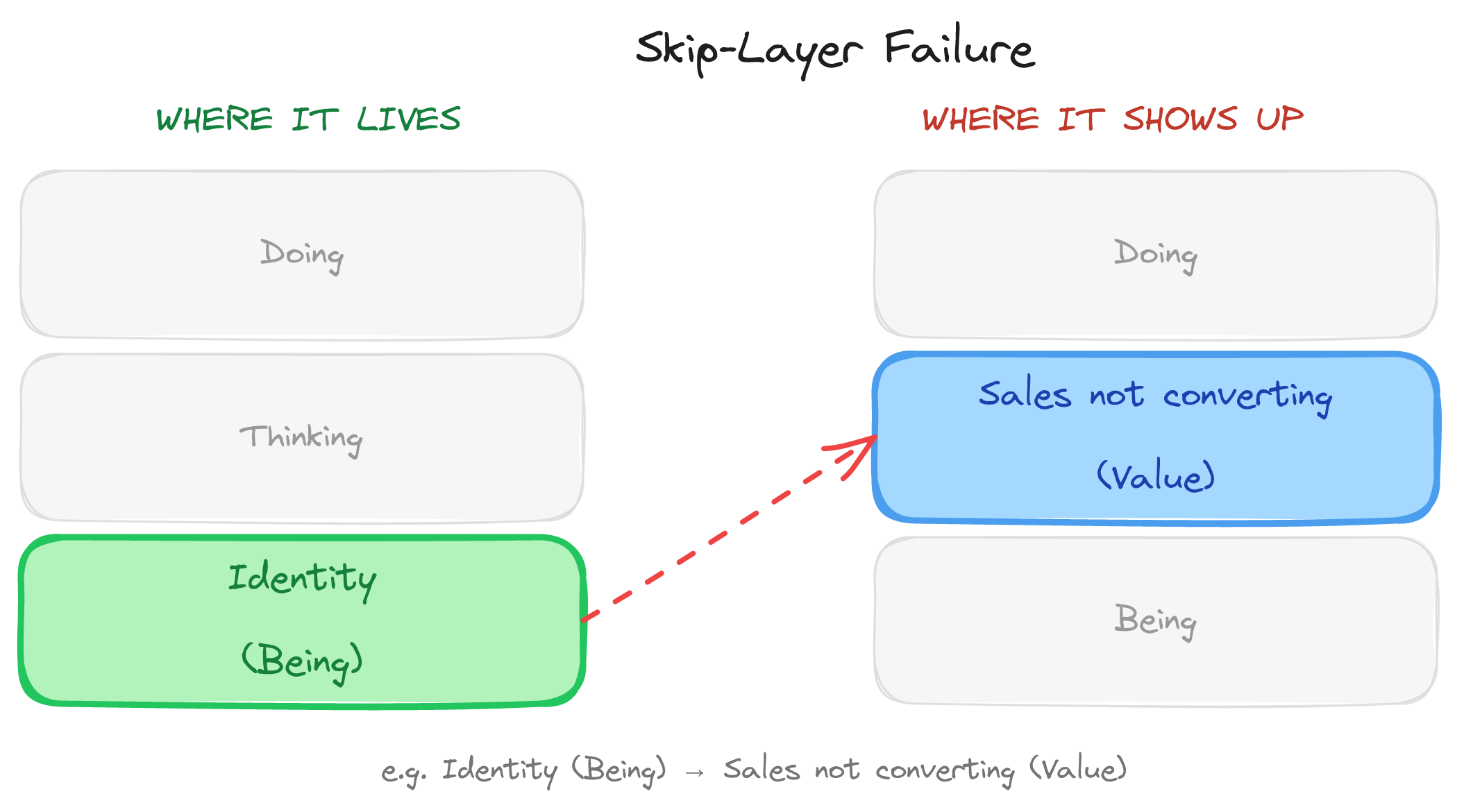
These are the patterns we see repeatedly across businesses at every stage and scale. In each case, the presenting problem is real. The apparent constraint is reasonable. But the actual root layer is upstream.
| Presenting problem | Apparent layer | Actual constraint |
|---|---|---|
| Sales not converting | Value | Identity: permission to ask, beliefs around worth |
| Team underperforming | Scale | Safety: fear of speaking up, unprocessed conflict |
| Founder burnout | Energy | Identity: worth tied to output |
| Strategy unclear | Meaning | Inquiry: wrong questions being asked |
| Growth plateaued | Scale | Energy: Capacity Debt limiting decision quality |
| Culture problems | Life | Safety: unresolved tension, no psychological safety |
| Can’t raise prices | Value | Identity: no internal permission to be worth more |
| Can’t delegate | Scale | Safety: trust issues, fear of loss of control |
The pattern across all eight is the same: the presenting problem sits in the Thinking or Doing stack, while the actual constraint lives in the Being stack. Tactics, strategy, and systems are all Thinking and Doing layer interventions. Which is why businesses that are rich in tactics keep stalling. They’re working two stacks above the real constraint.
Why Skip-Layer Failure Is So Hard to Catch
There are three reasons this pattern is so difficult to see, even for experienced operators.
The first is that the symptom is real and legitimate. When sales aren’t converting, the offer probably does need attention. When the team is underperforming, the systems probably do need improvement. The presenting problem is genuine. It’s just not primary. Treating it produces real, measurable improvement, which is exactly what makes it so easy to confuse with the actual fix.
The second reason is that lower-layer work feels uncomfortable and uncertain in a way that tactical work doesn’t. Redesigning a sales funnel is concrete, measurable, and external. Examining the beliefs driving your behaviour around asking for money is none of those things. So there’s a strong pull toward the tactical intervention, even when you suspect the constraint is deeper.
The third reason is what Constraint Migration does to the picture. When you do the right work at the right layer, the constraint resolves. Then a new constraint emerges at the next layer up. This feels like evidence that the work didn’t work. It isn’t. It’s the system progressing correctly. But if you don’t expect it, the reappearance of a problem after real work can push you back toward the tactical layer, where the interventions at least feel concrete.
All three of these forces push toward Doing-layer solutions. None of them are signs of incompetence. They’re structural features of how businesses experience their own constraints.
How to Diagnose Which Layer Your Constraint Lives In
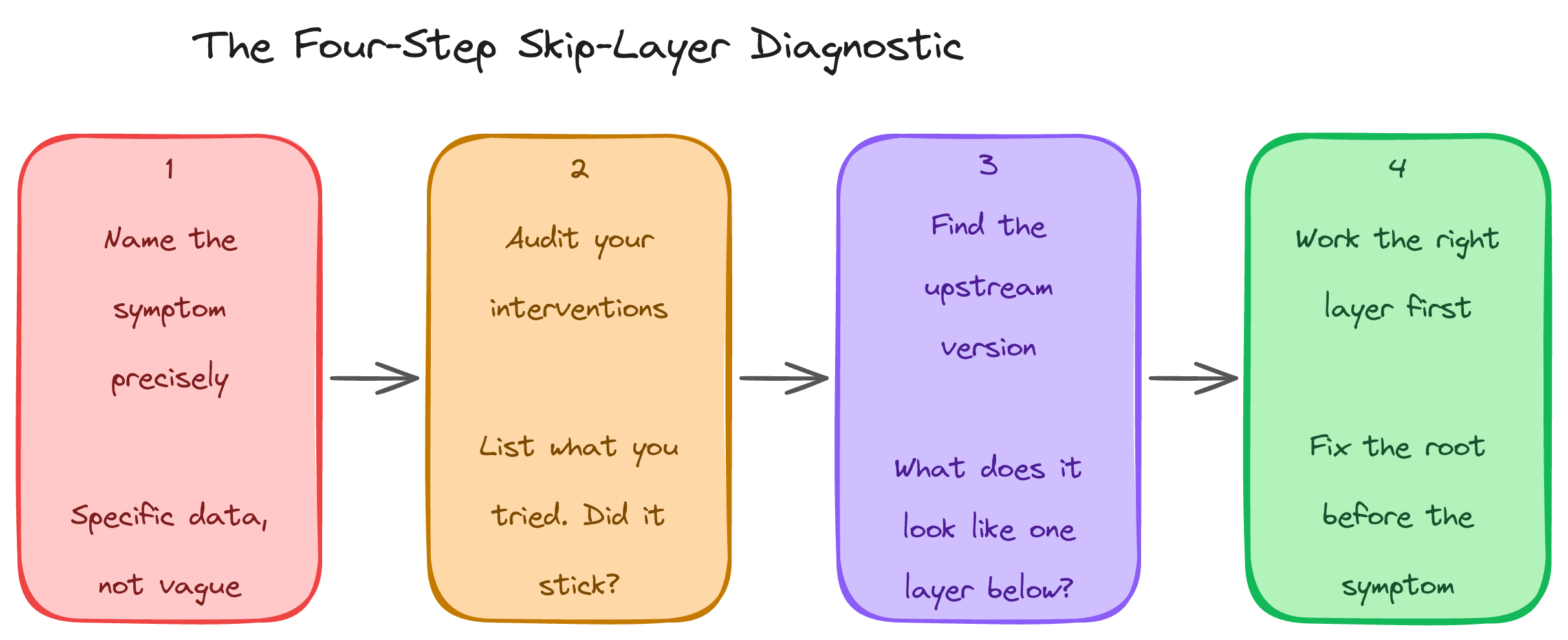
The diagnostic isn’t complicated, but it requires honesty about what you’ve already tried.
Step 1: Name the Symptom Precisely
Don’t generalise. “Things aren’t working” is not a diagnosis. “Our conversion rate on discovery calls sits at 11% despite three rounds of offer refinement over fourteen months” is. The more specific the symptom, the more clearly you can test whether you’re dealing with the presenting problem or the root constraint.
Step 2: Audit Your Interventions
List every meaningful intervention you’ve applied at the presenting layer over the last twelve months. Be honest about the results. If you’ve applied two or more reasonable, well-executed interventions and haven’t seen lasting change, the constraint almost certainly isn’t where you’ve been working. Persistent frustration after good-faith effort is the system’s clearest signal.
Step 3: Identify the Upstream Version of the Problem
For each layer the symptom is presenting in, ask: what would the version of this problem look like one layer below?
If it looks like a Value problem, ask what the Identity version would be. Is there anything about asking, worth, or permission that might be shaping your behaviour around this?
If it looks like a Scale problem, ask what the Safety or Energy version would be. Does the team feel safe enough to flag problems early? Does the founder have the actual capacity to make quality decisions in this domain consistently?
If it looks like a Thinking problem (unclear strategy, misaligned positioning, wrong priorities), ask what the Being version would be. Is there an Identity constraint around visibility, authority, or belonging in a certain category?
Step 4: Work the Right Layer First
Once you’ve identified the upstream constraint, work it before returning to the downstream symptom. This feels counterintuitive because the downstream problem is more visible and more urgent. But the leverage is upstream. Fix the root constraint, and the downstream symptom often resolves with far less effort than expected. Sometimes without any specific intervention at all.
A Note on Constraint Migration
One thing worth knowing before you start: resolving a constraint doesn’t eliminate constraint. It migrates it.
When the Identity constraint resolves, a Safety constraint may emerge. When Safety is solid, an Energy constraint may surface. When Energy is managed, a Meaning gap may appear. Each resolution reveals the next layer of constraint as the primary limiting factor.
This is not the system failing. It is the system progressing. Each migration means you’ve genuinely resolved the previous constraint and the business is now capable of operating at a level where a different layer becomes the bottleneck.
Expect it. When a new problem appears after real progress, resist the impulse to call it a setback. Ask which layer the constraint has migrated to, and work from there.
Where to Go From Here
The full Absolutely Awesome Framework maps all nine layers in detail, including the diagnostic tools, the progression logic, and the specific work that each layer requires.
If you want to see Skip-Layer Failure in action across a specific business function, this post on why your marketing often isn’t a marketing problem works through four detailed case studies using the same table above.
The starting point, as always, is the same: identify where the problem actually lives before you decide how to fix it.