Every week I meet a business owner who tells me the same thing.
“I use AI. I’ve got ChatGPT, I ask it stuff, it’s pretty useful.”
Every time I hear it, I think: that is like saying you own a Formula 1 car and use it to do the school run. You have the most powerful business technology in history at your fingertips. And you are typing questions into a chat box.
Most people using AI in business today are not using AI in business. They are using a slightly more sophisticated Google. The difference matters enormously, and the gap between where they are and where they could be is not a technical one.
After exiting Oh Crap, the sustainable dog waste brand I grew over nine years into Australia’s market leader, I set out to build something I haven’t truly seen done well before: a zero-employee, AI-first business powered by agents rather than headcount. What I built, rebuilt, and rebuilt again over hundreds of hours taught me something I could not have learned any other way.
The model is never the bottleneck. The system is.
There is a five-stage maturity ladder between “ChatGPT user” and “AI-first company.” Most business owners are stuck on rung one or two with no map for the climb. By the end of this post you will have a clear diagnosis of where your business sits right now, and the exact next step to move up.
Why most AI advice keeps you stuck at Stage 1
The problem with 95% of AI content for business owners is that it focuses on prompts.
“Use this prompt to write your emails.” “Try this template for sales calls.” “Here are 47 ChatGPT prompts for entrepreneurs.”
This advice is not wrong. It is just solving the wrong problem. A prompt is a one-time instruction. It tells the AI what to do once, in this conversation, right now. When the conversation ends, the AI forgets everything. Next session, you start from zero. The prompt gets you a better output today but does nothing to build a more capable system tomorrow.
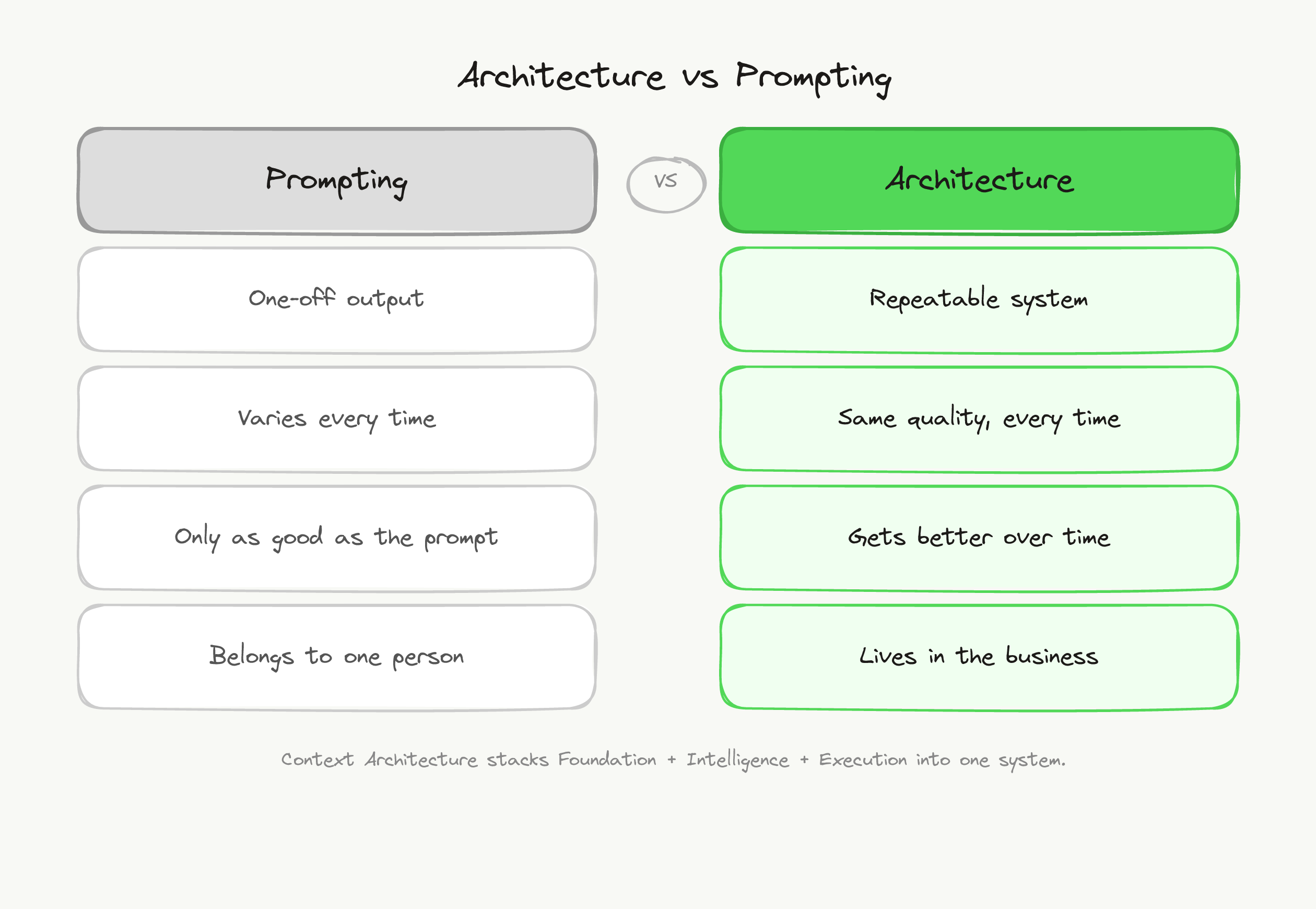
The businesses that are winning with AI have stopped optimising prompts. They have started building architecture.
As Tobi Lütke, Shopify’s CEO, observed in 2025, the skill that actually matters is “context engineering over prompt engineering: the art of providing all the context for the task to be plausibly solvable by the LLM.” Prompt engineering is a writing skill. Context engineering is an architecture skill. And the gap between them is where most AI initiatives go to die.
The architecture vs prompts distinction
You can be a world-class prompt writer and still run a Stage 1 business. The prompts get better outputs from the same broken system. Architecture changes what the system is capable of altogether.
This distinction maps directly onto the Context Architecture Method I developed after building the Awesome OS. The framework explains the technical layer beneath all of this. This post is not that blueprint. It is the field manual: the practical journey from where most business owners start to where the best ones are heading.
The five stages below describe that journey as I have observed it across dozens of founders, operators, and businesses. Read them, diagnose yourself honestly, and find your next step.
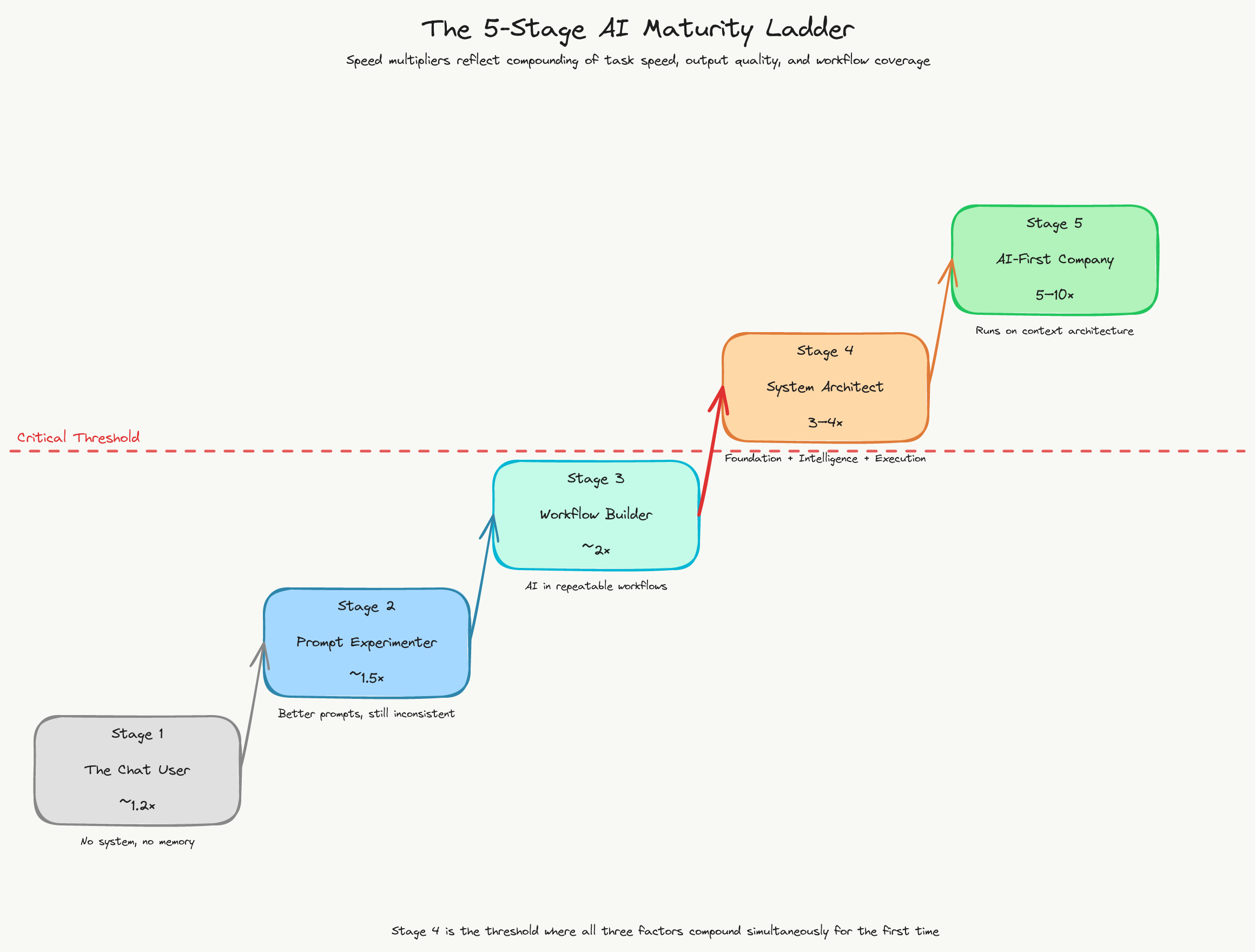
The 5-stage AI maturity ladder
Most businesses sit at Stage 1 or 2. Stage 3 is where AI starts delivering real wins on defined tasks, but those wins are additive, not compounding. The compounding only begins at Stage 4. That is where the gap between your business and everyone else’s starts to widen every single week, and why Stage 4 is the threshold that actually changes the trajectory of a business.
You do not need to reach Stage 5 to change your business. You need to reach the next stage above where you are now.
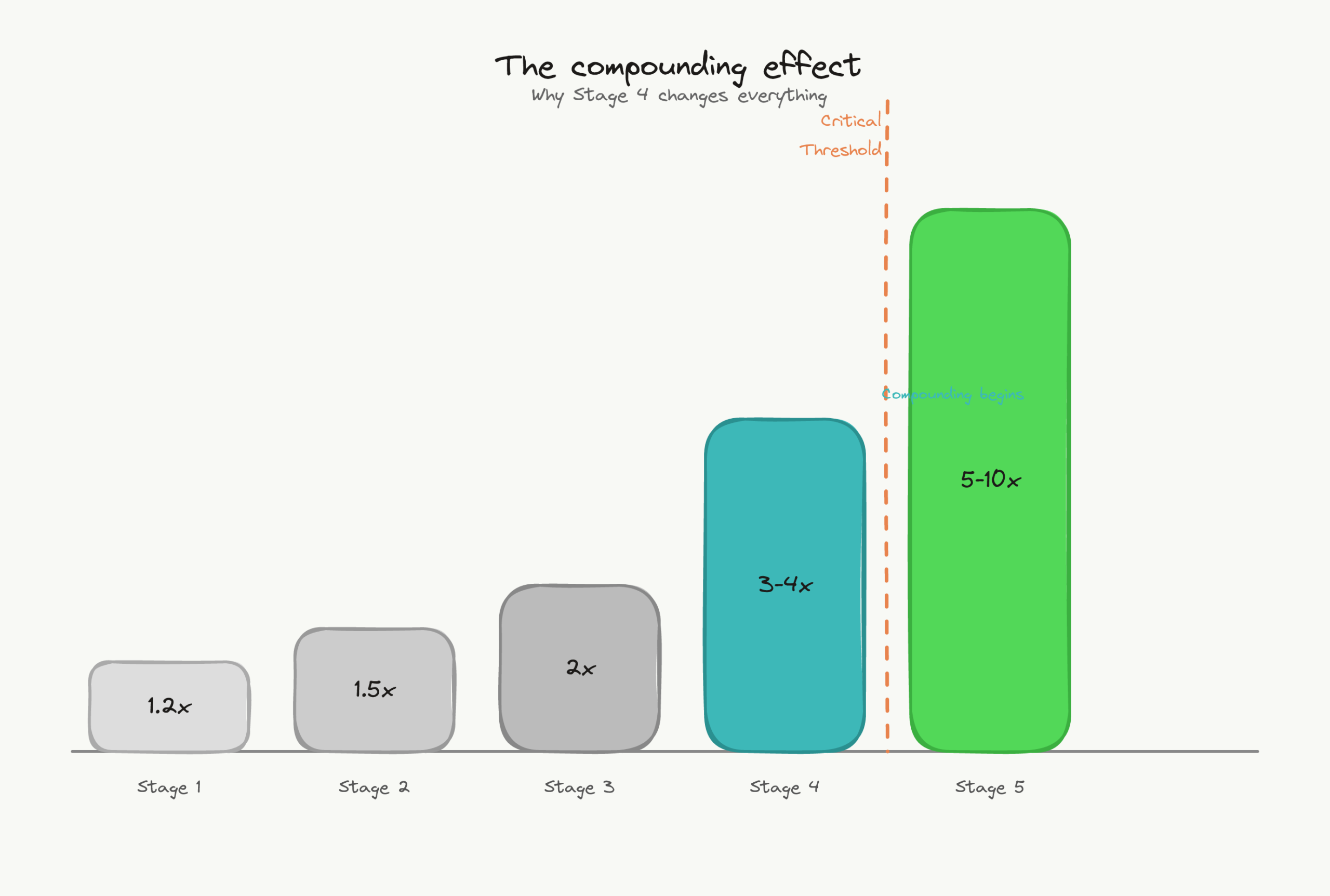
Each stage carries a velocity multiplier: a rough estimate of how much more your business can produce compared to a Stage 1 baseline. These are not arbitrary numbers. They reflect three factors that compound differently at different stages.
The first factor is task speed: how much faster you complete a piece of work. The second is output quality: how little editing the result needs before it is usable. The third is workflow coverage: what proportion of your total work AI is actually helping with at all. At Stages 1 and 2, only speed is affected, and only on the tasks you happen to use AI for. Coverage stays low, editing stays high, and the net gain is real but modest.
Stage 3 expands coverage across defined workflows, pushing toward 2×. But because each workflow runs in isolation, the gains stay additive rather than multiplicative. You plateau.
The Stage 3 to Stage 4 transition is the critical threshold. It is the first point where all three factors compound simultaneously. Strong context means coverage expands naturally across most workflows. Strong architecture means editing time collapses. And because the system improves over time rather than staying static, speed compounds without additional effort. That structural shift is why the jump from 2× to 3-4× is so significant, and why Stage 4 represents a genuine step-change rather than another incremental gain. Stage 5 adds a fourth factor: delegation. Humans step back from the execution layer entirely and focus on strategy and direction. That is where the 5-10× ceiling becomes realistic for a well-run AI-first operation.
Stage 1: The Chat User
This is where almost everyone starts. You open ChatGPT or Claude, type a request, get a response, and use it or move on. No system, no memory, no defined identity. Every conversation begins from absolute zero.
In practice, this looks like typing the same context into every new chat because the AI has no memory of previous sessions. You rewrite prompts hoping for better results without understanding why some work and some do not. Your team each has their own prompting style with no consistency between them.
The business cost is simple: every token you spend is wasted context. The AI knows nothing about you, your business, your voice, your standards, or your customers. It is producing generic output because it has only generic information to work with.
The Stage 1 to Stage 2 action
Write one paragraph defining who your AI is when it speaks on behalf of your business. What is its role? What tone does it use? What does it never say? That paragraph is the seed of what I call a Context Constitution, and it is the most valuable thing you can do this afternoon.
Stage 2: The Prompt Experimenter
You have discovered that how you ask matters. You save good prompts. You share them with your team. You probably have a Notion page, a Google Doc, or a Slack channel titled “Best Prompts.” Occasionally, the results are excellent. Overall, they are inconsistent.
In practice, you have a prompts library but it has no underlying logic: just a collection of phrases that worked once. You get wildly different quality between sessions even when you try the same prompt twice. The outputs still feel generic even when you add specific instructions.
The cost is real time spent on what I call prompt archaeology: digging through your collection trying to find the version that worked last time. And because the AI still knows nothing about your business, everything it produces still requires significant human review and editing.
McKinsey’s 2023 analysis of generative AI’s economic potential found that the companies capturing the most value from AI were not the ones with the best tools. They were the ones with the most structured integration. Prompts are not integration. They are improvisation.
The Stage 2 to Stage 3 action
Stop saving prompts. Start writing system instructions. The difference is fundamental: a prompt tells the AI what to do once. A system instruction tells the AI what it is, always. That shift in thinking changes everything.
Stage 3: The Workflow Builder
You have moved from ad hoc interactions to embedded workflows. AI is saving you real time on defined, repeatable tasks. You have custom instructions set up in your tools, you use templates, and some team members are ahead of others. You are producing consistently useful outputs in at least two or three core areas.
In practice, AI saves you real time on defined tasks like drafting, summarising, or research. But each workflow operates in isolation. The AI does not carry what it learned in one workflow into another. Your content agent does not know what your customer service agent discovered. Every workflow is a standalone tool rather than part of a connected system.
The result is siloed efficiency. You are getting individual wins but no compounding. The system is not getting smarter because the system does not actually know anything yet. It is still borrowing context from scratch each time.
The Stage 3 to Stage 4 action
Run a Context Audit. Ask yourself: what does an AI system need to know to serve my business well? Map the knowledge first, not the tasks. The question is not “what workflows do I want to automate?” It is “what does my business know, and where does that knowledge currently live?” Most of the time, the answer is: in people’s heads, scattered across documents, and completely inaccessible to any AI system.
Stage 4: The System Architect
This is the threshold stage. You have a defined Foundation Context covering your identity, voice, and non-negotiable principles. You have an Intelligence Layer: a structured knowledge base your AI can actually access. You have consistent Execution templates for your highest-volume tasks. AI outputs require minimal correction. Your team works from a shared context rather than individual prompts.
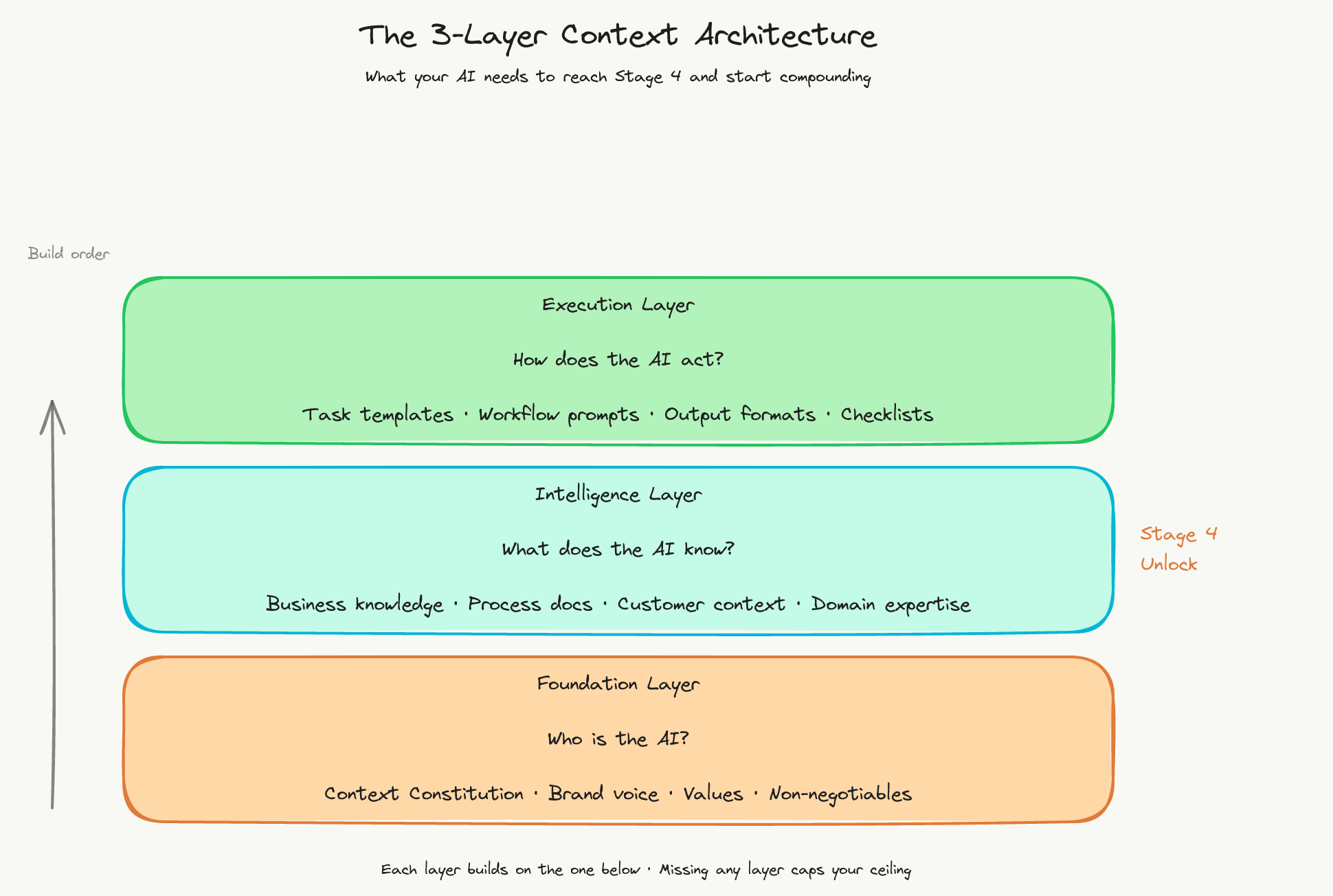
In practice, AI outputs are consistently on-brand without heavy editing. New team members can get AI-ready quickly using the same system everyone else uses. You have a clear sense of what your AI “knows” and, just as importantly, what it does not.
This is where Ethan Mollick’s research on human-AI collaboration becomes viscerally real for your team. His work shows that the biggest gains from AI come not from replacing humans but from augmenting them, specifically when the AI has enough context to operate at the edge of human capability rather than well below it. Stage 4 is where that augmentation actually begins.
The next constraint to watch for is entropy. Your system is static. It reflects the business as it was when you built it, not as it is today.
The Stage 4 to Stage 5 action
Appoint a Context Steward: a named person whose job is to own and evolve your context architecture. Establish a weekly review cadence. Start mining your most successful AI interactions as training material for improving the system. The architecture needs a caretaker, or it will quietly decay.
Stage 5: The AI-First, Token-First Company
At this stage, AI is not a tool the business uses. It is the infrastructure the business runs on. Every significant workflow has a context architecture behind it. The system monitors its own performance, identifies gaps, and improves continuously. Humans are supervisors, directors, and decision-makers, not executors of routine tasks.
In practice, your best AI outputs require almost no editing. Your context architecture outlasts and outperforms any individual model you use, which means when Anthropic or OpenAI releases a better model, you simply plug it in and the system improves overnight. Your knowledge base is a competitive asset that actually belongs to you: a competitor could not replicate it by choosing the same tools, because the tools are a commodity. The context is yours.
And this is not about running your business with fewer humans. It is about every human in your business operating at five to ten times the impact they have today. The tokens-or-humans debate resolves here: you need both. More humans doing higher-order work, supported by deep AI infrastructure that handles the execution layer.
For a deeper look at that question, the Tokens or Humans post makes the philosophical case for why this is the direction every serious business is heading.
Where do you sit right now? A quick self-assessment
Work through these five questions honestly. Each one points to a specific stage.
1. Does your AI know who it is when it works for your business?
If your AI has no written identity, no defined voice, and no stated principles, you are at Stage 1 or 2.
2. Do you have written system instructions, or just saved prompts?
If the answer is “saved prompts,” you are at Stage 2. System instructions that define what your AI is, not just what it should do, are the Stage 3 unlock.
3. Does your AI have access to your actual business knowledge?
If your AI cannot access your documents, your processes, your history, or your customer data, you have hit the Stage 3 ceiling. Good workflows without connected knowledge will always plateau.
4. Do you have a named person responsible for the quality of your AI context?
If no one owns it, no one maintains it, and you are stuck between Stage 3 and Stage 4.
5. Does your AI system improve automatically from its own interactions?
If the answer is no, you are at the Stage 4 ceiling. The system is static. It reflects a snapshot of your business, not the living, changing reality of it.
Reading your results
If you said no to questions 1 and 2, you are at Stage 1 or 2. Welcome to the majority. The good news is that Stage 2 to Stage 3 is a short sprint: an afternoon for a small business, a few focused days for a larger one.
If you said yes to questions 1, 2, and 3 but no to 4 and 5, you are at Stage 3. You have real AI wins. The Critical Threshold sits right above you. This is actually the most common place for AI progress to stall permanently, because the wins feel real enough that most businesses stop pushing.
If you said yes to all five, you are at Stage 4 or beyond. The question now is: what is the next constraint holding your system back from compounding?
The 90-day roadmap to Stage 4
Stage 4 is the game-changing threshold. Below is the practical sprint to get there. Not abstract advice; the actual sequence.
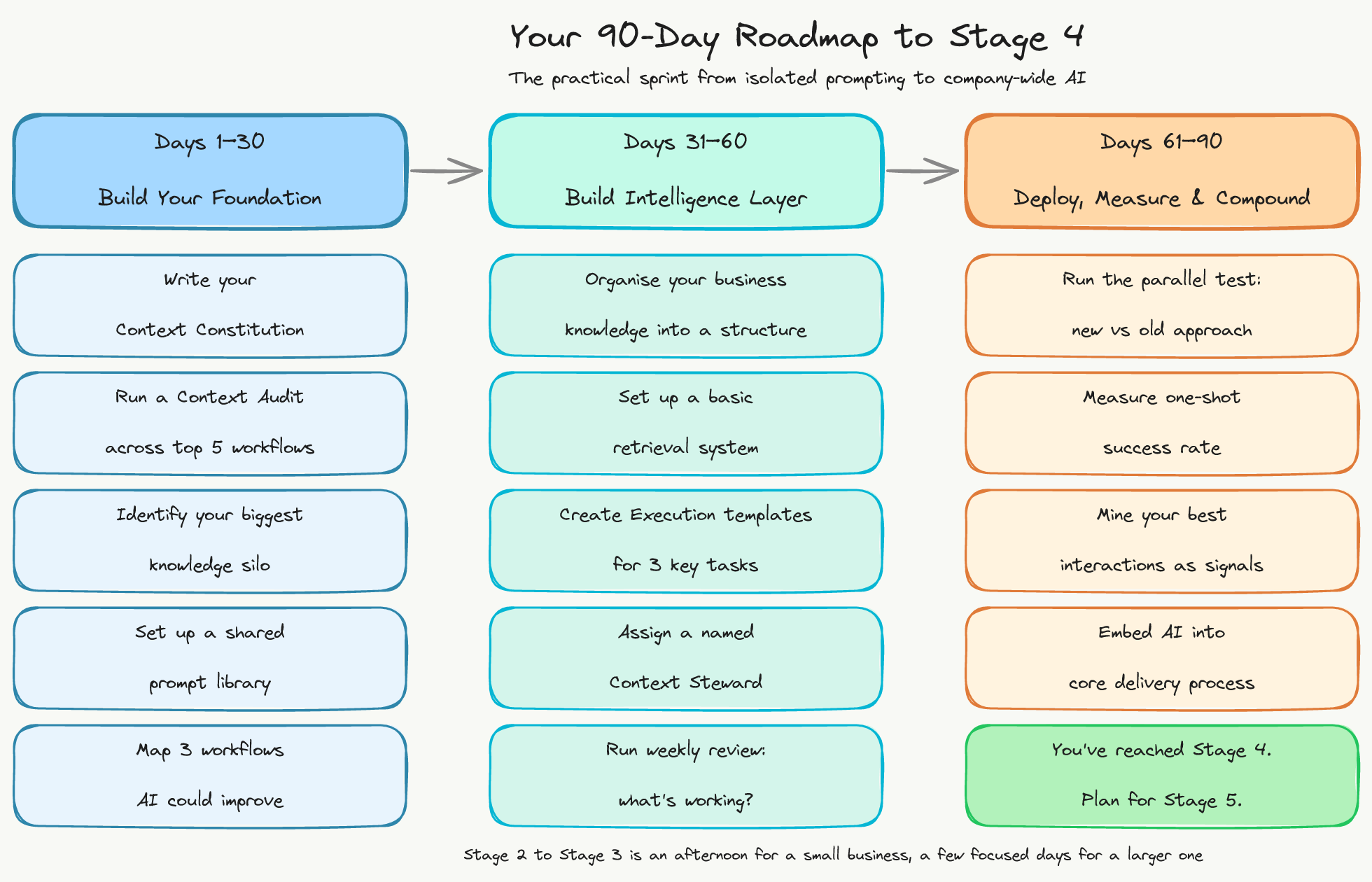
Days 1 to 30: Build your foundation
The Foundation is your AI’s identity. Without it, every output is generic because the AI has no idea who it is or who you are.
Write your Context Constitution
This is a 500 to 1,500-word document covering your brand voice, your values, your non-negotiables, words and phrases you never use, examples of great work, and examples of what “off-brand” looks like. Length matters less than specificity. A focused 600-word constitution built from real examples and concrete do/don’t pairs will outperform a vague 1,500-word one full of adjectives every time. Start lean and build it up as you learn what the AI needs from you. When I built my first Context Constitution, the improvement in AI output quality was immediate and dramatic. The model had not changed. What it knew had.
Run a Context Audit across your top five workflows
For each workflow, ask: what does the AI need to know to succeed here, and does it currently have that information? In most cases, the answer to the second question is no.
Identify your biggest knowledge silo
Where is the most valuable business knowledge currently locked away in a document, a person’s head, or a folder no AI system can reach? That silo is your biggest opportunity.
Days 31 to 60: Build your intelligence layer
The Intelligence Layer is where your business knowledge becomes accessible. This is the phase most businesses skip entirely, which is exactly why most businesses plateau at Stage 3.
Organise and connect your existing business knowledge
You do not need to build a vector database on day one. Even a well-structured folder system, consistently organised, is a meaningful step forward. The goal is to create a knowledge architecture your AI systems can actually navigate.
Set up a basic retrieval system
For many small businesses, this starts with a well-maintained knowledge base in Notion, a structured library of reference documents, or a simple folder hierarchy your AI tool can be directed to. The sophistication of the retrieval system can grow over time. What cannot wait is the organisational work of actually structuring the knowledge.
Create Execution templates for your three highest-volume tasks
An Execution template is not a prompt. It is a full context assembly: the Foundation (who the AI is), the relevant Intelligence (what it needs to know for this specific task), and the task definition (what it needs to do right now). Building three of these thoroughly will teach you more about context architecture than any amount of reading.
Days 61 to 90: Deploy, measure, and compound
This phase is about running the new architecture in parallel with the old approach, measuring the difference, and systematically improving based on what you find.
Run the parallel test
Run your three workflows on the new architecture alongside the old approach for two weeks. Measure one-shot success rate (how often does the output not need significant editing?), human correction rate (how much time are you spending fixing AI output?), and time per task.
Mine your best interactions
When an AI output is excellent, treat it as a training signal. What was in the context that made it work? Add that pattern to your Context Constitution or your Execution templates.
Keep updating the Constitution
It is a living document. The version you write in Week 1 improves significantly by Week 12 when you start feeding real production experience back into it.
Appoint your Context Steward
This is the most important structural decision of the sprint. Name a person. Give them responsibility for context quality. Without a named owner, the architecture will quietly degrade through what I call Context Entropy: the inevitable decay of context quality as the business changes but the system stays frozen.

The honest truth about where AI transformations actually stall
The Stage 2 trap: it’s not technical, it’s identity
It is not technical. It is identity.
The businesses that stall at Stage 2 almost always have unclear answers to the same foundational questions. What does this business actually stand for? What is our voice, really? What decisions would we never make, regardless of the opportunity?
If you cannot answer those questions for a new human employee on their first day, you cannot answer them for an AI system. The Context Constitution is not a technical document. It is a values document expressed in a format that AI can use. And if the underlying values are fuzzy, the Constitution will be fuzzy, and the outputs will be fuzzy, no matter how carefully you structure it.
The identity problem at the root of AI disappointment
I have worked with founders who are frustrated with AI because “it never sounds like us.” When I dig into what context they are giving their AI, the answer is always the same: none. The AI sounds generic because it has been given nothing to work with but a generic request.
This is also why research from the University of Washington presented at NeurIPS 2025 was so significant. The researchers found that across more than 70 language models from every major provider, the outputs to open-ended questions were strikingly similar regardless of which model produced them. They called it the Artificial Hivemind effect. Without distinctive context, every AI system converges on the same output.
The only escape from the hivemind is your context. Your knowledge, your voice, your methodology, your principles. That is something no competitor can replicate by choosing the same model or the same tools.
This is why the Context Architecture Method starts with Foundation. Not because it is a technical decision, but because it is a values decision. The business that knows who it is can build a context architecture that reflects that. The business that does not know who it is will keep getting generic outputs and wondering what is wrong with the tool.
Nothing is wrong with the tool. The tool needs to know who you are.
The Stage 3 trap: the comfortable plateau
Stage 3 is actually the most dangerous resting point on the ladder. You are getting real AI wins. Specific workflows are faster. You feel ahead of the curve because, relative to most businesses, you are.
That comfort is the trap.
Stage 3 businesses produce at roughly 2× their baseline. That is real progress. But crossing to Stage 4 requires upfront work without an immediate visible payoff: building an Intelligence Layer, connecting workflows through shared context, appointing someone to own the architecture. Most businesses at Stage 3 accept the plateau because 2× already feels like success. And the gap between them and Stage 4 businesses starts compounding in the wrong direction every quarter.
The Critical Threshold is not technically hard to cross. It is psychologically hard, because it requires deciding that good is not good enough.
Where to go from here
Two paths from here, depending on where you are.
If you want to go deeper on the technical framework, the Context Architecture Method post lays out the full three-layer system in detail: Foundation, Intelligence, and Execution context, plus the five phases for building and compounding the architecture over time. It is the blueprint beneath everything described in this post.
If you want the bigger picture on where this is all heading, Tokens or Humans makes the philosophical and commercial case for why every serious business will eventually be an AI-first business, not because it is fashionable, but because the economics are simply irresistible.
And if you want to work through this directly, reach out. I work with a small number of founders and operators on building their context architecture from the ground up.
The most important thing to take away depends on where you sit on the ladder. If you are at Stage 1 or 2, the move to Stage 3 is closer than it looks. For a small business, it is an afternoon’s work. Write one document. Run one audit. That is enough to start. If you are already at Stage 3, the work ahead is different: it is the architecture work of building your Intelligence Layer, connecting your workflows through shared context, and appointing someone to own it. That is what crossing the Critical Threshold actually requires. Either way, the compounding takes care of the rest once you move.
Frequently asked questions
Do I need a technical background to implement this?
No. The Context Architecture Method is designed to be implemented by operators, not engineers. The Foundation Context is essentially a Word document. The Intelligence Layer can start as an organised folder system. Technical complexity is optional and comes much later in the journey. Stages 1 through 3 require no technical skills at all.
How much does this cost to implement?
Stages 1 through 3 cost nothing except time. Stage 4 typically involves some tooling, such as a basic retrieval system or knowledge base, and entry-level options start at under $50 per month. Stage 5 is where infrastructure investment scales, but by that point the return on investment is clearly visible and justifiable.
What if my team is not on board?
Start with your own work. Build a personal Context Constitution and one well-designed workflow that produces visibly better outputs than what you were getting before. That single demonstration is more persuasive than any argument you could make in a meeting. Show, do not convince.
Is this only relevant for tech companies?
Not at all. The earliest and most dramatic wins from context engineering tend to come in professional services, content businesses, and client-facing roles: precisely the industries where voice, institutional knowledge, and consistency matter most. If your business depends on communication quality and domain expertise, you are in the sweet spot.
What is the single most important thing I can do today?
Write your Context Constitution. One document, 500 to 1,500 words, covering who your AI is when it speaks for your business. It will change your AI outputs immediately. And it will be the foundation every other improvement is built on.