Here’s a pattern I keep seeing across businesses right now.
Leadership comes back from a conference, or reads a headline, or finally tries one of the big AI tools for the first time. They’re genuinely excited. Within weeks they’re using it for emails, meeting summaries, strategic planning sessions, research. They feel more productive than they have in years. They recommend it to the team. They sign up for an enterprise plan.
Then six months pass.
And when someone actually looks at the numbers, almost nothing has changed. Revenue is flat. Costs are unchanged. Productivity metrics look exactly as they did before the AI subscription started. The CEO is bewildered because, from where they sit, the thing has been genuinely transformational. The team is quietly confused because, from where they sit, almost nothing is different.
This isn’t bad luck. It’s not a slow adoption curve. It’s a structural mismatch between where AI naturally performs best and where business value actually gets created. And until you can see it clearly, no amount of “getting the team to use AI more” will fix it.
Why AI was built for the boss’s job
There’s a reason your CEO adopted AI faster than anyone else on the team. It’s not that they’re more tech-forward. It’s that AI does almost exactly what executives do all day.
Think about the actual work at the top of most organisations. You read reports and form views. You attend meetings and synthesise what’s discussed. You write communications that set direction. You take disparate pieces of information and make decisions from them. Almost everything a senior leader does is fundamentally an information-processing task: consume, interpret, summarise, and respond.
And AI is extraordinarily good at that.
It reads a 40-page strategy document and pulls out the three things that matter. It synthesises a week of customer feedback into clear themes. It drafts a board update from bullet points in four minutes. For anyone whose work is largely about managing information and communicating clearly, AI is a genuine force multiplier right now.
The synthesis trap
The problem is that most businesses have confused “AI is great at synthesis” with “AI is great for business.” Those are not the same thing.
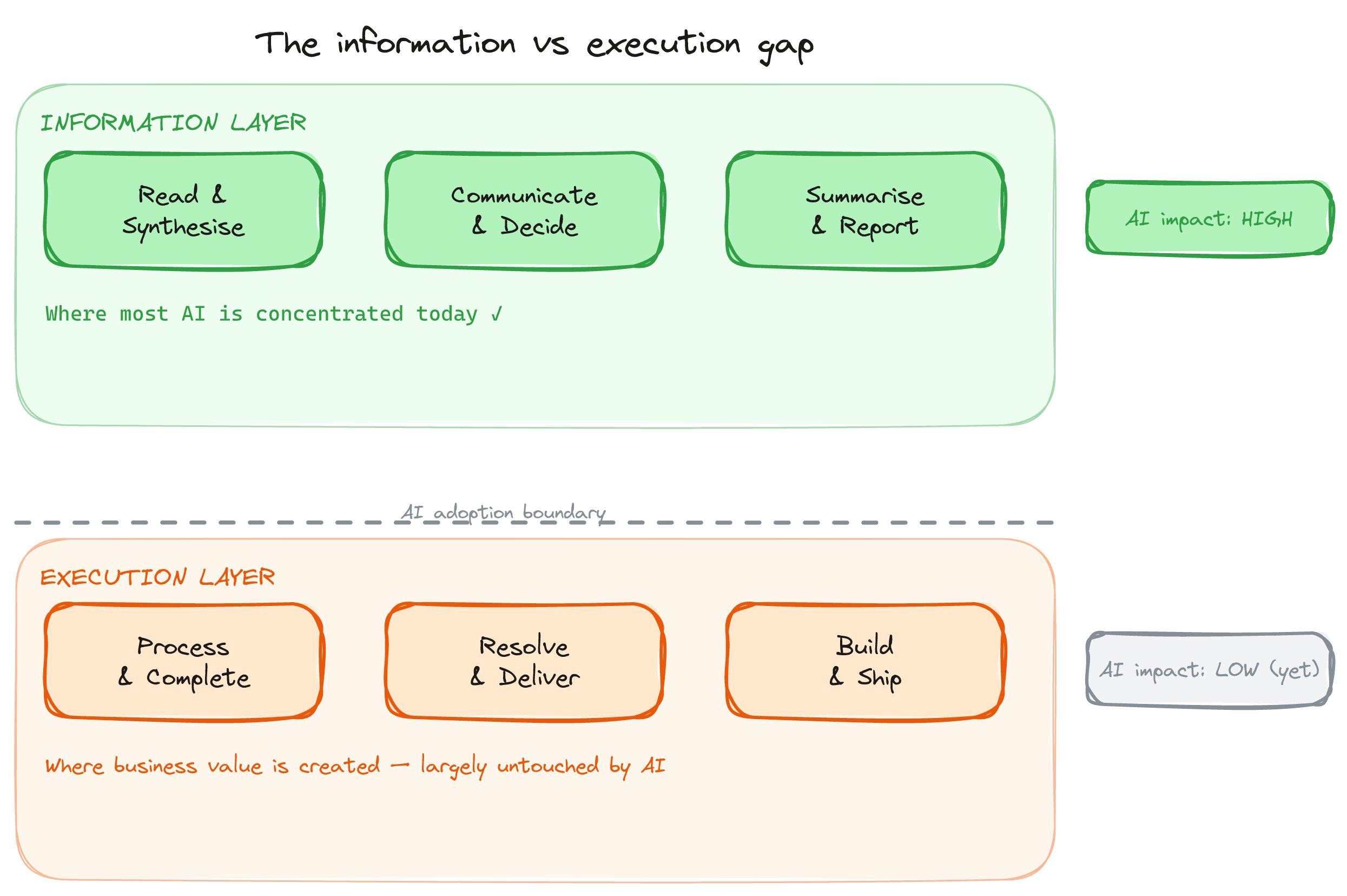
Synthesis, summarisation, and polished communication are how businesses process and share information. But they’re not how businesses produce value. Value gets created through execution: the customer order that gets resolved, the campaign that gets built, the invoice that gets raised, the product that gets shipped.
And that’s exactly where most organisations haven’t started yet.
Where employees actually work

If you ask the average employee what they need to do their job, they’ll give you a list of tasks. Not concepts. Not summaries. Tasks.
The invoice needs raising. The customer query needs resolving. The report needs building from raw data. The onboarding email needs to go out to the new client. Their entire working day is a sequence of specific outcomes they’re responsible for delivering.
So when you hand them a chat tool and say “use AI,” a few things happen. They experiment with drafting an email or two. They try looking something up. They notice it’s occasionally useful. And then they go back to their actual job, which is still structured exactly as it was before, and which the chat tool doesn’t touch.
The ChatGPT as search engine problem
This is the quiet ceiling that most AI rollouts hit.
When AI gets introduced across a team without a specific change to how work actually flows, people default to using it the way they use a search engine, or occasionally the way they use a spell-checker. These are low-leverage use cases. They save minutes per day. They don’t change outputs, they don’t change throughput, and they don’t change the bottom line.
The genuinely high-leverage use of AI is using it to complete tasks, not just assist with them. That’s a fundamentally different proposition, and most companies haven’t built for it yet.
The spectrum most businesses are sitting in the middle of
There’s a spectrum to how AI actually gets used in an organisation. Understanding where your business sits on it explains almost everything about whether your P&L has felt any impact.
At the low end, AI is a smarter search engine. People type questions and get answers. Sometimes useful, rarely transformative.
A step up, AI is a writing assistant. It drafts emails, polishes documents, generates first cuts of things people would otherwise write themselves. This is where most “AI-forward” companies actually sit today, and it explains a lot about the CEO-versus-P&L gap. Because writing and communication is overwhelmingly a leadership function. Front-line employees don’t spend most of their day writing. They spend it doing: processing, completing, resolving.
Further along the spectrum, AI starts automating discrete tasks. Instead of helping someone draft a customer reply, it drafts and sends it. Instead of helping someone analyse a dataset, it runs the analysis and surfaces the insight. Human time gets freed up for exceptions and decisions, not for the routine processing.
At the far end, where the genuine operational gains live, is AI operating inside workflows: receiving triggers, making decisions, taking actions, and completing loops without human involvement unless something genuinely requires a judgement call. This is what people mean by agentic AI, and for most businesses it’s still largely theoretical, or at best a single proof-of-concept that nobody has rolled out properly.
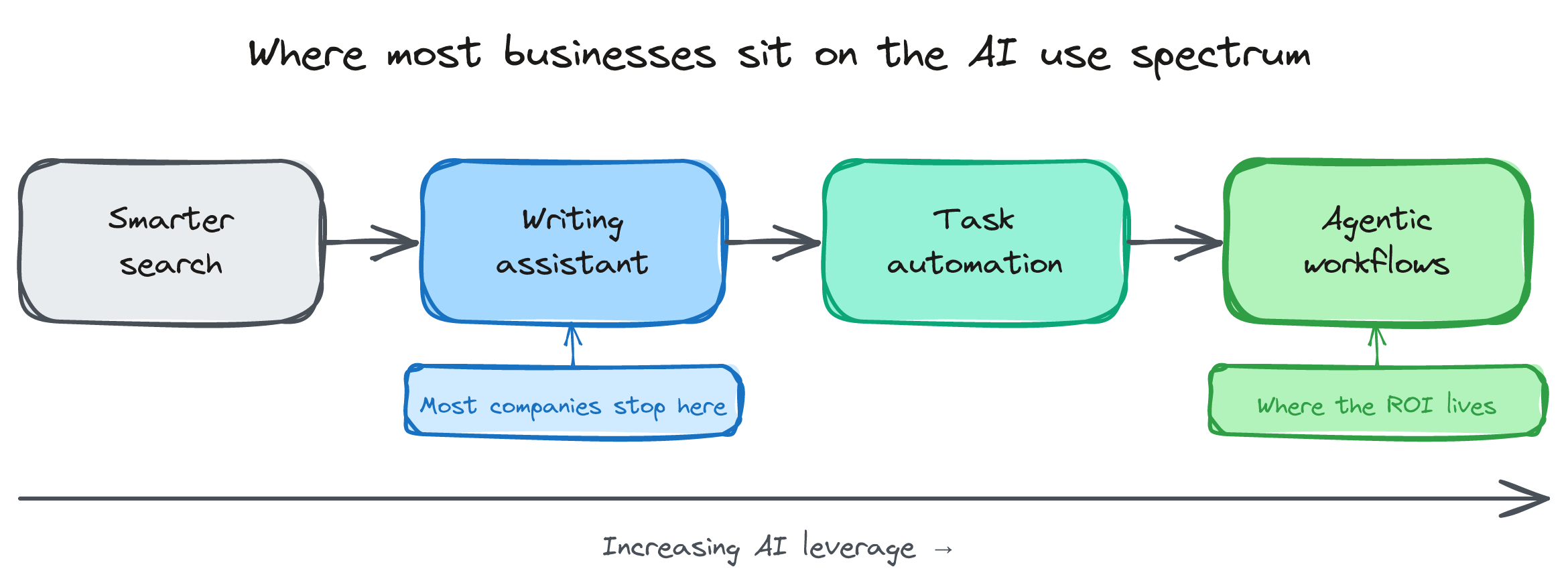
Most companies cluster around the writing-assistant stage and call themselves AI-forward. Their leaders feel productive. Their P&L is unchanged.
What it actually looks like when AI does the work
I want to be specific here, because “agentic AI” and “task completion” sound abstract until you see what they mean in practice.
Consider a customer service function. In the writing-assistant model, a team member copies a customer’s email into a chat tool, gets a draft reply, tweaks it, and sends it. The human is still in the loop for every single interaction. The process takes about the same time as before, with slightly better writing.
In a task-completion model, the incoming message gets classified automatically. If it’s a standard query that matches known resolution paths, the AI handles it end to end: checks the order status, applies the correct policy, drafts and sends the response, and closes the ticket. The team member sees the exception queue, not the full queue. That’s a different business.
Three more examples worth making concrete
A procurement process where incoming purchase orders get validated against inventory, checked against supplier terms, and either processed automatically or routed for approval based on value and risk. The order never lands in a human inbox unless it genuinely needs a human.
A content operation where a brief triggers research, drafting, internal review routing, and scheduling in sequence, without anyone managing the handoffs manually.
A sales function where a prospect enquiry generates a personalised response based on their industry and stage, pulls in the relevant case study, and books a follow-up call without a sales rep having to action it at all.
In each of these cases, the AI isn’t helping someone complete a task faster. It’s completing the task. That’s where operational leverage comes from.
Why most attempts at this fail early
Here’s what I’ve noticed building these kinds of systems across my own zero-employee business and watching others try: the reason most attempts at task-completion AI fail early isn’t the model. It’s the context.
An AI system that genuinely completes a task needs to know who it is, what the rules are, what the specific situation looks like, and what good resolution means for this organisation. Without that structured context, it produces generic outputs that still require a human to review, correct, and action. You haven’t automated anything. You’ve added a drafting step before the same manual process.
This is what I work through in detail in my Context Architecture Method post. The model is rarely the bottleneck. The context is. When you build the right architecture around your AI, the same tool that was producing half-useful drafts starts actually closing the loop on real work.
The honest question worth sitting with
If your P&L hasn’t moved since you started using AI, it’s worth asking honestly: where in the organisation is AI actually being used?
If the answer is mostly writing, summarising, and presenting, that tells you something. You’ve touched the information layer. You haven’t touched the execution layer.
The people whose work involves processing, completing, and delivering are still doing those things the same way they did before. They will keep doing them until someone specifically builds the workflows that change their working day. That’s not something a chat tool rollout achieves. It requires thinking about which tasks should change, what the AI needs to know to complete them, and what the human’s role becomes when it does.
The companies that are figuring this out right now are creating a performance gap that’s going to be genuinely difficult for late movers to close. Context architecture compounds. Every workflow you automate with properly structured AI gets faster, more consistent, and more reliable over time. Every company still at the writing-assistant stage doesn’t accumulate any of that.
Your CEO is going to love AI for a while yet. The real question is when it starts showing up in the numbers.
Frequently asked questions
Why does AI seem to work better for executives than for employees?
Because executives spend most of their working day on information tasks: reading, synthesising, communicating, and deciding. AI was built precisely for this kind of work. Employees are more task-oriented. Their days are structured around completing specific outputs, and most AI tools, as currently deployed, don’t touch those workflows at all.
What’s the difference between a writing assistant and agentic AI?
A writing assistant helps a human do a task faster. Agentic AI completes the task itself. The distinction matters because writing assistance still requires a human at every step. Agentic workflows free up human time for exceptions, decisions, and the work that genuinely requires judgment.
Do we need expensive custom AI to see bottom-line impact?
No. The tools most companies already pay for are capable of far more than writing assistance. The gap isn’t capability, it’s context and architecture. Building proper workflows around standard frontier models produces significantly better results than buying more expensive tools and using them the same way.
Where should a business start if it wants to move beyond writing assistance?
Pick one high-volume, rules-based process where the inputs are consistent and the resolution criteria are clear. Customer service standard queries, purchase order processing, and onboarding sequences are common starting points. Define what the AI needs to know to handle it end to end. Build the workflow. Measure the before and after. That first working example changes how your whole team thinks about what’s possible.
What is the Context Architecture Method?
It’s a framework I developed for building the intelligence layer that makes AI genuinely useful in business operations. It covers how to structure the knowledge, rules, and decision frameworks that AI needs to complete real tasks rather than just assist with them. You can read the full breakdown here.