There is a number that should haunt every founder.
You have probably met somewhere between five hundred and a thousand legitimate, talented, interesting professionals over the course of your career. Really met them. Had real conversations. People you felt a genuine spark with. People who said “we should catch up” and meant it. People who gave you their card, their number, their LinkedIn, and genuinely wanted to stay connected.
How many of them could you call tomorrow and pick up where you left off?
For most people, the answer is fewer than twenty.
That means 98% of your potential network has silently decayed to functional zero. And with it went every introduction that was never made, every collaboration that never happened, every referral that never came. Because the relationship that would have generated it had quietly eroded before either of you noticed.
“The Compound Cost™ is the number that should haunt every founder. It’s the invisible price of every relationship you let silently decay, and it’s enormous.”
Henry Reith
I call this The Compound Cost™. The invisible, accumulating price of relationship decay. It doesn’t show up in any spreadsheet. But it is enormous.
The strange thing is that most of the people reading this already know that “your network is your net worth.” You’ve heard it at every conference. Read it in every business book. Shared the LinkedIn post. And knowing it hasn’t changed the outcome.
That’s because the problem isn’t a shortage of advice. There are over 4,000 books about networking on Amazon. Millions of posts dispensing the same tactical wisdom. Almost all of it operates at the wrong level.
It tells you what to do. It doesn’t address who you need to become, or what’s actually happening in your nervous system, to make those actions sustainable and genuine.
That’s what The Awesome Relationships Framework™ is here to fix.
Why most networking advice fails before you even start
You’ve probably lived this scene.
You’re at a networking event. You’ve psyched yourself up. You’re going to be more intentional this time, follow up properly, make this count. You work the room. You swap cards. You have some genuinely good conversations. You promise to follow up.
Then you get home, and life hits. The follow-ups happen for about four days. Then they stop. The cards sit in a drawer. The connections, which felt real in the room, evaporate.
Three months later, you run into one of those people at another event. There’s an awkward moment of half-recognition. You can’t remember their name. The opportunity is gone.
Most networking frameworks diagnose this as a systems problem. You need a better CRM. A follow-up schedule. A template. And yes, systems matter. But they’re not the root cause.
The root cause is that most networking advice is written for your rational, strategic brain. Psychologists call this System 2. Your actual networking behaviour is governed by something much older: your automatic, emotional, threat-detecting System 1.
When Thursday arrives and you’re tired, your System 1 evaluates the follow-up task as low urgency, emotionally uncomfortable, and cognitively expensive. It quietly redirects your attention toward something with a more immediate reward. The follow-up doesn’t happen. Not because you’re lazy. Because you’re human.
Then there’s the deeper problem. Many professionals carry an unconscious belief that says: “I’m not a networker. Networking is something other people do, people who are more extroverted, more confident, more established than me.”
When you try to implement tactical advice on top of that identity, the identity wins. Every time.
This is what the Absolutely Awesome Framework calls The Skip-Layer Failure™. Problems on one layer (Being, Thinking, or Doing) cannot be solved with interventions on a different layer. When someone with a Being-layer problem tries to solve it with a Doing-layer tactic, they experience The Skip-Layer Failure™.
Most networking advice skips straight to Doing. The Awesome Relationships Framework starts with Being.
The evolutionary case: connection isn’t a strategy, it’s a survival mechanism
The lone wolf dies
Your brain was built for a village, not a global network
Something important needs to be said before we get into the framework.
The lone wolf problem
Connection isn’t a professional strategy. It’s a survival mechanism.
For 99.9% of human history, being excluded from your group meant death. Not metaphorically. Literally. You couldn’t hunt alone, defend against predators alone, or raise children alone. The evolutionary pressure this created was so profound it shaped the architecture of the human brain itself. Robin Dunbar’s Social Brain Hypothesis argues that the human neocortex didn’t expand to help us make tools or navigate terrain. It expanded to handle the complexity of social relationships.
Baumeister and Leary’s landmark research established that the need to belong isn’t a preference or a personality trait. It’s a fundamental human motivation, as basic as hunger or thirst. And Julianne Holt-Lunstad’s meta-analysis of over three million participants found that social isolation increases mortality risk by 29%. Greater than the risk from obesity. Comparable to smoking fifteen cigarettes per day.
This isn’t just a story about elderly people. The mortality risk from loneliness is actually stronger in populations under 65. Young, successful, busy founders building companies online are significantly at risk.
The brain processes social exclusion using the same neural circuitry that processes physical pain. Being disconnected isn’t metaphorically painful. It is neurologically painful, processed by real circuits that evolved when exclusion meant death.
So when you build and maintain a strong network, you aren’t doing something artificial or corporate. You are doing exactly what your brain was designed for.
Why your village brain needs a system
The problem is that your brain evolved for a village of 150 people, where relationships maintained themselves through daily physical proximity. You didn’t need a system to stay in touch with your tribe because you literally couldn’t avoid them.
Now you live in a city of millions. You meet hundreds of people per year across different industries and contexts, and then they vanish from your daily environment. Your village brain hasn’t kept up with your global life. The Awesome Relationships Framework is the bridge.
The Maintenance Paradox™: why the most valuable behaviour feels the least productive
Here’s the finding that explains why “your network is your net worth” is universally agreed upon and almost universally ignored.
Every founder knows that acquiring a new customer costs five to twenty-five times more than retaining an existing one. A 5% increase in customer retention can increase profits by 25–95%. Existing customers convert at 60–70%; new prospects at 5–20%.
We know this. And we still pour disproportionate energy into acquisition.
The same economics apply exactly to relationships. Meeting someone new at a conference has roughly a 5–20% chance of becoming a meaningful connection. Deepening an existing relationship has a 60–70% chance of creating real value. The existing relationship already has trust, context, and history. It compounds at dramatically higher rates.
Yet most professionals will spend three days at a conference chasing new connections while neglecting the thousand people already in their contact list.
“The networking behaviour that feels most productive is the least valuable. The one that feels least productive is where your real wealth compounds.”
Henry Reith
The Maintenance Paradox™ is this: the networking behaviour that feels most productive, meeting new people, is dramatically less valuable than the behaviour that feels least productive, maintaining existing relationships.
The framework exists to correct this inversion. Not by eliminating new connections, but by ensuring maintenance comes first.
The 5C Relationship Cycle™: the five stages that turn contacts into compound
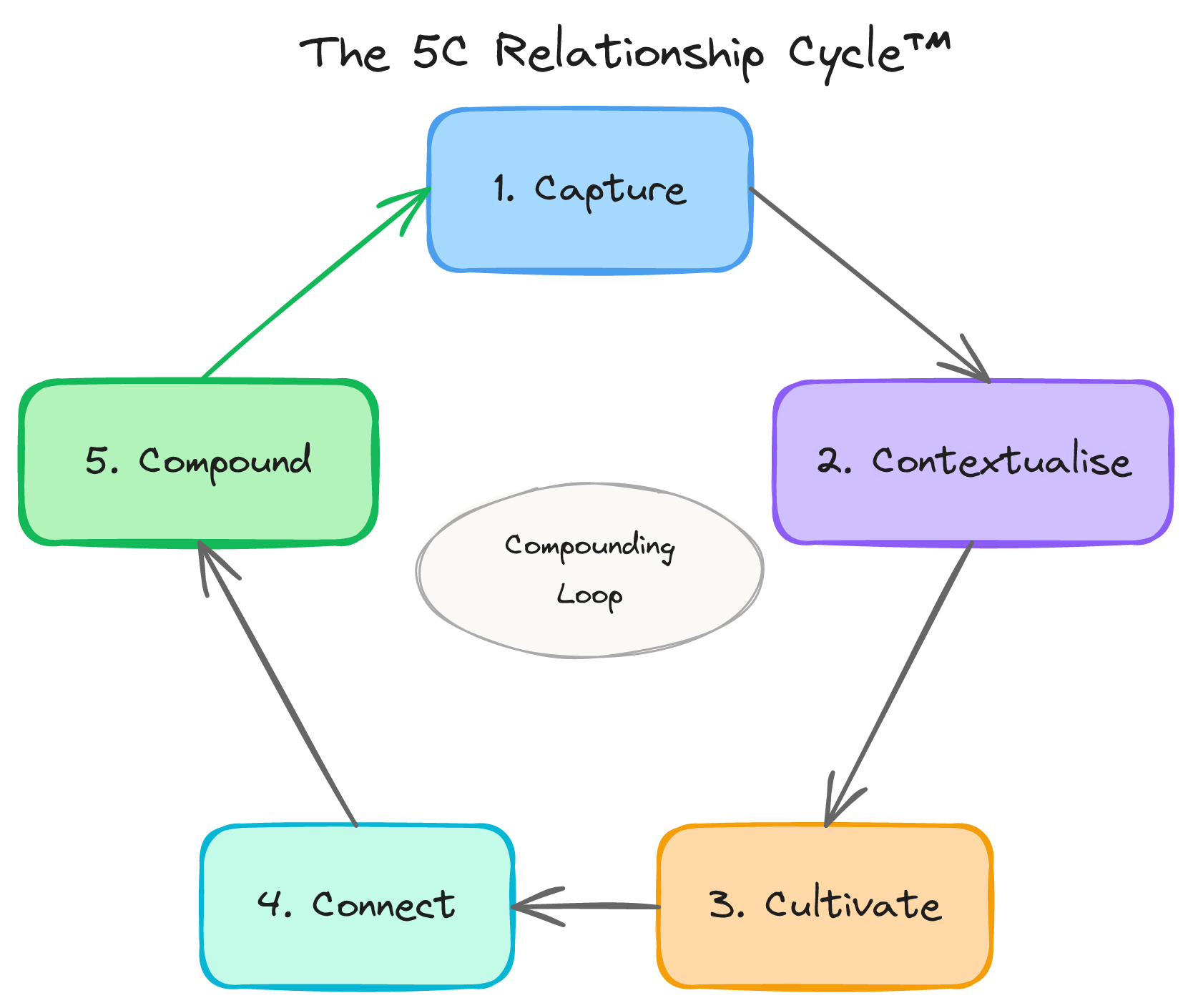
The Awesome Relationships Framework organises the science and the wisdom literature into five sequential, cyclical stages.
Sequential because each stage builds on the previous. Cyclical because the final stage feeds back into the first, creating a compounding loop rather than a linear process. Here’s what that looks like.
Stage 1: Capture
“Never lose a person, a context, or a moment.”
Most relationships die not from conflict. They die from forgetting.
You meet someone interesting. You exchange details. Within seventy-two hours, the encounter has faded. Their name is gone. The context is gone. The potential connection, which might have changed the course of your career, evaporates before you even realised it existed.
Capture is the discipline of recording who you meet, where, what you discussed, and what matters to them, at the moment of meeting, not weeks later when memory has degraded.
This isn’t data entry. It’s an act of attention. Dale Carnegie’s foundational insight, that a person’s name is the sweetest sound in any language, is really an observation about what it means to pay genuine attention to another human being. When you remember someone’s name, their current project, the challenge they mentioned in passing, you’re communicating something: “You mattered enough for me to notice.” That signal is rare. And it is powerful.
Research on the mere exposure effect (Zajonc, 1968) demonstrates that familiarity breeds liking. When you remember details about someone and reference them later, you create a feeling of being known. And being known is the precursor to feeling safe. Safe is where trust begins.
In practice: Immediately after meeting someone, spend two minutes recording the key context. What they’re working on. What they’re worried about. One personal detail. One person in your network who might benefit from knowing them. This takes less time than checking social media. It’s also exponentially more valuable.
Stage 2: Contextualise
“Understand the whole person, not just their title.”
Most contact systems store job titles and email addresses. This is what makes them feel like databases rather than relationship tools. A CRM knows that someone is “Head of Marketing at Acme Corp.” A genuine relationship knows that they’re training for their first marathon, quietly considering leaving their job to start something of their own, and worried about a parent’s health.
Contextualisation is the practice of understanding what someone cares about, what they’re working towards, what challenges them, and what lights them up, and recording it so you can show up with genuine relevance in future interactions.
Stephen Porges’ Polyvagal Theory explains why this matters so profoundly. When someone senses that you genuinely understand their situation, not just their job function, their autonomic nervous system registers safety. The ventral vagal pathway activates. Their body literally opens to connection. Before their conscious mind has decided anything, their nervous system has already registered: this person sees me.
This is the dimension no other networking framework addresses. Before you can give genuine value in Stage 3, before you can make genuine introductions in Stage 4, you need to establish genuine safety. Contextualise is that stage.
In practice: Shift from “professional profile” thinking to “whole person” thinking. Ask questions that go beyond job function. Listen for what someone is actually working on, not what their title says they should be. What do they care about? What do they want that they haven’t quite said aloud?
Stage 3: Cultivate
“Consistent, generous presence over time.”

This is where most networking advice begins. And where most people fail.
Not because the advice is wrong. Because they haven’t done the work of the first two stages. They try to cultivate relationships they haven’t properly captured or contextualised, which means their outreach feels generic, forced, or performative. The other person can tell.
Cultivation is the practice of showing up consistently with value. Not selling. Not asking. Not performing. Simply being present in someone’s life in ways that communicate: I’m paying attention, I care about what you’re building, and I’m here when you need it.
Adam Grant’s research on givers, matchers, and takers provides the empirical foundation. Successful givers offer what Grant calls “five-minute favours”, small, high-impact acts of generosity that cost almost nothing but create disproportionate relational value. A thoughtful introduction. A relevant article sent at the right moment. A genuine acknowledgement of someone’s recent win.
Paul Zak’s neuroeconomics research shows why these small acts compound: generosity triggers oxytocin, which makes the recipient more trusting and generous in return, which deepens the relationship. This is the biology of how human trust actually works.
The sequence matters enormously here. Generosity without prior safety signals can be interpreted as manipulation rather than kindness. Cold outreach with unsolicited resources, before you’ve established genuine context, can actually damage trust. Safety first (Stages 1 and 2), then value. You earn the right to give by first demonstrating that you understand.
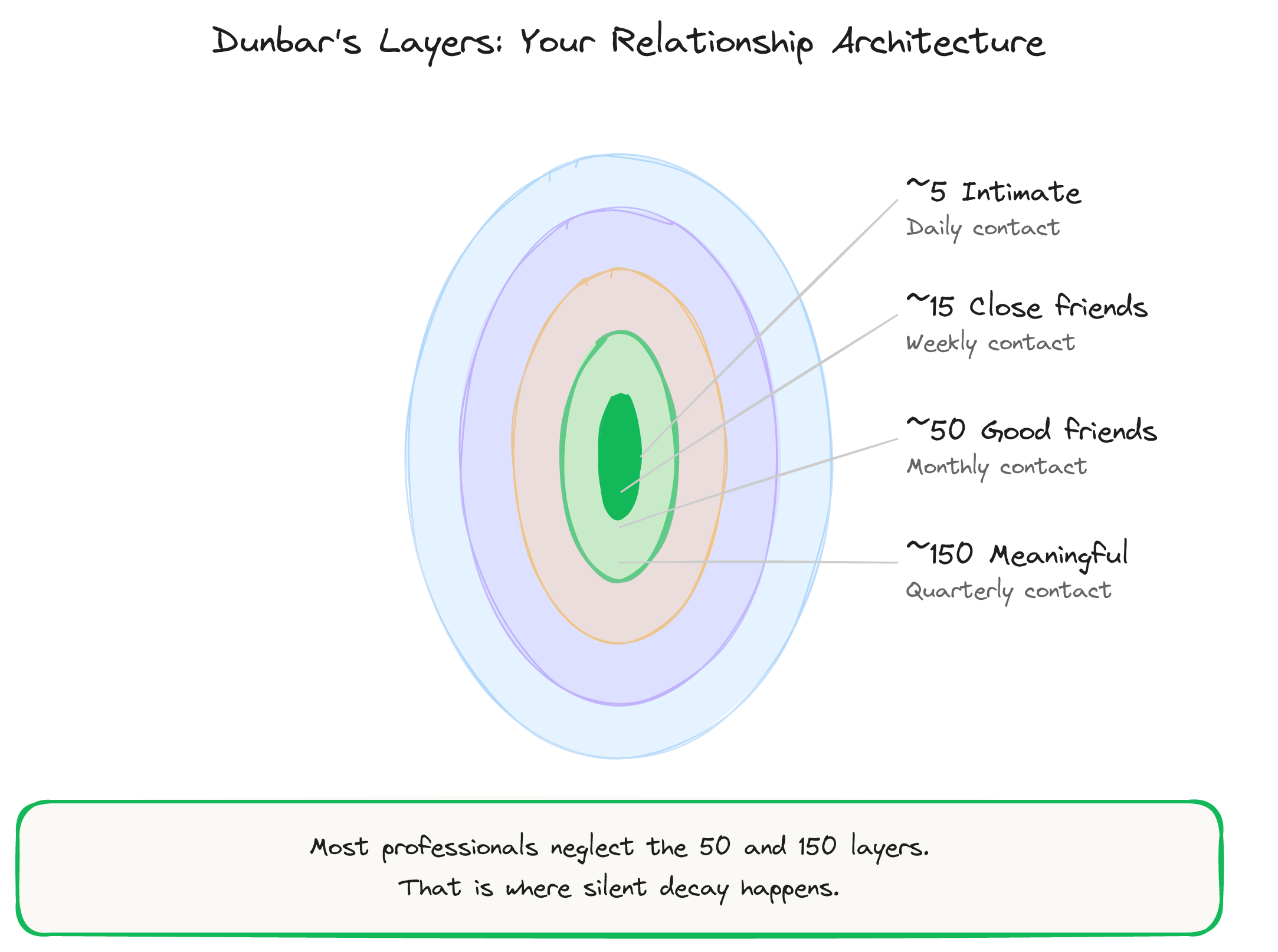
Dunbar’s layer model reveals where cultivation matters most and is most neglected. Your inner five don’t need systematic cultivation. The relationship’s natural momentum sustains it. The high-value zone is Dunbar’s layers three and four: the fifty and the one hundred and fifty. These relationships have enough trust to be meaningful but not enough momentum to be self-sustaining. Without intentional cultivation, they decay silently over eighteen to thirty-six months.
In practice: Identify your “50 layer”, the people you know genuinely but haven’t spoken to in a while. Set a cadence. Three minutes, three times a week. Send something relevant. No agenda. Just presence.
Stage 4: Connect
“Bridge people, ideas, and opportunities.”
This is the stage that separates good networkers from transformational ones.
The first three stages are about your relationship with individual people. Stage 4 is about the relationships between people in your network.
Ronald Burt’s decades of research, confirmed across industries and cultures, is unambiguous: people who bridge “structural holes”, the gaps between disconnected groups, are compensated better, promoted faster, generate better ideas, and have more influence. It is the single most professionally rewarded network behaviour in existence.
Within the Awesome Relationships Framework, we call the mechanism powering Stage 4 The Serendipity Engine™. It’s the systematic practice of asking: “Who in my network should know each other?”
The Serendipity Engine operates through three distinct practices. The first is the Double Opt-In Introduction: before connecting two people, you ask both parties separately whether they’d welcome the introduction. This respects autonomy, prevents unwanted contact, and dramatically increases the success rate of every intro you make.
The second is the Opportunity Router. When an opportunity arrives that isn’t right for you, you route it to the person in your network who would benefit most rather than discarding it. You become a creator of value, not just a passive recipient.
The third is Weak Tie Activation: deliberately surfacing dormant contacts, people you haven’t spoken to in six to twelve months, and finding genuine reasons to reconnect. Granovetter’s 1973 research on weak ties, confirmed by a 2022 study of 20 million LinkedIn users, proved these are your most valuable connections for novel information and opportunity.
In practice: Once a week, ask: “Who in my network should meet each other?” Make one double opt-in introduction. Total time: five minutes. Cumulative impact over five years: career-defining.
Stage 5: Compound
“Relationships are assets that appreciate over time.”
The final stage isn’t a destination. It’s a recognition.
When the first four stages are practised consistently, relationships begin to generate returns that exceed the investment. Introductions arrive unsolicited. Opportunities surface from unexpected corners. Your reputation precedes you into rooms you’ve never entered.
This is the compound interest of social capital. Every five-minute favour compounds. Every thoughtful introduction compounds. Every act of genuine attention compounds. The returns are nonlinear. Small, consistent investments create exponential relational wealth over years and decades.
Stage 5 feeds back into Stage 1. The new connections generated by compounding need to be captured, contextualised, cultivated, and connected. The cycle continues. The compound builds.
There’s also a mathematical dimension worth sitting with. When you maintain 150 active, meaningful relationships and each of those people maintains their own 150, your second-degree network extends to approximately 22,500 people. The superconnector’s power isn’t knowing everyone. It’s knowing 200 people well enough to bridge across two degrees within twenty-four hours.
Beyond the 5C: Community™
The 5C Relationship Cycle is a personal operating system. It describes what you do with your relationships. But there is an evolution that becomes available once you have been practising all five stages consistently over time.
Community™ is what happens when your network starts building itself.
At the Hub stage, you are still the primary connector. Every introduction flows through you. Every bridge requires your involvement. This works. But it has a ceiling. You remain the bottleneck, and your network’s value is limited by your available time and attention.
Community™ is the transition from being the connector to being the architect of a self-sustaining network. It is the moment when people in your network start connecting each other without your involvement. When two people you introduced three years ago collaborate on a project you never heard about. When someone you cultivated brings a new person into the ecosystem using the same principles you modelled. When your founders’ dinner runs itself because the culture of generosity and bridging has been absorbed by the group.
Community does not come from content
This is Seth Godin’s Tribes thesis, grounded in the science of the preceding stages. Community does not emerge from charisma or content. It emerges from the sustained practice of the 5C Relationship Cycle over years, reaching a tipping point where the network’s culture of reciprocity and connection becomes self-reinforcing.
Not everyone will reach this stage. Not everyone needs to. But for founders who aspire to movement-building, thought leadership, or community-driven business models, Community™ is the natural destination of a well-compounded network.
The 5C Relationship Cycle builds your network. Community™ is what your network becomes when you have been building it properly for long enough.
The Relationship Compound Equation™
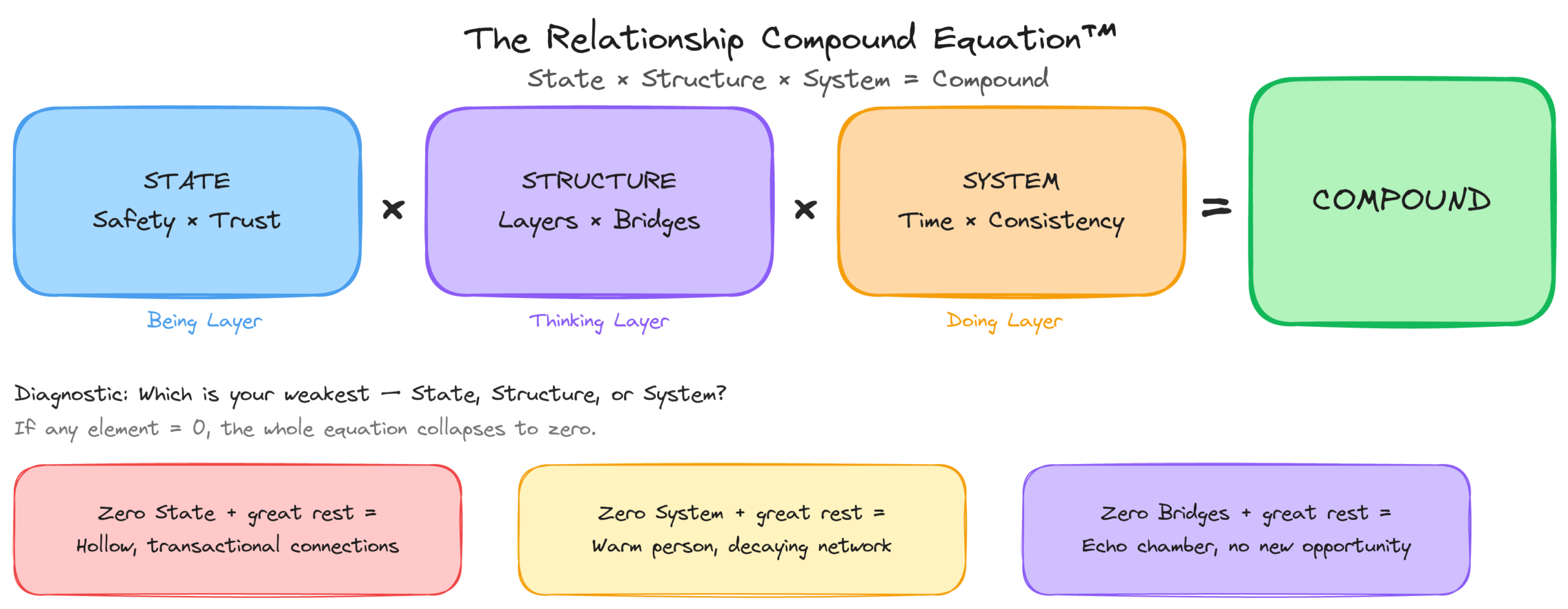
The science behind the framework can be expressed as a single multiplicative equation. It mirrors the Absolutely Awesome Framework’s core architecture of Being, Thinking, and Doing:
State × Structure × System = Compound
State (Being layer) = Safety × Trust. Your nervous system state when you show up. Ventral vagal openness versus sympathetic guardedness. The oxytocin cycle that transforms transactions into genuine bonds. The question this layer answers: who are you when you arrive?
Structure (Thinking layer) = Layers × Bridges. How deliberately you invest across Dunbar’s concentric circles, particularly the neglected 50 and 150. How many structural holes you span. How many weak ties you maintain. The question: how is your network architected?
System (Doing layer) = Time × Consistency. The raw hours invested in shared experience. The maintenance cadence that prevents relationship decay. The question: what do you actually do, and how reliably?
“State × Structure × System = Compound. If any one of those is zero, the whole equation collapses, no matter how strong the others are.”
Henry Reith
Why multiplicative, not additive
The equation is multiplicative, not additive, and that distinction matters enormously. If any single element is zero, the entire equation collapses to zero, regardless of how strong the others are.
Perfect Structure with zero State produces a meticulously mapped network that generates transactional, hollow relationships. Others sense the guardedness through neuroception and respond in kind.
Brilliant State with zero System produces a warm, genuine, present person whose relationships silently decay because there’s no maintenance architecture. They light up every room they enter but can’t find last week’s business card.
Strong System with zero Bridges produces a person who diligently maintains contact with the same fifteen people, creating an echo chamber of redundant information and zero novel opportunity.
The equation gives you an instant diagnostic. Which of the three, State, Structure, or System, is your weakest? That’s where to focus. That’s where The Skip-Layer Failure™ lives.
The Seven Connector Archetypes™: where you are right now
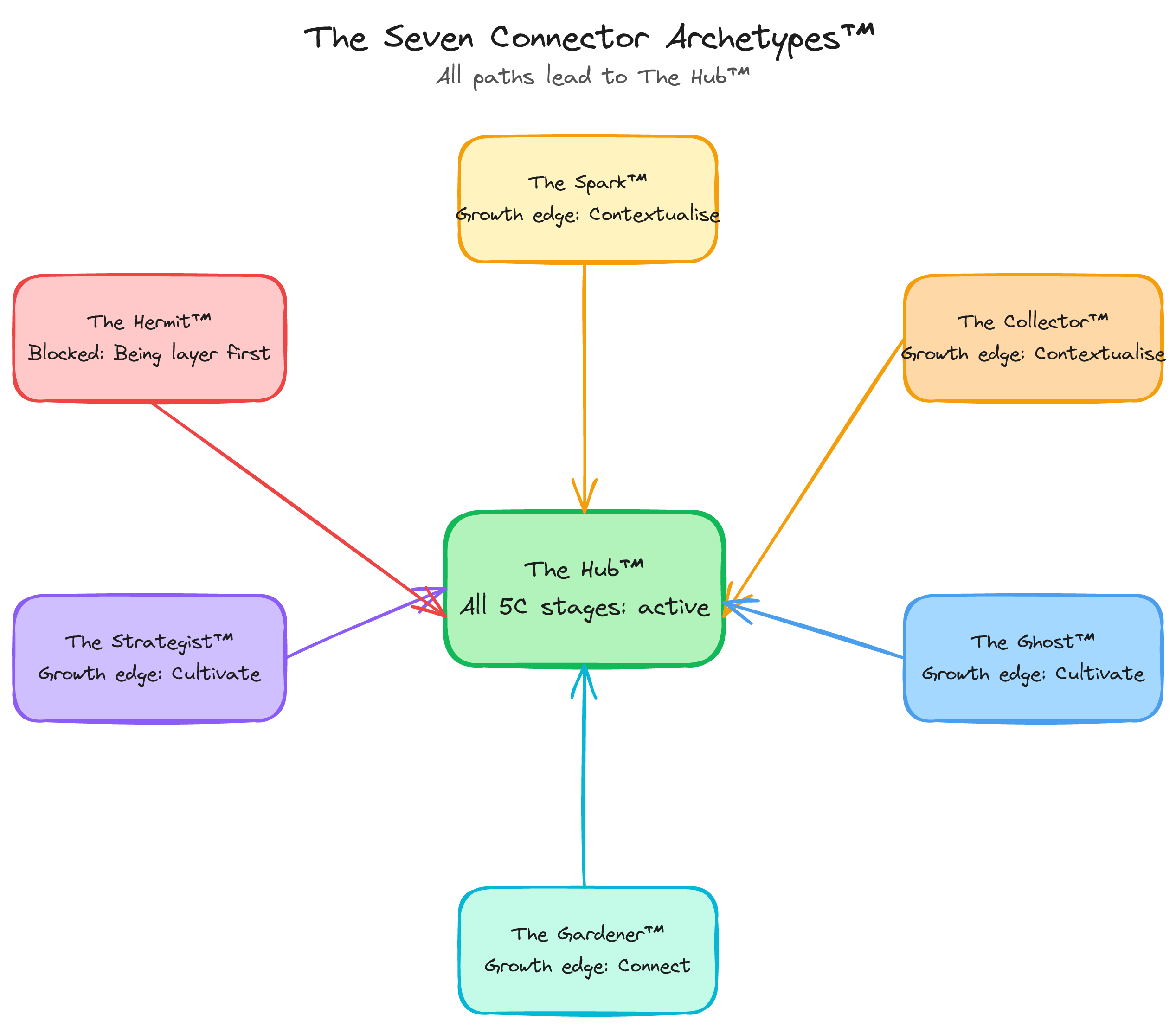
Different people fail at different stages of the framework. Understanding your natural archetype reveals exactly where your leverage and your blind spots live.
These aren’t fixed personality types. They’re observable patterns of relational behaviour, which means they can be changed.
| Archetype | Pattern | Where they get stuck |
|---|---|---|
| The Spark™ | Lights up rooms, genuine rapport, no system | Loses every connection (Contextualise) |
| The Collector™ | Thousands of contacts, zero depth | Confuses size with value (Contextualise) |
| The Ghost™ | Magnetic first impression, then vanishes | Attention always moves forward (Cultivate) |
| The Strategist™ | Chess-board thinker, but feels transactional | Leads with strategy before warmth (Cultivate) |
| The Gardener™ | Deep, warm small circle, never bridges | Never introduces (Connect) |
| The Hermit™ | Capable at all stages, blocked at Being layer | Nervous system / identity upstream of 5C |
| The Hub™ | All five stages operational, system-driven | The destination for all archetypes |
The destination for every archetype is The Hub™. And here’s what most people miss about that: The Hub™ isn’t a personality type. It’s a practice. You don’t become a Hub by being more extroverted or more charming. You become a Hub by systematically operating the five stages regardless of your natural temperament.
The Hermit™ is the most important archetype to understand. This is someone intellectually capable across all five stages but blocked at the Being layer, nervous system dysregulation, identity barriers, or permission structures that prevent action. For The Hermit™, no amount of tactical advice helps. The work is upstream. And that work is exactly what the Absolutely Awesome Framework’s Being layer is designed to address.
What twenty minutes of daily practice actually looks like
Morning, 2 minutes (Capture + Contextualise). You had a call yesterday with someone new. Before the day begins, you spend two minutes recording key context. What they’re building. What challenges them. Who in your network they should know. One personal detail. Less time than checking Instagram. Exponentially more valuable.
Mid-morning, 3 minutes (Cultivate). Your system surfaces a reminder, someone in your “50” layer hasn’t heard from you in six weeks. You send them an article relevant to something they mentioned last time you spoke. No ask. No agenda. Just: “Saw this and thought of you.”
Lunch, 5 minutes (Connect). Someone mentions they need a Shopify developer. Your contextualised network immediately surfaces a match, someone you spoke with last month who just pivoted into exactly that. Two messages. Double opt-in protocol. Introduction made. Value created: potentially career-defining for both parties.
Late afternoon, 0 minutes (Compound). An email arrives from someone you haven’t spoken to in four months. Someone you introduced them to last year just became a major client. They want to send you a referral in return. You didn’t ask. It arrived because the compound has been building silently for months.
Evening, 5 minutes (Being layer). A brief heart coherence practice. Not because it’s spiritual, but because HeartMath research shows it resets your autonomic nervous system to a baseline of openness and calm. Tomorrow, when you walk into that industry event, your nervous system will be in ventral vagal, genuinely open and curious rather than performing. Others will sense it through neuroception, even if they can’t name what they’re sensing. Trust will form faster. Conversations will go deeper. The framework compounds.
Total: approximately twenty minutes of deliberate practice. Value created: immeasurable and compounding.
The layer beneath the method
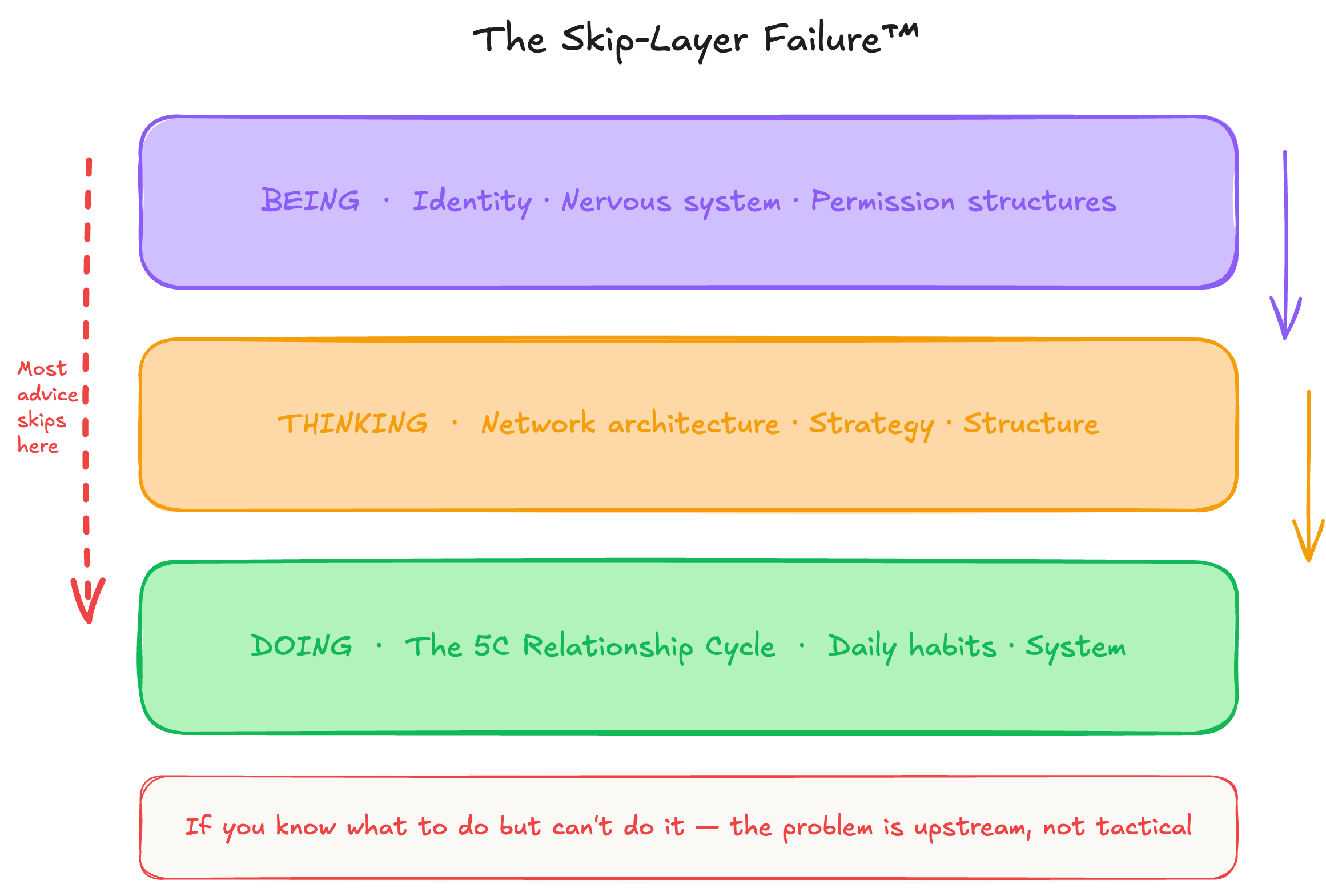
This is where the Awesome Relationships Framework diverges from every other networking methodology.
Every other framework operates at the level of behaviour. They tell you what to do. And the advice is often sound. But it doesn’t explain why most people who read those books don’t actually change.
The answer is The Skip-Layer Failure™.
“Most networking advice fails not because it’s wrong, but because it’s aimed at the wrong layer. You can’t fix a Being problem with a Doing solution.”
Henry Reith
The Absolutely Awesome Framework is built on three layers: Being, Thinking, and Doing. Its central insight is that problems on one layer cannot be solved with interventions on a different layer. The networking books address Doing and sometimes Thinking. They largely skip Being.
If you know what to do but can’t bring yourself to do it, the problem isn’t the method. The problem is upstream.
Three questions worth sitting with honestly
Three Being-layer questions worth sitting with honestly:
Your networking identity. Do you see yourself as someone who builds relationships deliberately? Or do you see networking as something other people do, people who are more extroverted, more confident, more established than you are?
Your nervous system capacity. Can you show up in social situations in a genuinely open, curious state? Or does the prospect of reaching out trigger an anxious, performative energy that others can sense and that makes your outreach feel forced to both of you?
Your permission structures. Do you believe you’re allowed to ask for introductions, share your work, take up space in someone’s inbox? Or do you carry unconscious rules about who is permitted to build a network, and have you quietly decided that you’re not one of them?
The framework doesn’t require you to resolve every identity question before you start. It simply asks you to notice which stage feels hardest and to check whether the resistance is tactical or existential.
The five stages provide the architecture. The science provides the confidence. The Being layer provides the foundation that makes it all sustainable.
Where to go from here

The Awesome Relationships Framework isn’t about adding networking to your to-do list. It’s about transforming the way you show up in every interaction you already have.
You already meet people. You already have conversations. You already have a network, you’re just letting most of it decay.
The five stages don’t require more time. They require more intention. And a system, because your brain was built for a village, not a global professional network, and it needs help with the architecture.
Awesome Contacts is being built as the dedicated system for this framework, designed specifically to make The 5C Relationship Cycle™ operational in daily life. To take the strategy of this framework and turn it into a practice. To help founders and professionals stop losing the relationships that could change everything.
Your network is your net worth. But only if you build it like this.
Frequently asked questions
What is the Awesome Relationships Framework?
The Awesome Relationships Framework™ is a science-backed, five-stage methodology for building professional and personal relationships that compound over time. It synthesises research from network science, neuroscience, social psychology, and psychophysiology into a single teachable system called The 5C Relationship Cycle™: Capture, Contextualise, Cultivate, Connect, Compound.
How is this different from other networking frameworks?
Most networking frameworks operate exclusively at the tactical level (Doing). The Awesome Relationships Framework integrates all three layers: Being (nervous system state, identity, permission structures), Thinking (network architecture, structural design), and Doing (the five stages of the 5C Cycle). This integration is what makes behaviour change sustainable rather than temporary.
What is The Maintenance Paradox™?
The Maintenance Paradox™ is the finding that the networking behaviour that feels most productive, meeting new people, is dramatically less valuable than the behaviour that feels least productive, maintaining existing relationships. Just as in business, where retention dramatically outperforms acquisition on ROI, existing relationships compound at far higher rates than new connections.
Who are The Seven Connector Archetypes™?
The Seven Connector Archetypes™, The Spark™, The Collector™, The Ghost™, The Strategist™, The Gardener™, The Hermit™, and The Hub™, are observable patterns of relational behaviour that reveal where someone’s leverage and blind spots live within The 5C Relationship Cycle™. They are not fixed personality types. They are patterns that can be diagnosed, understood, and changed.
What is Awesome Contacts?
Awesome Contacts is the dedicated software system being built to operationalise The Awesome Relationships Framework in daily life, helping founders and professionals systematically capture, contextualise, cultivate, connect, and compound their relationships.