Most professionals are brilliant at meeting people. They are terrible at keeping them.
You have probably met hundreds of legitimate, interesting people over your career. Founders, investors, potential partners, talented collaborators. People you genuinely connected with.
And 98% of them have silently disappeared.
Not from conflict. Not from falling out. Just from the slow invisible erosion that happens when life gets busy and nobody has a system.
The Awesome Relationships Framework exists to reverse that.
What is the Awesome Relationships Framework?
The Awesome Relationships Framework is a science-backed methodology for building professional and personal relationships that compound over time.
It sits within the Absolutely Awesome Framework ecosystem and applies the same three-layer architecture (Being, Thinking, Doing) specifically to how you build and maintain your network.
The framework draws on research from network science, neuroscience, social psychology, and psychophysiology. It pulls the core principles from thirteen of the most influential books on human connection and organises them into a single, teachable, daily-practice system.
At its heart it answers one question: why do some people turn their network into their net worth, while most people watch their connections quietly decay?
The answer is not tactics. It is not a better CRM. It is not attending more events.
Almost all networking advice addresses the wrong layer. This framework starts with the right one.
The 5C Relationship Cycle
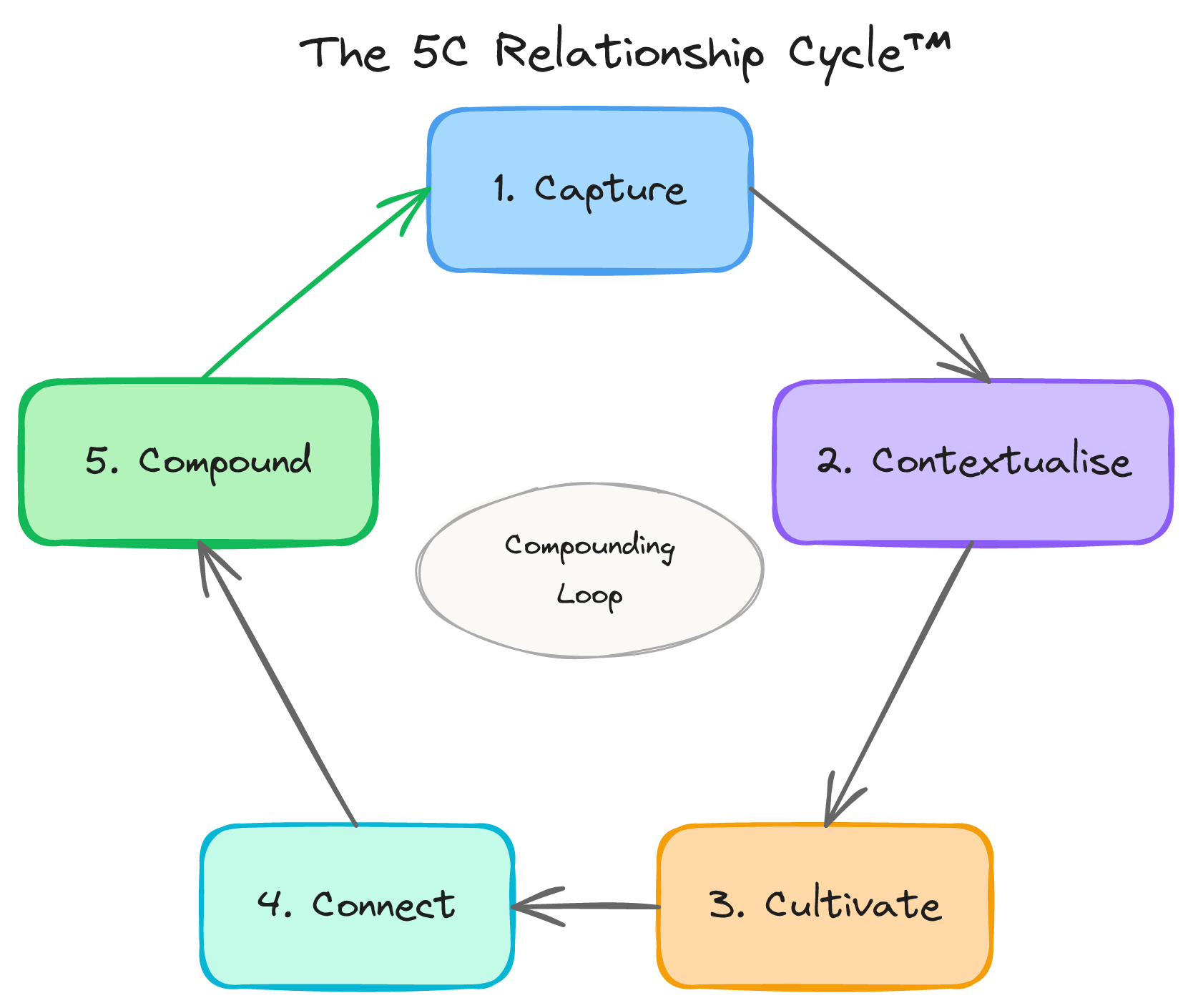
The framework’s core engine is The 5C Relationship Cycle, five sequential, cyclical stages that turn contacts into compound.
Stage 1: Capture
Record who you meet, what matters to them, and why they matter to you at the moment of meeting. Not data entry. An act of attention. Your memory was not designed to hold hundreds of relational contexts. Your system is.
Stage 2: Contextualise
Understand the whole person, not just their title. What are they working towards? What challenges them? What lights them up? This is what creates the nervous system safety that makes genuine trust possible.
Stage 3: Cultivate
Show up consistently with value. Not selling, not asking, not performing. Five-minute favours: a relevant article sent at the right moment, a genuine acknowledgement of someone’s win, a thoughtful introduction. Small acts that compound into deep trust over time.
Stage 4: Connect
Bridge people in your network who should know each other. This is The Serendipity Engine: the systematic practice of asking “who in my network should meet each other?” Research spanning three decades is unambiguous: bridging disconnected groups is the single most professionally rewarded network behaviour that exists.
Stage 5: Compound
When the first four stages are practised consistently, relationships begin generating returns that exceed the investment. Introductions arrive unsolicited. Opportunities surface from unexpected corners. Your reputation precedes you into rooms you have never entered.
Stage 5 feeds back into Stage 1. The cycle continues. The compound builds.
And beyond: Community™
There is an evolution that becomes available after mastering all five stages. The framework calls it Community™.
The 5C Relationship Cycle is a personal operating system. Community™ is the leadership evolution: when you stop being the connector and start being the architect of a self-sustaining network. When people in your ecosystem begin connecting each other without your involvement. When the culture of generosity and bridging has been absorbed by the group and the network builds itself.
Not every founder needs to reach this stage. But for movement-builders and community-driven businesses, it is the natural destination of a well-compounded network.
The Relationship Compound Equation
The framework can be expressed as a single multiplicative equation:
State x Structure x System = Compound
State is your nervous system when you show up, open and genuine versus guarded and performative.
Structure is how your network is built, whether it spans genuinely different worlds or just echoes the same fifteen people back to you.
System is what you actually do, and how reliably you do it.
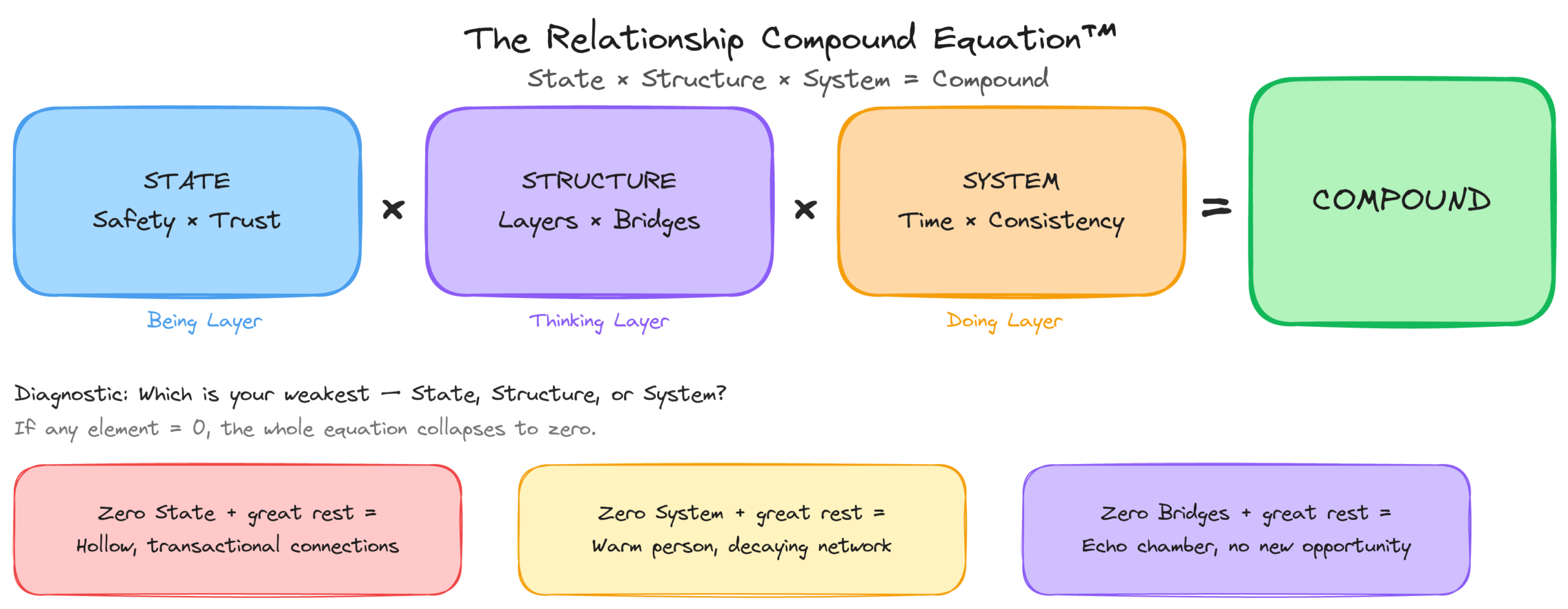
The equation is multiplicative, not additive. If any one element is zero, the whole thing collapses regardless of how strong the others are. A brilliant system with a dysregulated nervous system produces hollow, transactional relationships. A warm, generous person with no system watches their network decay silently.
Both are fixable. The equation tells you exactly where to focus.
Which type of connector are you?
Most people recognise themselves in one of seven patterns, The Seven Connector Archetypes. These are not personality types. They are observable habits, which means they can change.
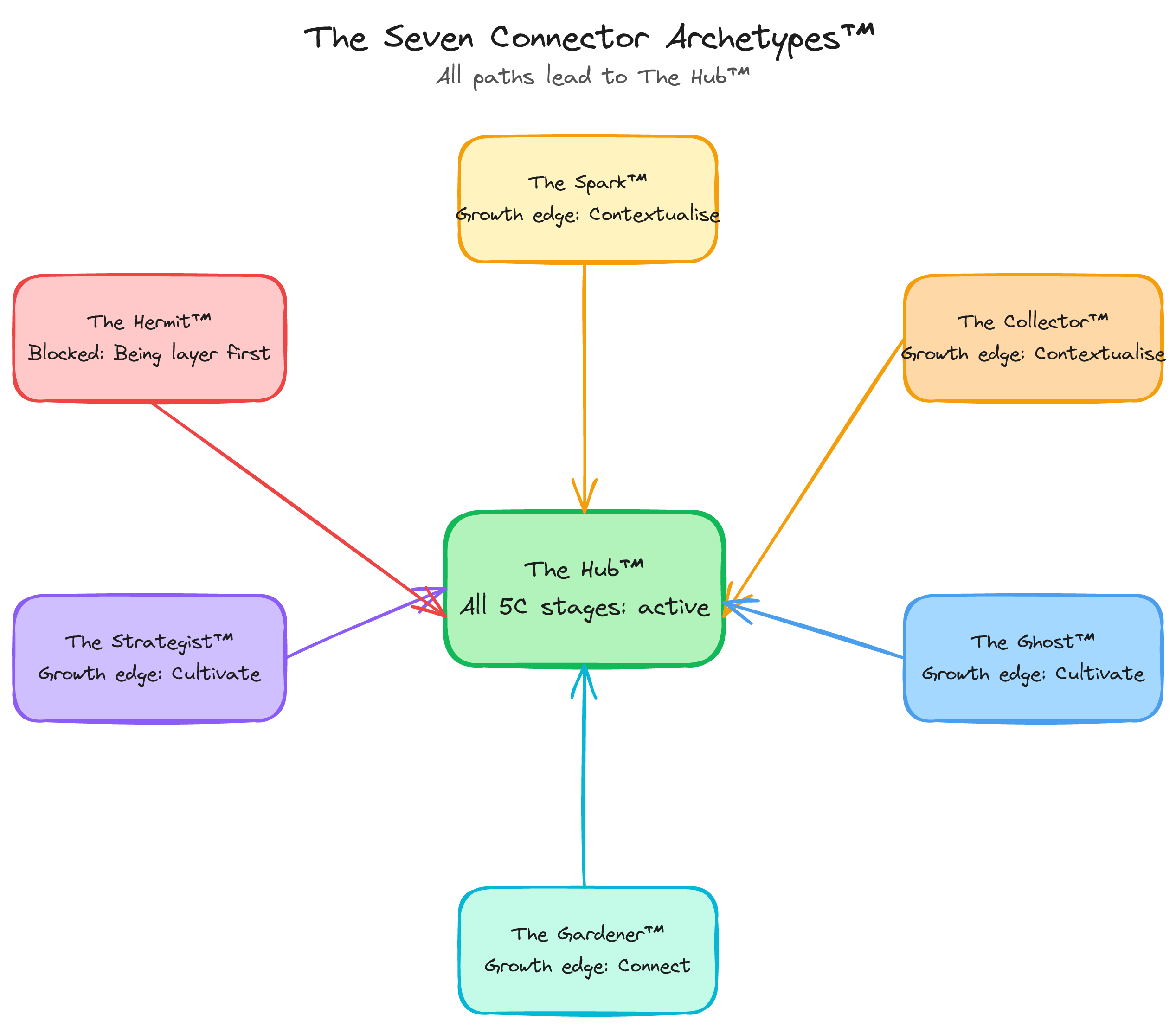
| Archetype | The pattern | The growth edge |
|---|---|---|
| The Spark | Lights up rooms, genuine rapport, no system | Loses every connection |
| The Collector | Thousands of contacts, zero depth | Confuses size with value |
| The Ghost | Magnetic first impression, then vanishes | Attention always moves forward |
| The Strategist | Chess-board thinker, sees opportunities everywhere | Feels transactional to others |
| The Gardener | Deep warm inner circle, never bridges outward | Connecting amplifies, not dilutes |
| The Hermit | Capable at every stage, blocked at Being layer | The work is upstream of tactics |
| The Hub | All five stages operational, system-driven | The destination for all archetypes |
The path to Hub looks different depending on where you start. The direction is always the same: strengthen your weakest stage, one at a time.
Why most networking advice does not work
Every networking book tells you what to do. Almost none of them address who you need to become to make those actions sustainable.
This is The Skip-Layer Problem, one of the central insights of the Absolutely Awesome Framework. Problems on one layer cannot be solved with interventions on a different layer.
“If you know what to do but cannot bring yourself to do it, the problem is not the method. The problem is upstream.”
Henry Reith
The Awesome Relationships Framework is the only methodology that integrates all three layers, Being (your nervous system and identity), Thinking (your network architecture), and Doing (the five stages) into a single coherent system. That is what makes the change stick rather than evaporate after three weeks.
Where to go from here
For the full depth, the science, the research, and the complete breakdown of all five stages, read the long-form guide: Stop networking. Start compounding. The Awesome Relationships Framework explained.
If you want the system to make this operational in daily life, Awesome Contacts is being built to be the dedicated tool for exactly that.
Your network is your net worth. But only if you build it like this.
Frequently asked questions
Is this just another networking framework?
No. Most networking frameworks live at the tactics layer (Doing). The Awesome Relationships Framework integrates all three layers, Being, Thinking, and Doing. That integration is why it produces lasting behaviour change rather than a three-week enthusiasm spike.
Do I need to be extroverted for this to work?
The Hub archetype is not a personality type. It is a practice. The framework was designed to work regardless of natural temperament, including for people who find networking exhausting or inauthentic.
What is Awesome Contacts?
Awesome Contacts is the dedicated software system being built to make The 5C Relationship Cycle operational in daily life, helping founders and professionals capture, contextualise, cultivate, connect, and compound their relationships without it consuming their entire week.