I wanted a million-dollar company before I knew what a balance sheet was.
As a kid, that was the number. A million dollars. It meant I had made it. So I grew up, started building, and a few years later I had exactly that. A company turning over a million dollars a year.
Then I sat there. For five years.
Every year, I set bigger goals. New offers, new hires, longer hours, better systems. And every year the business landed back around the same number, like it was tied to a stake in the ground. I blamed the market. I blamed my pricing. I blamed myself for not working hard enough, which is a fun way to spend a Sunday night.
It took me an embarrassingly long time to see the truth. The million dollars was never a target I was chasing. It was a ceiling I had already built. The block was not in the market. It was in me.
The Real Ceiling Is Not Your Strategy. It Is Who You Think You Are.
Here is the pattern I missed for years. You can only hold the success your self-image allows. Push past it and something quietly drags you back.
You drop the ball on a big deal. You “forget” to follow up. You pick a fight, hire the wrong person, talk yourself out of the bigger room. It feels like bad luck. It is the system correcting.
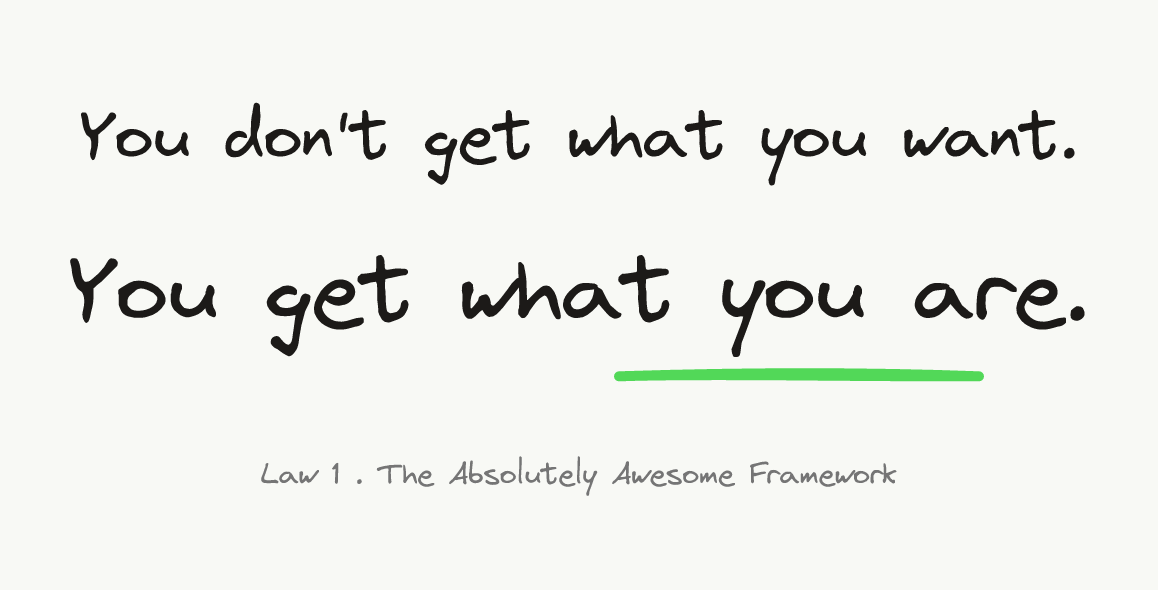
In the framework I built, I call this the Identity Ceiling. The most success, money, or visibility you can carry before you self-correct back to who you believe you are. Its first law is blunt: you do not get what you want, you get what you are.
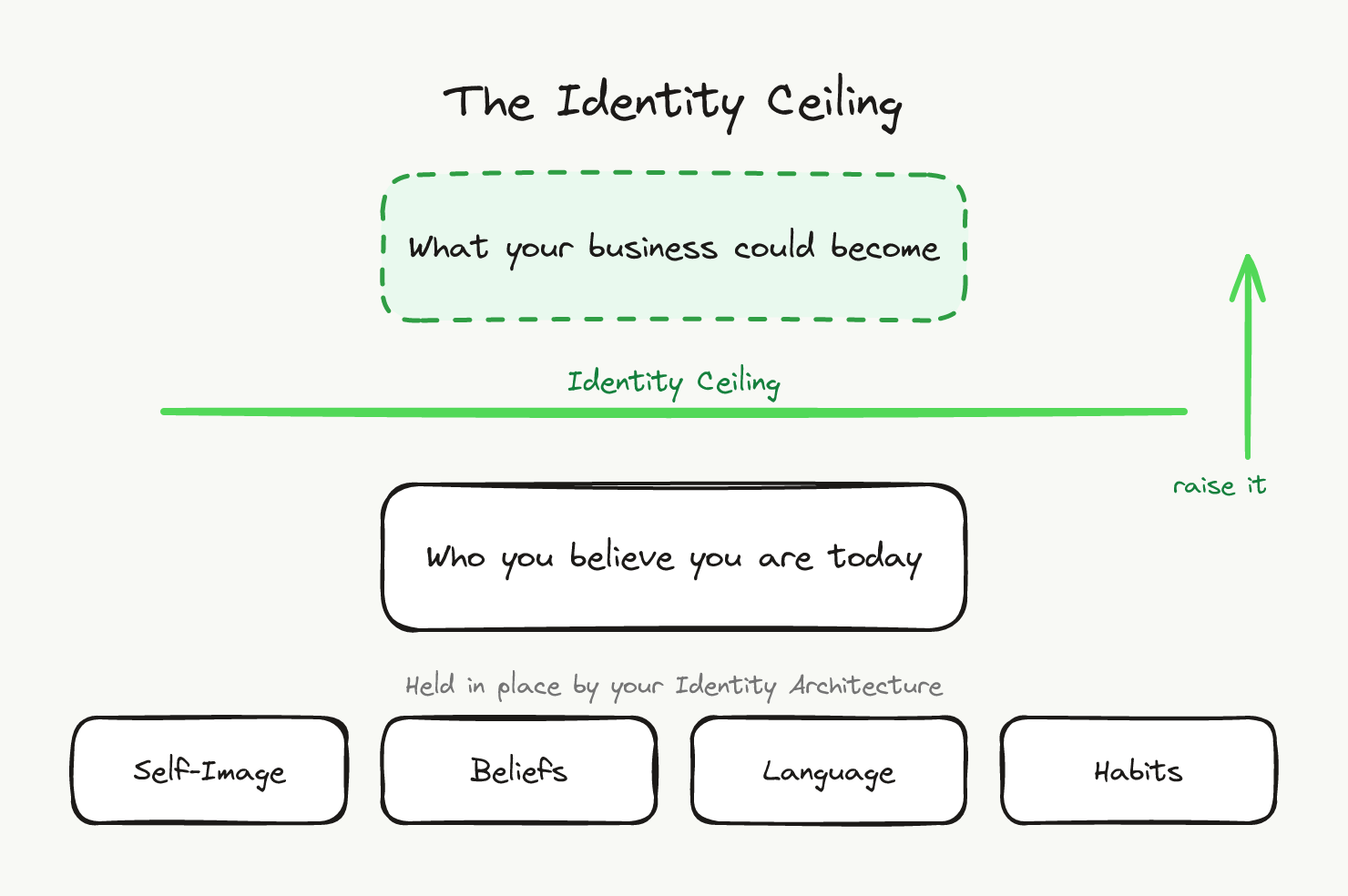
This is not just a nice line. Psychologists have a name for the pull. They call it self-verification. We seek out, and even “see”, the feedback that matches the story we already hold about ourselves.
William Swann’s research found the drive can be so strong it overrides our wish for good news, and that it quietly stalls people even in therapy. We do not just believe the ceiling. We defend it.
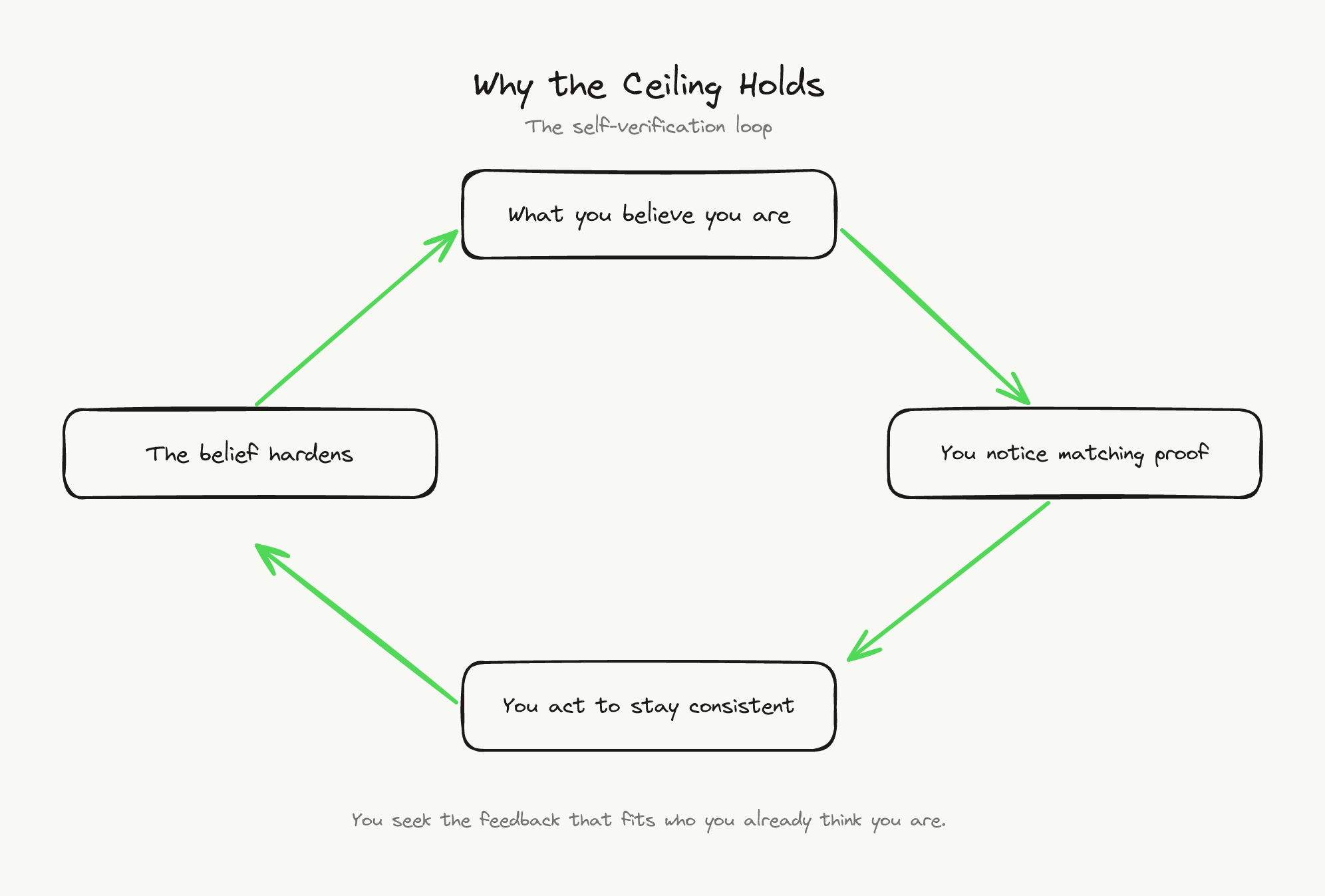
And your business inherits all of it. A founder who is uneasy about money builds a company that undercharges. A founder who hates being seen builds a company that hides. My business could only ever be as bold as I privately believed I was allowed to be. That is why the number would not move. I was the number.
How I Find the Limiting Belief (Three Exercises, Ten Minutes Each)
The good news, and the reason I am writing this, is that finding the belief is faster than fixing it. You do not need years of therapy to see the ceiling. You need a pen and a bit of honesty. Three exercises do most of the work for me.
1. Write Out Your Childhood Dreams
I sat down and wrote what I wanted as a kid. Not what I should have wanted. What I actually pictured. You can do the same.

When I did this, my million-dollar company belief fell straight out of the page. That dream was not fuel. It was a finish line I had crossed years ago and never replaced. My subconscious had been running the original spec the whole time, and the spec said “a million dollars, then you have made it”. No wonder I parked there.
The story you carry about yourself shapes where you let yourself go. That is not just my hunch. Research on narrative identity shows the life story we tell ourselves predicts how we actually do, beyond our personality traits. Change the story and you change the road.
2. Write About What Is Possible With Your Non-Dominant Hand
This one has no studies behind it. It has just worked for me, so I will be honest about that.

Take a pen in your wrong hand and write what you believe is truly possible for you. The hand is slow and clumsy, which is the point. It outruns the polished adult answer you have rehearsed a thousand times, and the quieter, more honest belief leaks onto the page. Mine usually says something smaller than I would admit out loud.
3. List Everything Your Goal Would Actually Cost You
Write your real goal at the top. Then list everything reaching it would actually mean. More staff to manage. Lawyers and accountants in every decision. Travel that pulls you away from your partner and your kids.

Now watch where you flinch. The resistance is not random. It is the exact spot where your identity says “not me”. The flinch is the map. For me, the resistance was never about the money. It was about who I would have to become to hold it, and quietly, I did not want the job.
How to Change Your Identity
Finding the ceiling is the quick bit. Raising it takes repetition. The good news is that it moves, because you are not fixed.
Your brain stays plastic your whole life. It rewires with use. Even rehearsing something only in your mind builds some of the same wiring as doing it for real. In one study, people who only imagined practising a piano exercise reshaped their brain’s motor map much like the people who actually played.
So picture the version of you who runs the bigger thing, often enough, and you start laying the track for them. The release that helped me most is simpler still. What happened, happened. The story about it is optional. The million-dollar dream was a story I had mistaken for a fact, and once I saw that, I could put it down.
I am not writing this from the far side. I am in it with you. Some of what follows has worked for me for years. Other parts I have used more with the people I coach than on myself. Take what fits.
Here is what actually shifts the ceiling for me. I will be honest about where the science is solid and where it is just my experience.
I sit with one question, through breath and stillness. When something is stuck, I breathe and meditate on that single thing until an answer arrives. It does not show up as a thought. It shows up as a knowing in the body, lower and steadier than my chatter. The framework calls this the Energy pillar. The body holds what the mind cannot reason its way to.
I will level with you, the science here is unsettled. The idea that the body guides good decisions is serious but contested, and the gentler “felt sense” methods are more philosophy than proof. I use it anyway, because it works for me.
I reprogramme with audio. Listening to the right tracks, on repeat, has been one of the biggest levers in my life. Hypnosis, the closest thing with real evidence behind it, does shift state and behaviour. The flashier stuff, subliminal tapes and the like, I keep in the “works for me, proves nothing” pile.
Most of all, I change the room. This is the big one. I do not journal or positive-think my way into a new identity. I get around people whose standards are higher than mine, and I rise to meet them. I am wired to absorb whatever is around me. Put me near people playing a bigger game and my own game lifts without effort.

I will be straight about the science here too, because it is softer than the quotes pretend. “You are the average of the five people around you” is a Jim Rohn line, not a study. The famous research on social contagion is real but argued over by serious people.
The data is messy. My experience is not. Some people change by looking inward. I change by changing who is in the room. Work out which one you are.
A quick warning while you experiment. Plenty of this world, the energy work, the “rewire your genes in a weekend” promises, runs well ahead of the evidence. Use what moves you. Just do not confuse what works for you with proof it works for everyone.
You Drew the Line. You Can Redraw It.
The ceiling is real. But I built mine out of a childhood daydream and five years of treating it as fact. That is the part that gives me hope. A ceiling you constructed is a ceiling you can move. The first step is not a new strategy or a new hire. It is seeing the line you have been bumping against, and admitting you drew it.
So here is the one thing I would ask you to do this week. Take ten minutes and write out your childhood dreams. See what number, or what picture, you have quietly been building toward. You might find, like I did, that you crossed the finish line years ago and forgot to draw a new one.