Listen to this article
Tonight I’m going to an AI startup event because someone I’ve met thought of me.
About two weeks ago a friend introduced us, and the four of us spent a co-working session on AI. Ten days later a spare ticket came up for tonight’s event, and they offered it to me. Without that one session, I wouldn’t be going.
I think about that when I see what AI has made easy to copy. A rival can buy the same subscription you use to research a market, write a pitch deck or send a thousand cold emails.
The part of my business I’d find hardest to replace is the handful of people who’d think of me first. You can have hundreds of contacts in your phone and still go years without speaking to some of the people you’d most like to hear from.
If you run a business, some of the people you’ve lost touch with are still likely to open doors for you.
You can start getting back in touch in about fifteen minutes a week.
AI Can Copy Everything Except the Person Who Knows You
Contacts have always mattered to me. AI has changed how much work I can do on my own, and I still get stuck on things a friend can spot in a conversation.
My best business friends work like mirrors. They see a problem in my business or my life that I can’t see from where I’m standing. Even with my brain switched on, I can watch YouTube, read or ask AI and still miss the blocker.
I learn more about how people use AI in one-on-one chats than I do from demos. A business friend can tell me how they use it in their work, and I can take an idea from that conversation straight into mine.
The same friend can help me join the dots on something I’ve been thinking through on my own. I can come out of a conversation with a much clearer idea of what to try next.
It’s the same when I’m trying to understand an industry. Someone with 10 or 20 years in it can tell me what they’re seeing on the ground, which helps me work out how to position what I’m building.
An AI agent could send a friendly check-in to everyone in your contacts once a month. The reason someone thought of me when that ticket came up was that we’d sat down and worked on AI together.
The rule I use is to let a system remind me when to reach out and write the message myself.
The People Who Move Your Business Are Rarely the Ones You See Most
Two of my recent opportunities came from people I see very little. Someone I’d met once got me into tonight’s event, and someone I see once a year gave me a consulting contract.
I pay attention to those contacts because they come across things my closest friends and I would all miss. Researchers have been looking at how that works for more than 50 years.
What a 1973 Job Study Found
In 1973 the sociologist Mark Granovetter reported on a random sample of people in a Boston suburb who had recently changed jobs. They worked in professional, technical or managerial roles, and he asked the ones who found work through a contact how often they saw that person.
Of those 54 people, about one in six saw their contact often. That’s 16.7%, compared with 55.6% who saw them occasionally and 27.8% who saw them rarely.
Your close friends tend to know the people you know, so you often hear about the same opportunities. A person you see every so often moves in other circles and might hear about a job, a client or an idea that would never reach you.
Granovetter studied one suburb, and the pattern has since shown up on a much bigger scale.
What 20 Million LinkedIn Members Taught Us About Weak Ties
Between 2015 and 2019, LinkedIn randomly varied the mix of people it suggested as new connections to over 20 million members. Over those five years, members made about 2 billion new connections and found 600,000 new jobs across the experiments.
By changing the recommendations at random, the researchers could see what difference the new connections made to job moves. They published their findings in Science in 2022.
When the researchers measured tie strength by how many contacts two people shared, moderately weak ties helped most. The benefit peaked at around 10 mutual connections, according to MIT’s summary of the study.
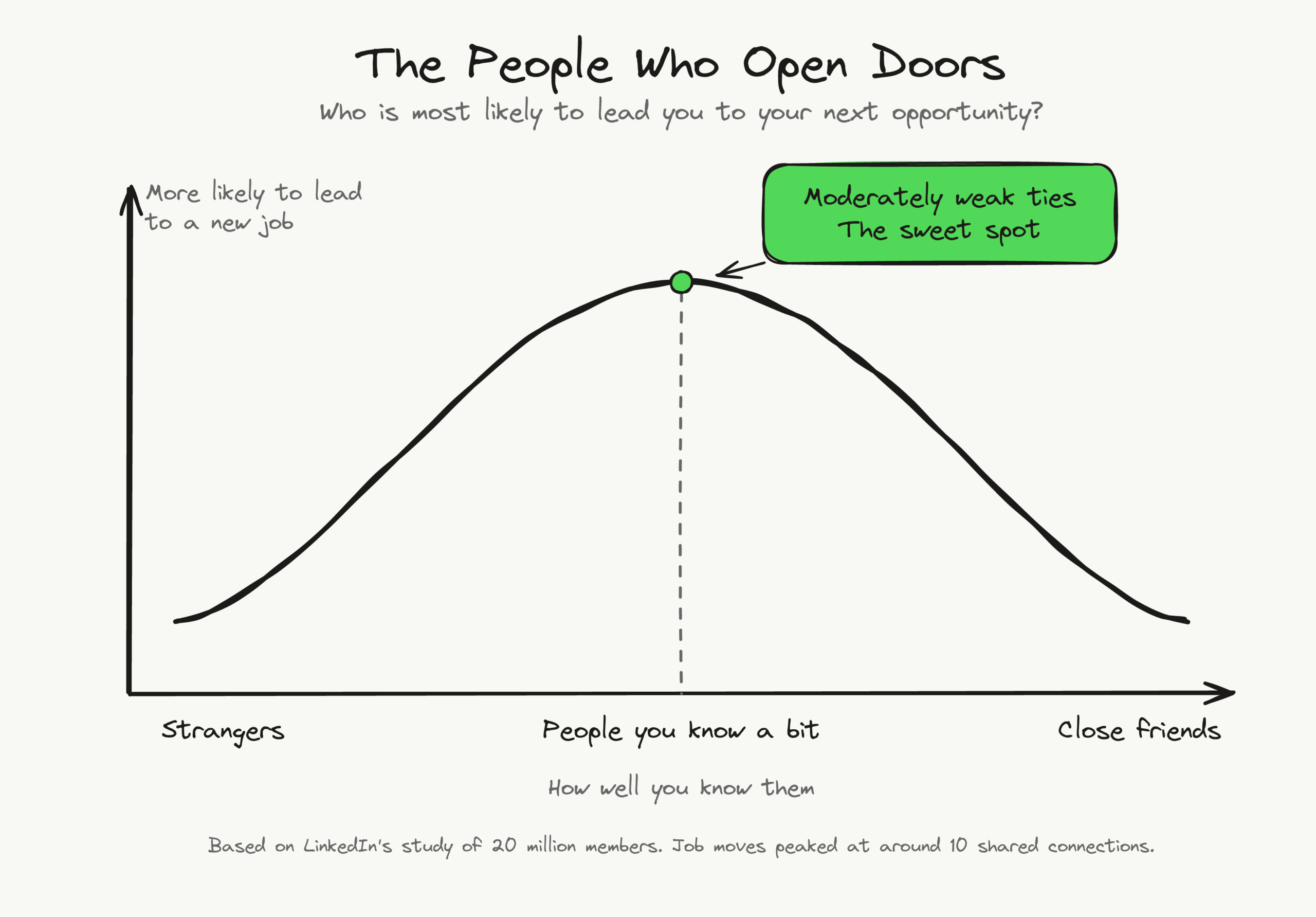
When they measured strength by how much people interacted, the weakest ties helped most. Weaker ties helped more in digital industries, and stronger ties helped more in less digital ones.
The experiment tracked people moving jobs. From experience, I’d bet the same holds for winning work.
The person who got me tonight’s ticket was a friend of a friend.
Silence Doesn’t Kill a Good Relationship
When you’ve been out of touch for years, it’s easy to imagine your message will feel awkward or that the other person has forgotten you.
Daniel Levin, Jorge Walter and Keith Murnighan call those relationships dormant ties. For their study, that meant people who’d once known each other and had gone at least three years without being in touch.
They asked 224 executives in four Executive MBA classes to get back in touch with two people, one they’d been close to and one they’d known less well. The executives asked both for advice on a work project.
The executives rated the advice as favourably as advice from people they were already in touch with. Reconnecting took about as much time as talking to a current acquaintance and brought in more new ideas. Where they’d once been close, much of the trust and shared perspective was still there.
In a second study, 116 executives ranked their top 10 dormant contacts. The researchers asked them to reconnect with their first choice and one other person picked at random from the list. The executives’ ratings showed no clear drop in how useful the advice was further down the list.
The fifth or tenth name on your list can be as good a place to look for advice as the first.
Would it feel like you were only getting in touch because you wanted something? The executives were asking for help with a project and, when they wrote about the conversations afterwards, most were glad they’d got in touch.
After I sold my business, I got in touch with a couple of people I knew. They knew me well enough to let me work through some ideas with them, and that led to paid projects.
A Referral Starts With Trust Already Built
My mentor knew what I was good at and had a friend who needed that kind of help. We started talking after my mentor introduced us, and I went on to work with that person for nine years on Oh Crap.
Within a couple of years I’d made it a million-dollar business, and I exited earlier this year.
Cold outreach has worked for me at times. When there’s someone I want to reach, I usually get there through someone we both know.
A German bank paid customers for referrals, and researchers tracked about 10,000 of its customers for almost three years.
On average, referred customers stayed longer and were worth at least 16% more than similar customers who signed up without a referral.
I see the value of a referral in that first conversation. Someone the other person trusts has already explained why they thought of me, so we can start with what the person needs.
Business Relationships Still Fade When Nobody Tends Them
You can pick up with an old friend after years apart and still have a lot to catch up on.
Sam Roberts and Robin Dunbar followed people’s active personal networks for 18 months through a big change in their lives. Friendships tended to get weaker over that period, and the people who put in more effort lost less ground.
In that study, talking more made the most difference to women’s friendships. For men, it was doing more things together.
A friend of mine runs an event every year, and I’ve been going for a couple of years. I got to know someone there well enough that, when they wanted AI consulting work done, I was the obvious choice.
We barely spoke between events. Seeing each other once a year was enough to stay in touch, and I’m doing that consulting work now.
Fifteen Minutes a Week Is Enough to Tend Them
I used to try once a week to think of someone I’d lost touch with and send them a message or give them a call. It was a fairly haphazard way of doing it.
These days I use Awesome Contacts, the personal CRM I’m building, to help me keep up the habit.
You can do the same thing in about fifteen minutes a week.
Write Down What People Tell You
When someone mentions a launch date or talks through a worry about their business, write down what they told you that day. A line is enough if it gives you something specific to come back to.
A note in the contact card on your phone will do. A few months later, when you’re looking up their number and wondering what to say, you’ve already got something you wanted to ask them about.
Pick the Three Who Went Quiet
Each week, pick three people you haven’t spoken to in a while. I’d start with people you liked or learned from. Think of the person you used to call when you were trying to work something out, or someone who taught you something you still use.
Keep it to three so you have time to remember where you left off with each person before you write.
Send Something Specific
Use the thing you wrote down and make it easy to reply. If someone mentioned plans for a second clinic, you could write, “You said you were opening the second clinic in March. How’s it going?”
A calendar reminder can tell you when to send it. Keep the first message to something you’d ask them over coffee and leave it at that.
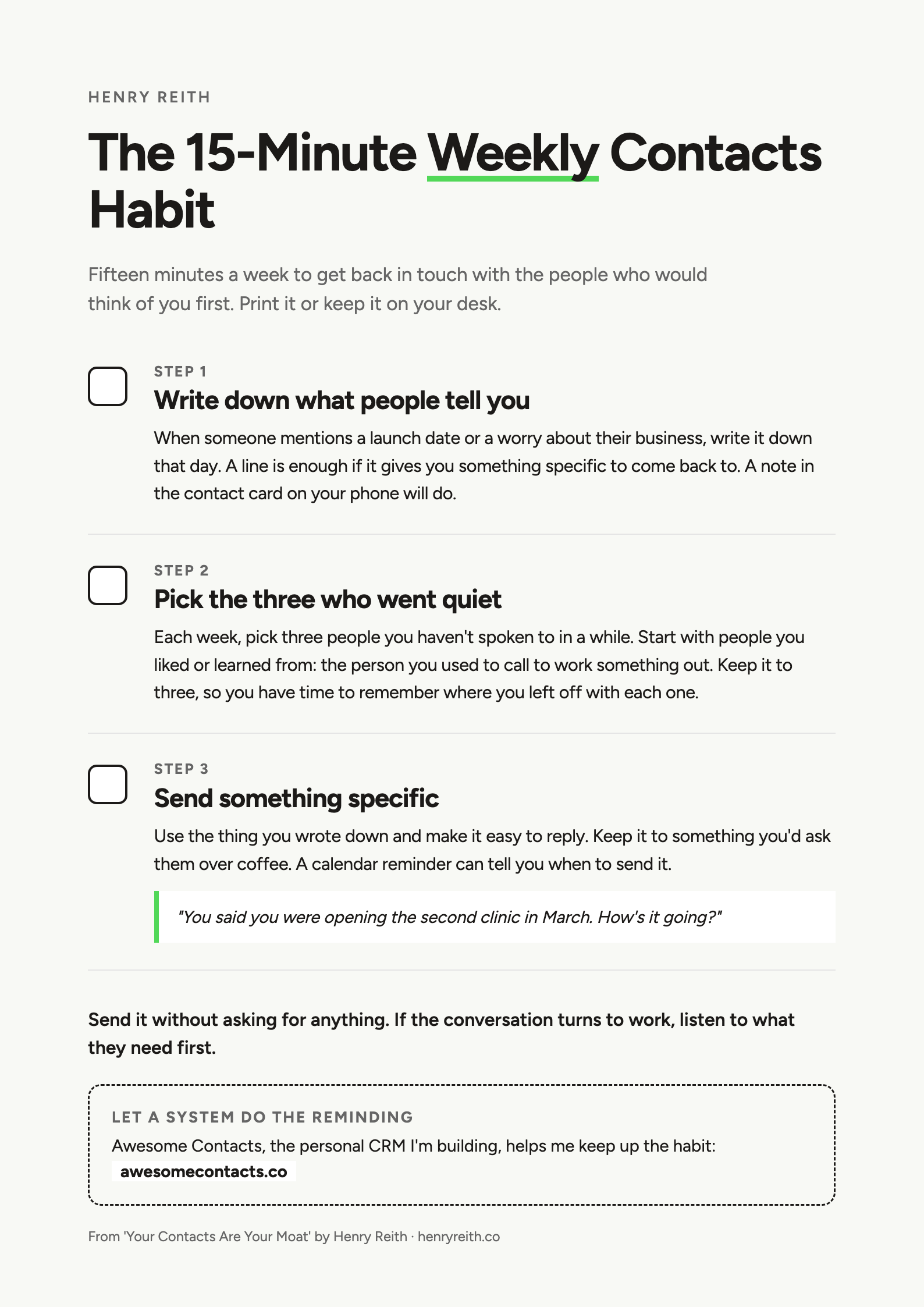
Download the one-page checklist (PDF)
What This Will Not Do
Use those fifteen minutes to stay in touch. If a conversation turns to work, take the time to hear what the other person needs and whether you have something that fits.
Being useful to people is part of keeping in touch, and I write more about that in my Awesome Relationships Framework. My business friends help me see where I’m stuck, and I can do the same for them when they want another view on something.
Back to Tonight’s Ticket
Tonight’s ticket came from one co-working session and a friend who made an introduction. Somewhere in your contacts is someone who might think of you the next time a ticket or a project comes up.
This week, write down one thing someone tells you. Pick three people who’ve gone quiet and send one of them a specific message without asking for anything.
Who’s the one person you’ve been meaning to get back in touch with, and what’s stopped you so far?